

2024 BUSINESS FORECAST: TECH-DRIVEN OPTIMISM MEETS RISING GEOPOLITICAL CHALLENGES
- Written by: PR Newswire Asia - Daily Bulletin Au RSS
- Technological Transformation: Executives express confidence in technology as the driving force behind the future of global trade, with 98% already leveraging AI to enhance supply chain operations – from inventory management to optimizing transport routes
- Proactive Adoption: In anticipation of evolving challenges, businesses plan to ramp up technology adoption. A third will focus on advanced automation, 28% on blockchain, and 21% on AI, big-data analytics, and predictive analytics
- Supply Chain Adaptation: As geopolitical tensions cast a shadow, more companies are turning to friendshoring and dual supply chain strategies. Over a quarter are opting for fewer suppliers
- Economist Impact forecasts a 0.9% drop in global GDP if trade tariffs on high-tech goods increase significantly
DAVOS, Switzerland, Jan. 16, 2024 /PRNewswire/ -- Despite the challenges of 2023 and escalating geopolitical tensions, business leaders remain surprisingly optimistic for 2024, according to new research from Economist Impact and DP World, unveiled today at the World Economic Forum.
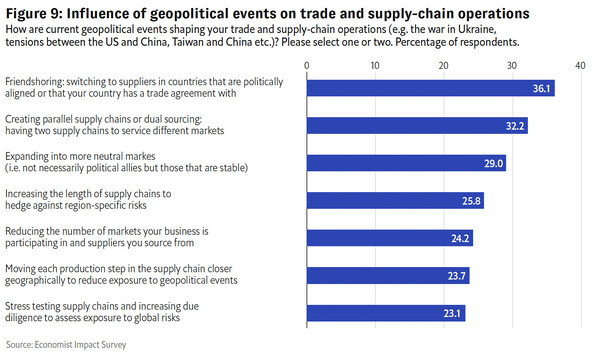 The influence of geopolitical events on trade and supply-chain operations
The primary driver is a growing belief that technology will transform the efficiency and resilience of supply chains. Amid escalating concerns about protectionism, global fragmentation and political instability, businesses are reassessing risks within their supply chains and pivoting towards friendshoring and dual supply chain strategies.
The fourth annual Trade in Transition study, commissioned by DP World and led by Economist Impact, captured the perspectives of trade experts and senior executives across a variety of regions and sectors. This period of unprecedented transformation – heightened geopolitical risk, the urgent realities of climate change and significant advancements in technologies – is causing businesses to face complex challenges. Yet there are also opportunities.
2023 was a pivotal year in supply chain innovation as technology drives optimism for 2024
The global survey of 3,500 company executives found technologies that improve supply chain efficacy and resilience to be the main source of optimism for business leaders when asked to assess the future of global trade. At the core of this sentiment is the widespread adoption of AI, with 98% of executives already using AI to revolutionise at least one aspect of their supply chain operations.
From solving inventory management issues and reducing trade expenses to optimising transport routes, executives are taking advantage of integrating AI. A third of businesses are utilising AI to deliver a reduction in overall trade operation costs and the same amount to enhance resource and supply chain planning. Over one-third of companies view boosting the use of digital tools for enhanced inventory management as the most effective strategy in cutting overall trade and supply chain costs.
Businesses expect to ramp up their technological adoption further this year, a proactive approach that underscores a commitment to deploying innovation to navigate the evolving business landscape with increased efficiency and resilience. Of those surveyed, a third will focus on advanced automation and robotics for logistics efficiency; 28% will turn to blockchain for enhanced traceability and data security; and 21% will embrace artificial intelligence, big-data analytics and predictive analytics for real-time insights and disruption forecasting.
Supply chains adapt as geopolitical tensions weigh
In the new era of globalisation, a landscape of heightened geopolitical risk is shaping the contours of global trade as businesses attempt to reduce risks across their supply chains. More than a third of companies are using friendshoring to shape trade and supply chain operations, while 32% are creating parallel supply chains or dual sourcing.
In addition, more than a quarter are opting for fewer suppliers – a 16-percentage point increase from the previous year – as businesses weigh the advantages of consolidation against diversification and control against resilience.
Concerns that political instability, rising trade friction and global fragmentation could hamper growth are increasing. A fifth of businesses are concerned with higher tariffs, or uncertainties around tariffs, in key markets they export to or import from. In fact, 22% of executives emphasised the challenge of political instability in their sourcing markets, while almost a quarter (23%) are concerned about heightened geopolitical uncertainty.
Economist Impact conducted a quantitative trade analysis through the Global Trade Analysis Project (GTAP) platform to estimate the potential global output loss from hypothetical scenarios of further "geo-economic fragmentation." In a scenario focused on significantly increased trade barriers on high-tech goods – a focal point in the current geopolitical climate – Economist Impact projected a 0.9% decline in worldwide GDP.
Speaking at the launch of the report at the World Economic Forum in Davos today, DP World Group Chairman and CEO Sultan Ahmed bin Sulayem said:
"The findings in this report reveal a remarkable optimism, despite businesses having to operate in an increasingly uncertain environment. Governments can maximise the significant economic benefits of trade by providing the predictability that businesses need, while reducing trade friction. This entails not only tariff reduction, but also collaborating with the private sector to roll-out technological advancements – most notably in digitalisation, automation and AI – that enable greater efficiency, visibility and adaptability."
John Ferguson, Global Lead, New Globalisation, Economist Impact, added:
"In 2024, amidst heightened geopolitical risk and the rising impact of climate change, there is an observable increase in the variability of approaches businesses are taking to their supply chains. This reflects a growing understanding that no single strategy will meet the needs of different businesses. What's clear is that technology is being implemented across supply chains to ensure business can adapt faster and smarter."
To view the full report, please click here.
About Economist Impact
Economist Impact combines the rigour of a think-tank with the creativity of a media brand to engage an influential global audience.
We partner with corporations, foundations, NGOs and governments across big themes including sustainability, health and the changing shape of globalisation to catalyse change and enable progress.
About Trade in Transition
This is the fourth edition of the Trade in Transition report commissioned by DP World and led by Economist Impact. It is a global survey that retrieves data from over 3,500 executives, examining private sector sentiment on international trade and supply chains. More specifically it looks at how factors such as geopolitics, climate change and technology impact trade and supply chains. Trade in Transition also looks into regional (North America, South America, Europe, Middle East, Africa, and Asia-Pacific) and sectoral data (FMCG, industrial, consumer goods, food-and-drink, energy-and-natural resources, health and pharma, and logistics and distribution) to compare and contrast priorities in international trade.
economistimpact.com/trade-in-transition/
For DP World media enquiries, please contact:
Follow DP World on
Twitter: https://twitter.com/DP_WorldLinkedIn: https://www.linkedin.com/company/dp-world
About DP World
Trade is the lifeblood of the global economy, creating opportunities and improving the quality of life for people around the world. DP World exists to make the world's trade flow better, changing what's possible for the customers and communities we serve globally.
With a dedicated, diverse and professional team of more than 103,000 employees spanning 75 countries on six continents, DP World is pushing trade further and faster towards a seamless supply chain that's fit for the future.
We're rapidly transforming and integrating our businesses -- Ports and Terminals, Marine Services, Logistics and Technology – and uniting our global infrastructure with local expertise to create stronger, more efficient end-to-end supply chain solutions that can change the way the world trades.
What's more, we're reshaping the future by investing in innovation. From intelligent delivery systems to automated warehouse stacking, we're at the cutting edge of disruptive technology, pushing the sector towards better ways to trade, minimising disruptions from the factory floor to the customer's door.
WE MAKE TRADE FLOW TO CHANGE WHAT'S POSSIBLE FOR EVERYONE.
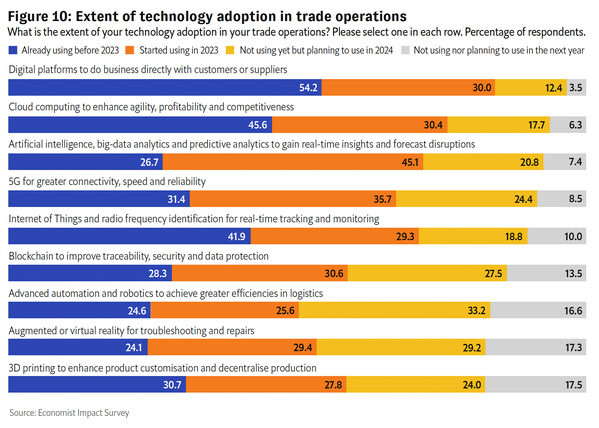 The extent of technology adoption in trade operations
Authors: PR Newswire Asia - Daily Bulletin Au RSS

Read more https://www.prnasia.com/story/archive/4309972_AE09972_0


 Daily Bulletin


