

Can we bend it? The challenge for Samsung and others to make flexible technology
- Written by: Drew Evans, Associate Professor of Energy & Advanced Manufacturing, Australian Research Council Future Fellow, University of South Australia
Imagine the day when you’ll unroll or unfold your smartphone to answer it. If things go to plan, this day may be sooner than you think.
And we’re not just talking flip-phones here, but smartphones where the actual screens are flexible, not just the handset.
Okay, so Samsung’s plans to launch its Galaxy Fold phone might be on hold after a few early reviews reported cracks in the screen, but 2019 is said to be a year when many of the major mobile phone manufacturers aim to release their new foldable phones.
 Samsung Galaxy Fold on hold.
Samsung/Screenshot, CC BY-NC-ND
Samsung Galaxy Fold on hold.
Samsung/Screenshot, CC BY-NC-ND
The promise of technology as intelligent as our smartphones that can simply be folded up like a piece of paper sounds amazing. So what are the challenges in making flexible technology?
How flexible?
To answer this we need to understand what is meant by flexible.
Do we need something that can be deformed without breaking (so it’s okay if you sit on your phone, as it will only bend and not break)? Maybe we want to roll it up into a cylinder with the ease of rolling a piece of paper? Or even to fold it like the Galaxy Fold?
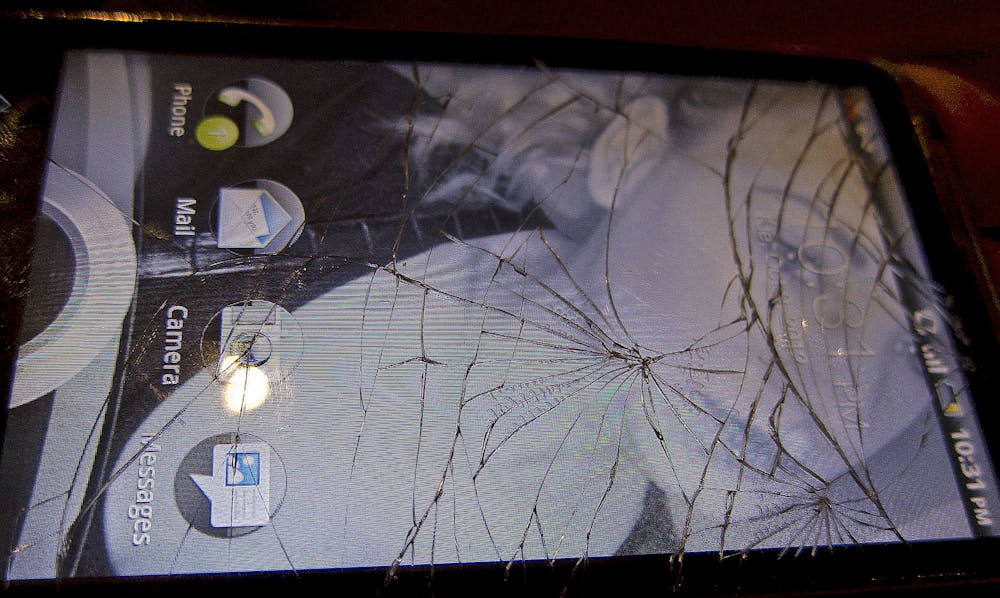 The cracked glass of a smartphone, sitting on the device is the usual cause.
Flickr/John Garghan, CC BY-NC-ND
The cracked glass of a smartphone, sitting on the device is the usual cause.
Flickr/John Garghan, CC BY-NC-ND
These are very different scenarios, with each putting a greater performance requirement on the device and the materials within.
Are the materials brittle? Or are they inherently flexible? And when they are bent, rolled, flexed or folded, do they continue to work the way they did when flat?
These are the questions many scientists and engineers are asking. Enter the world of materials science, mixed with a dose of advanced manufacturing.
The glass
Consumer electronics traditionally use materials designed for use on rigid glass substrates, or surfaces. The beauty of glass is its rigidity and thermal stability, and can be made on commercial scales.
That means it will rarely bend or flex, and can be heated to high temperatures. These are important factors when manufacturing an electronic device - especially those with a flat panel display.
To make an electronic device, complex patterns of materials need to be made to create an electronic circuit. In some cases the patterns will have features smaller than the width of your hair, even down to the size of viruses (less than 100 nanometers). Producing such patterned coatings of high-performance electronic materials can be done easily on glass at temperatures greater than 500℃.
But when flexibility is required, the substrate needs to change. The obvious choices are polymers and plastics. Thin sheets of these materials can be manipulated into a range of different shapes without breaking.
But not many of these plastics can withstand greater than 500℃ during processing.
New developments from companies such as Corning Incorporated in the US have made special types of thin glass that are bendable.
Bendable glass may be one of many steps towards flexible electronics. But, as we’ll see later, maybe even bendable glass is not that useful for some applications.
The electronics
Beyond the substrate, there are still challenges for the electronic materials themselves. Modern electronics are built on metals and ceramics that require very high temperatures to be fabricated into electrical circuits, and are not ideal for bending.
Polymers such as Nylon, Teflon and polyester are inherently flexible and can be bent, folded or rolled. But polymers are usually insulators (they don’t conduct electricity) and they really do not like being heated too high.
That is why efforts are being made to engineer polymers that are conductive (conducting polymers). Being conductive means that the polymers can transport electrical charge with ease - like your charging cable carries electricity from the power outlet to your portable device’s battery. In parallel engineers are changing the way the existing and new materials are manufactured.
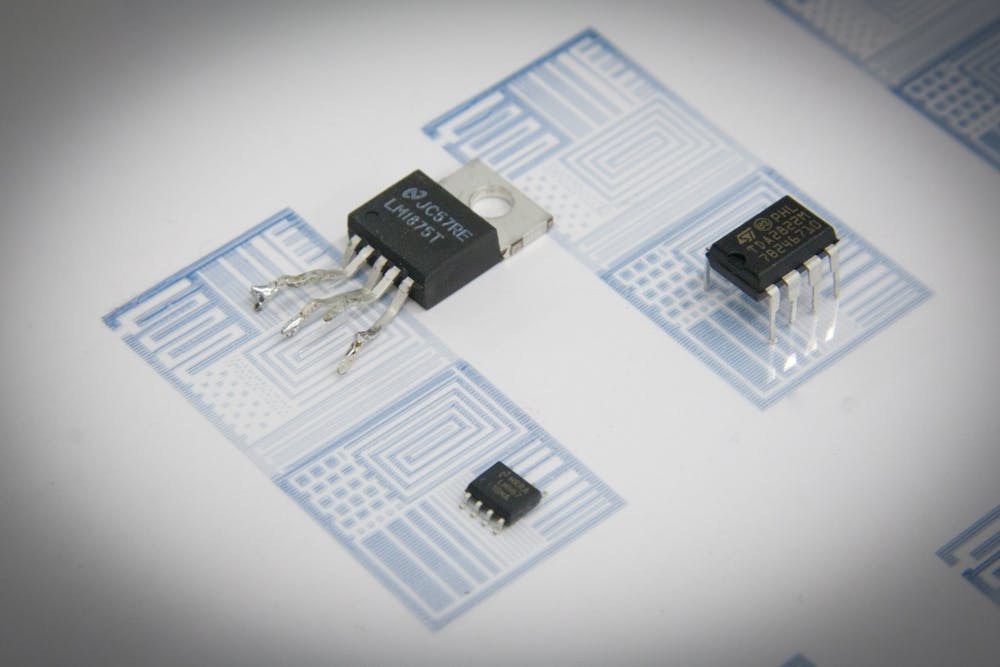 Flexible electronics: An example of polymers that conduct electricity, fabricated as an electrical circuit on a flexible substrate using inkjet printing.
Kamil Zuber, Author provided
Flexible electronics: An example of polymers that conduct electricity, fabricated as an electrical circuit on a flexible substrate using inkjet printing.
Kamil Zuber, Author provided
Manufacturing is moving away from high temperatures in large coating machines, into things similar to inkjet and roll-to-roll printing (printed electronics). Soon your new mobile phone may be printed at high speed in a similar way to a daily newspaper.
But should we bend tech?
Tackling these technical challenges of materials and manufacturing seems within reach. But why do we want flexible technology?
Sure there are some of us that dream of a flat panel TV that can be rolled and unrolled, mounting anywhere we like. Think about it as an electronic poster being hung on your bedroom wall and flexible TVs are almost here - in 2018 LG showcased a 65 inch rollable TV.
Watch it unfold.Beyond this there are some neat advantages to flexible technology. There is a big drive towards integrating electronics with biology in the ultimate wearable computer.
As we know, our skin (and everything contained within it) is to some degree soft, flexible and elastic. Having flexible technology would allow our wearable computers to seamlessly integrate with us. This will be done so well that we won’t realise we are wearing it.
Glass as a substrate, even if flexible, won’t fulfil the desire to interface with biology. This is because it lacks the softness and deformability to react to the bodies movement.
On the other side of it, the contact lens is made of materials that many people routinely wear on a daily basis (with hopefully little annoyance).
So what about electronics on these soft gel-like substrates? An example of efforts to achieve this is work done by Madhu Bhaskaran and team at the Royal Melbourne Institute of Technology.
Read more: How to take better photos with your smartphone, thanks to computational photography
They are developing electronics that can be worn like a temporary tattoo, giving wearers real-time data about UV exposure. Some companies are even developing electronics directly on a contact lens.
But similar to the Samsung Galaxy Fold, the electronic contact lens project has been paused, the early results from testing are not up to scratch at the moment.
But sometime in the (near) future I believe we will have flexible technologies in our daily lives. This will represent major breakthroughs in the materials and manufacturing used to create them. Most exciting is by achieving this, opportunities will open to interface the physical and cyber worlds to a level we can today only imagine.
Authors: Drew Evans, Associate Professor of Energy & Advanced Manufacturing, Australian Research Council Future Fellow, University of South Australia


 Daily Bulletin


