

NZ Budget 2019: support for lower-emission business, transport, land use
- Written by: Robert McLachlan, Professor in Applied Mathematics, Massey University
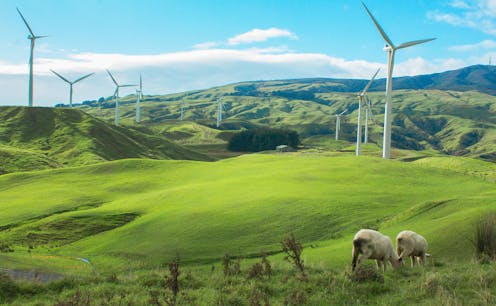
A decade ago, one of New Zealand’s leading scientists, the late Sir Paul Callaghan, put forth his vision for the country in his book Wool to Weta. He envisaged New Zealand emphasising green high-technology industries and reducing dependence on agriculture.
This approach would lift productivity and reduce pollution, but it would need an increased investment in research and development. It was then woefully low at around 1% of GDP, compared to the OECD average of 2.4%.
Last December, the government signalled that it was on board with this vision. Two of the government’s five spending priorities reflect this: one a goal to create opportunities for productive businesses to transition to a low-emissions economy, and another to support a thriving nation in the digital age through innovation.
Read more: New Zealand's 'well-being budget': how it hopes to improve people's lives
Investing in green ideas
A new NZ$300 million venture capital fund will support early stage companies. There is an additional NZ$157 million of direct support to businesses to develop high-value, low-emissions products. It appears these are on top of the NZ$100 million Green Investment Fund established last year and due to launch shortly.
Last year’s budget also moved NZ$657 million from a grant scheme into an estimated NZ$1 billion research and development tax incentive. Since this kicked in only in April 2019, it’s too soon to tell if it is having an effect.
But research and development is certainly on the right track in New Zealand. Over the five years between 2014 and 2018, spending has grown 38% in real terms to reach 1.37% of GDP. The target is 2% of GDP by 2027. Notably, the lion’s share of the increase has been from business, not state, investment.
These investments are crucial. Studies have shown that disruptive innovation emerges when small start-ups and grassroots enterprises are given resources to pilot concepts, learn, adjust and scale up.
A lifeline for rail infrastructure
Rail gets a major boost with NZ$1 billion in investment for Kiwirail. Rail suffered under privatisation from 1993 to 2008, but even since renationalisation it has not had a dedicated funding line like roads do. Some passenger services entered the National Land Transport Plan in 2018, but not yet freight.
This investment will bring much-needed new rolling stock, track improvements and new ferries for the critical link between islands. Rail carries 15% of New Zealand’s freight and growth has the potential to reduce emissions and make roads safer.
The investment includes NZ$300 million from the Provincial Growth Fund for regional rail initiatives. This could include a proposal for regional rapid rail linking Auckland with other centres in the north of the country, or investment for the beleaguered commuter lines linking the capital with surrounding regions. It could also go towards an upgrade of the partly mothballed rail link north of Auckland.
Unfortunately, we don’t know yet which projects will go ahead. There appears to be only NZ$34 million for regional rail in the coming year.
Further electrification of the network, hinted at last year by Climate Change Minister James Shaw, is not in the budget, but at least the existing electrified section is saved.
Food, forests, freshwater
Research into agricultural greenhouse gases, the only area in which the New Zealand government funds research overseas, continues. There is money to set up and run a climate change commission. There is also money for policy advice on a “just transition to a low‐emissions economy”. But there’s nothing that will specifically reduce emissions in the coming year.
Electric vehicle proponents, alarmed by the growth in transport emissions (up 82% since 1990, and up 6% in 2017 alone) and stagnant EV sales and encouraged by hints last year about coming incentives, will be disappointed. But the long-term strategy remains in place, with a focus on passing the zero carbon bill, currently open for submissions, with bipartisan support this year.
Read more: NZ introduces groundbreaking zero carbon bill, including targets for agricultural methane
The big winner in environment and climate funding in this budget is agriculture. NZ$229 million is going towards cleaning up waterways and improving wetlands and sustainable farming. Much of this will go directly to farmers.
Freshwater quality was a key issue in the 2017 election. Agricultural intensification, especially dairy farming, is the main reason for the continuing decline in water quality in rivers and lakes. There is NZ$122 million for “enabling the transition in agriculture”, primarily advice to farmers and improvements to data collection. A further NZ$184 million goes towards the One Billion Trees Program, currently on track and a key part of the present plan to lower net emissions.
A decade ago, Wool to Weta seemed like a pipe dream. Even Paul Callaghan did not foresee that, by 2019, New Zealand would be a spacefaring nation. Today, the technology and creative sectors are booming and we are embarking on the low-emission transition.
Authors: Robert McLachlan, Professor in Applied Mathematics, Massey University


 Daily Bulletin


