

Three charts on: how much Australia spends on all levels of education
- Written by: Daniel Edwards, Research Director, Australian Council for Educational Research
Australia spent A$111.8 billion on education in 2015, the most recent year for which the full dataset for all levels of education spending is available. A report from the Australian Council for Educational Research (ACER) released today shows this was an increase of nearly 80% from 2000 spending.
The federal government contributed A$47.2 billion (42%) of the overall funding. State, territory and local governments spent A$39.1 billion (35%). A further A$25.5 billion (23%) came from private sources.
The ACER report is the first to capture data on education spending at all levels of education – from early childhood to higher education – from all funding sources.
The analysis separates funding into three sources: federal government; state, territory and local governments; and private sources (the latter includes contributions by students in the form of fees, as well as contributions by private businesses and non-profit organisations).
The report also organises spending by education sector and levels, as defined in Australia.
Spending by education level
Education funding goes through a range of transfers between the three sources. At different points in the funding cycle, the contributions by government sources are transferred to other funding sources.
Read more: Explaining Australia's school funding debate: what's at stake
For instance, the federal government transferred A$14 billion of its initial education funding to private sources in 2015, mainly in the form of student loans. It transferred a further A$17.7 billion to state, territory and local governments which then fund schools and other areas of education.
 The final distribution of national education spending, after the transfers, was A$15.5 billion (14%) from the federal government, A$55.4 billion (49%) from state, territory and local governments and A$40.9 billion (37%) from private sources.
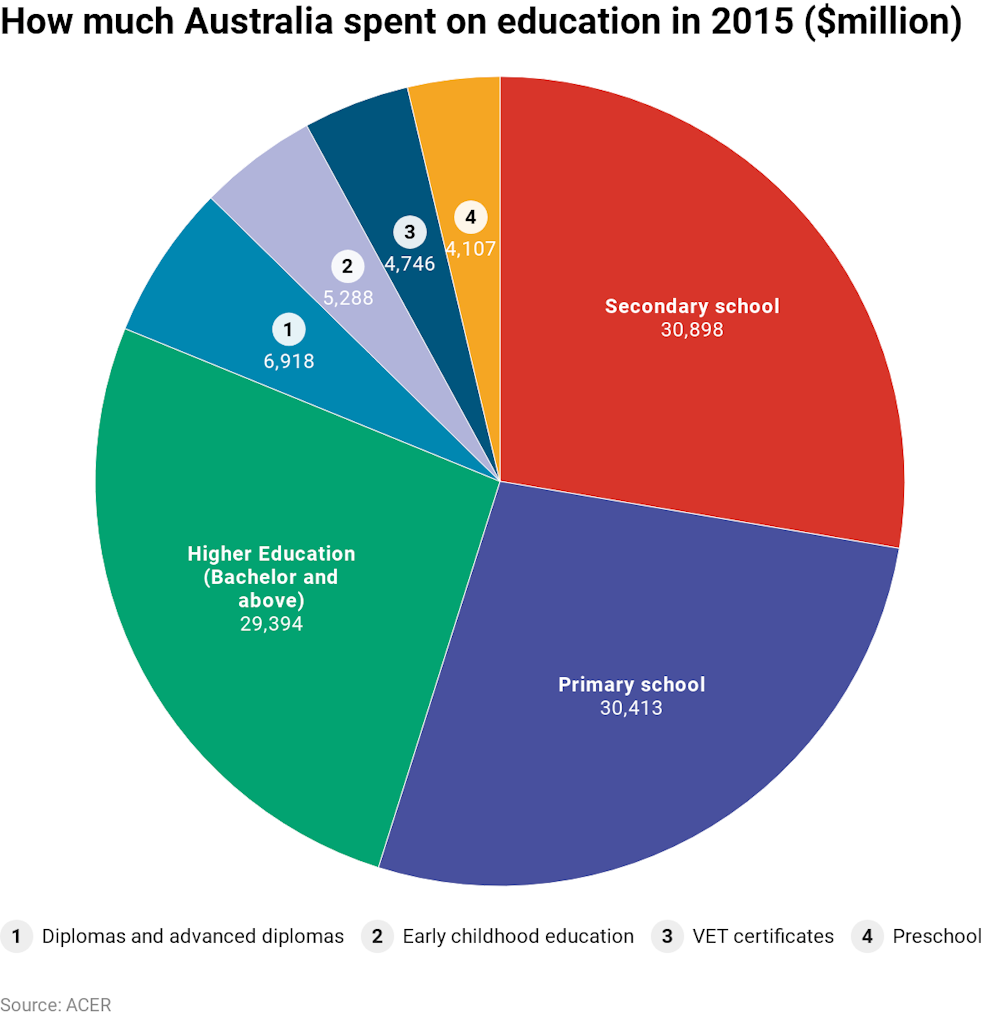
The bulk of Australia’s education spending is directed to three levels of education: primary schools (27%), secondary schools (28%) and higher education (26%).
The remaining 19% is spread between early childhood education, preschool, vocational education and training (VET) certificates, diplomas and advanced diplomas.
Spending as a percentage of GDP
In 2015, Australia spent A$102.4 billion on primary school and above. In real terms this spending has grown substantially since the beginning of the century and faster than student numbers.
While spending on education increased by 79% between 2000 and 2015, the number of students in the Australian education system increased by only 22%. As a result, education spending per student (primary and above) increased by 46% over this period.
Read more:
Yes, education funding has increased – but not everyone benefits
Australia’s spending on education as a proportion of GDP has also increased, from 5.1% in 2000 to 5.9% in 2015.
This increase has largely been driven by private sources of funding, rather than government funds, indicating an increasing willingness by people to invest in their own (or their children’s) education.
The share of private spending on education (primary and above) after transfers increased from 26% of total education spending in 2000 to 34% in 2015.
The fastest period of growth in private spending has been since 2012. This coincided with the introduction of the higher education sector’s demand-driven funding arrangements (where universities didn’t have a cap on the number of bachelor degree students they could take).
But it’s important to remember the government allocates a significant amount of its initial funding (before transfers) to student loans.
Spending as a percentage of total government spending
Government spending on education before transfers increased by 67% in real terms between 2000 and 2015. At the same time, total government spending rose by 65%.
So, government spending on education before transfers, as a percentage of total government spending, was 1% higher in 2015 than in 2000. It peaked in 2010 due to the global financial crisis stimulus spending and fell in the interim.
Australia’s government spends a relatively large proportion of its budget on education compared to other OECD countries. In total, government spending on education is 13.5%, which ranks Australia ninth of the 39 countries in the OECD reporting.
But Australia’s total government spending for all services (including health, education, social protection, defence, public order and safety) is relatively low.
Read more:
FactCheck: is Australia below the international average when it comes to school funding?
ACER’s analysis is drawn from annual expenditure data the Australian Government Department of Education submits for the joint UNESCO Institute for Statistics, OECD and Eurostat (UOE) data collection on education statistics – which the OECD releases as the Education at a Glance publication.
The Education at a Glance reports are good for obtaining a snapshot of Australian education spending in relation to other OECD countries. But until now the data have not been organised in a useful way for further examining the Australian context.
To fully appreciate the nuances of the data, we need increased expertise in the economics of education in Australia. More emphasis on this would enable long-term forecasting of the policy implications of Australia’s investment in education and would offer an additional objective voice at the education policy table.
The final distribution of national education spending, after the transfers, was A$15.5 billion (14%) from the federal government, A$55.4 billion (49%) from state, territory and local governments and A$40.9 billion (37%) from private sources.
The bulk of Australia’s education spending is directed to three levels of education: primary schools (27%), secondary schools (28%) and higher education (26%).
The remaining 19% is spread between early childhood education, preschool, vocational education and training (VET) certificates, diplomas and advanced diplomas.
Spending as a percentage of GDP
In 2015, Australia spent A$102.4 billion on primary school and above. In real terms this spending has grown substantially since the beginning of the century and faster than student numbers.
While spending on education increased by 79% between 2000 and 2015, the number of students in the Australian education system increased by only 22%. As a result, education spending per student (primary and above) increased by 46% over this period.
Read more:
Yes, education funding has increased – but not everyone benefits
Australia’s spending on education as a proportion of GDP has also increased, from 5.1% in 2000 to 5.9% in 2015.
This increase has largely been driven by private sources of funding, rather than government funds, indicating an increasing willingness by people to invest in their own (or their children’s) education.
The share of private spending on education (primary and above) after transfers increased from 26% of total education spending in 2000 to 34% in 2015.
The fastest period of growth in private spending has been since 2012. This coincided with the introduction of the higher education sector’s demand-driven funding arrangements (where universities didn’t have a cap on the number of bachelor degree students they could take).
But it’s important to remember the government allocates a significant amount of its initial funding (before transfers) to student loans.
Spending as a percentage of total government spending
Government spending on education before transfers increased by 67% in real terms between 2000 and 2015. At the same time, total government spending rose by 65%.
So, government spending on education before transfers, as a percentage of total government spending, was 1% higher in 2015 than in 2000. It peaked in 2010 due to the global financial crisis stimulus spending and fell in the interim.
Australia’s government spends a relatively large proportion of its budget on education compared to other OECD countries. In total, government spending on education is 13.5%, which ranks Australia ninth of the 39 countries in the OECD reporting.
But Australia’s total government spending for all services (including health, education, social protection, defence, public order and safety) is relatively low.
Read more:
FactCheck: is Australia below the international average when it comes to school funding?
ACER’s analysis is drawn from annual expenditure data the Australian Government Department of Education submits for the joint UNESCO Institute for Statistics, OECD and Eurostat (UOE) data collection on education statistics – which the OECD releases as the Education at a Glance publication.
The Education at a Glance reports are good for obtaining a snapshot of Australian education spending in relation to other OECD countries. But until now the data have not been organised in a useful way for further examining the Australian context.
To fully appreciate the nuances of the data, we need increased expertise in the economics of education in Australia. More emphasis on this would enable long-term forecasting of the policy implications of Australia’s investment in education and would offer an additional objective voice at the education policy table.
Authors: Daniel Edwards, Research Director, Australian Council for Educational Research


 Daily Bulletin


