

How ancient seafarers and their dogs helped a humble louse conquer the world
- Written by: Loukas Koungoulos, PhD Candidate, University of Sydney
This is the story of how a parasitic, skin-chewing insect came to conquer the world.
For more than a century, scientists have been puzzled as to how an obscure louse native to Australia came to be found on dogs across the world. Heterodoxus spiniger evolved to live in the fur of the agile wallaby.
Despite little evidence to back the idea, many researchers believed it was linked to people from Asia bringing the dingo to Australia in ancient times. Perhaps people later took dingoes infested with this parasite back home, where it spread to local dogs, and onwards from there.
Read more: Dingoes do bark: why most dingo facts you think you know are wrong
But when we approached the question again using the most up-to-date information, my colleague Peter Contos and I came up with a completely different explanation – one that better fits what we know of ancient migration and trade in the Asia-Pacific region.
As we report in the journal Environmental Archaeology, this louse probably originated not in Australia but in New Guinea, an island with a long history of intimate connection with seafaring Asian cultures.
Louse on the loose
H. spiniger is a tiny louse that lives on mammals around the world, mostly dogs. Using its clawed legs to hang on, it bites and chews at the skin and hair of its hosts to draw the blood on which it feeds.
As all its closest relatives are specialised parasites of marsupials, mostly other wallabies, logic suggested that H. spiniger must have evolved within Australia. It also seemed logical it would have spread first to the dingo, Australia’s native dog.
Our first task was to figure out just how far away from Australia it had spread; this would inform the likely pathways by which it could have travelled to the wider world.
We looked at museum collections, entomological surveys, and veterinary research reports to generate a map of its worldwide distribution.
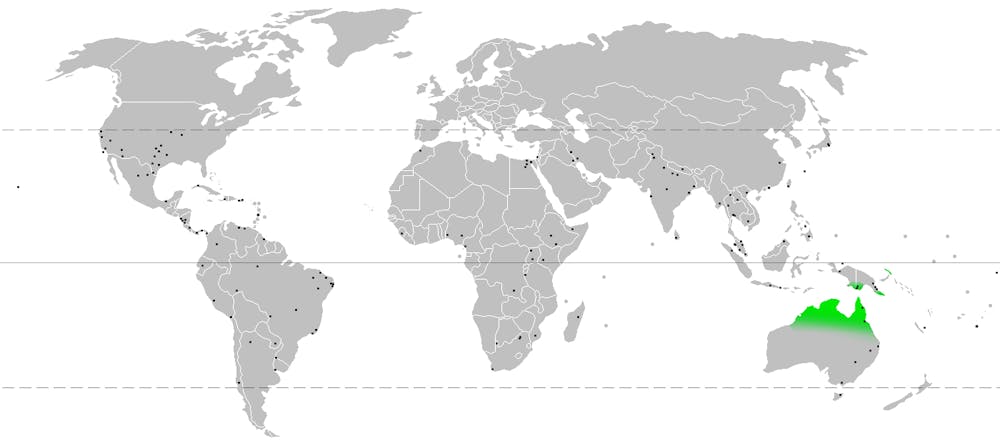 Global distribution of H. spiniger.
Lougoulos and Contos, Author provided
Global distribution of H. spiniger.
Lougoulos and Contos, Author provided
The specimens we found, collected from the late 19th century to the present day, showed that this species is found on every continent except Europe and Antarctica.
But in Australia, we couldn’t find a single verifiable instance of the parasite living on dingoes. The only cases were from agile wallabies and domestic dogs.
That meant the prevailing wisdom had been wrong, and we had to look elsewhere for the origins of H. spiniger.
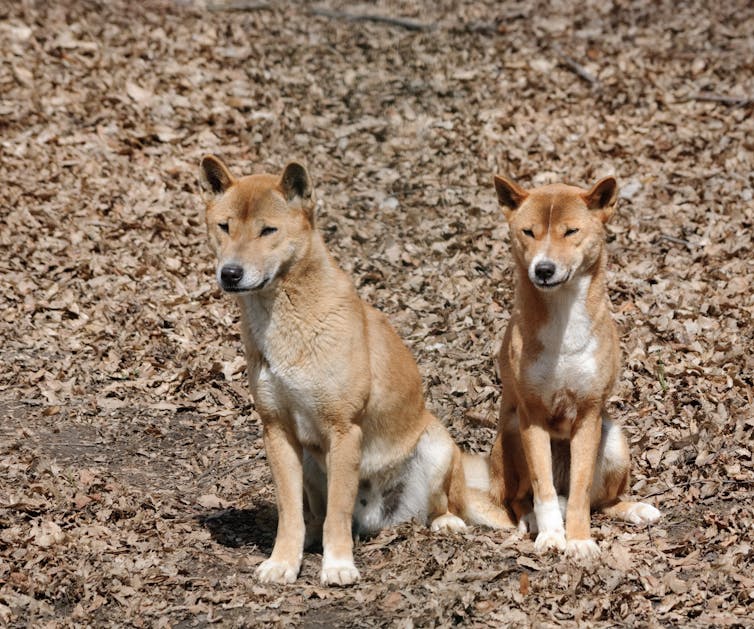 Don’t blame the dingoes.
Blanka Berankova/Shutterstock
Don’t blame the dingoes.
Blanka Berankova/Shutterstock
Where did it really come from?
Although marsupials are best known from Australia, they are also found in other parts of the surrounding region. The agile wallaby is also native to the island of New Guinea, which was once joined with Australia.
Dogs have also been in New Guinea for at least as long as the dingo has been in Australia. Traditionally, dogs were kept in Papuan villages, and were used to hunt game, including wallabies.
It came as little surprise, then, that we found H. spiniger on both agile wallabies and native dogs in New Guinea – and only a few decades after the first ever identification of the species.
So here was a more likely place in which the first transfer from wallaby to dog took place. But who took them out of New Guinea and into the wider world?
Austronesian voyagers
New Guinea was first colonised by humans around the same time as Australia. But since that time, compared with Australia it has had notably stronger connections with the outside world, reaching back millennia before European colonisation of Australia in 1788.
Around 4,000 years ago, agriculturalists known as Austronesians sailed out of Taiwan to settle several archipelagos in Oceania. With them they brought domestic species of plants and animals, including dogs.
By 3,000 years ago, at the latest, they reached New Guinea. We suggest this was the crucial moment when dogs first picked up H. spiniger.
In the ensuing centuries, Austronesians went on to settle much of Indonesia, the Philippines, Melanesia and Polynesia, and coastal sections of mainland Southeast Asia.
They even settled as far as Madagascar, suggesting their voyages probably took them around the rim of the Indian Ocean, along the margins of India and the Middle East.
Dogs accompanying the migrants probably helped spread the louse, which is found almost everywhere they went.
This spans an enormous distance – from Hawaii to Madagascar – a testament to the ancient Austronesians’ supreme seafaring skills.
New directions
Our research suggests how the parasite first got around the world, but not precisely when. Its journey probably progressed at different times in different places.
The Austronesian diaspora established trade routes between the places they settled, some of which spanned impressive distances across several island groups.
Read more: How to get to Australia ... more than 50,000 years ago
Later, foreign traders connected these communities with greater Asia and Africa. And in modern times, dogs continue to be transported as desirable goods themselves.
Trade and contact has probably led to further, possibly ongoing, dispersal of H. spiniger.
Unfortunately there are no archaeological examples that could demonstrate the louse’s early presence outside New Guinea, because this species prefers hot, humid environments.
A genetic approach is a better way forward. A start would be testing specimens from different parts of the world, to see when different regional populations – if they exist - branched off from one another.
This is particularly important in tracking its spread to the Americas, which likely occurred in recent centuries alongside European colonisation.
This research will help us further understand how migration, contact and trade unfolded in the prehistoric Asia-Pacific region, and how it affected the animal species – including the humblest of parasites – we see there today.
This paper would not have been possible without the contributions of Peter Contos, the work of volunteers on the Natural History Museum’s Boopidae of Australasia digitisation project, and the contributions of the public to Wikipedia Creative Commons, for which we are grateful.
Authors: Loukas Koungoulos, PhD Candidate, University of Sydney


 Daily Bulletin


