

Climate change is bringing a new world of bushfires
- Written by: Dale Dominey-Howes, Professor of Hazards and Disaster Risk Sciences, University of Sydney
Spring has barely arrived, and bushfires are burning across Australia’s eastern seaboard. More than 50 fires are currently burning in New South Wales, and some 15,000 hectares have burned in Queensland since late last week.
It’s the first time Australia has seen such strong fires this early in the bushfire season. While fire is a normal part of Australia’s yearly cycle and no two years are alike, what we are seeing now is absolutely not business as usual.
Read more: Grim fire season looms but many Australians remain unprepared
And although these bushfires are not directly attributable to climate change, our rapidly warming climate, driven by human activities, is exacerbating every risk factor for more frequent and intense bushfires.
The basics of a bushfire
For some bushfire 101, a bushfire is “an uncontrolled, non-structural fire burning in grass, scrub, bush or forest”. This means the fire is in vegetation, not a building (non-structural), and raging across the landscape – hence, uncontrolled.
For a bushfire to get started, several things need to come together. You need fuel, low humidity (which also often means the fuel itself has a low moisture content and is easier to burn), and oxygen. It also helps to have an unusually high ambient temperature and winds to drive the fire forward.
In Australia, we divide bushfires into two types based on the shape and elevation of the landscape.
First are flat grassland bushfires. These are generally fast-moving, fanned by winds blowing across flattish open landscapes, and burn through an area in 5–10 seconds and may smoulder for a few minutes. They usually have low to medium intensity and can damage to crops, livestock and buildings. These fires are easy to map and fight due to relatively straightforward access.
Read more: The summer bushfires you didn't hear about, and the invasive species fuelling them
Second are hilly or mountainous bushfires. These fires are slower-moving but much more intense, with higher temperatures. As they usually occur in forested, mountainous areas, they also have more dead vegetation to burn and are harder to access and fight.
They burn slowly, passing through an area in 2-5 minutes and can smoulder for days. Fires in upper tree canopies move very fast. Mountainous bushfires actually speed up as they burn up a slope (since they heat and dry out the vegetation and atmosphere in front of the fire, causing a runaway process of accelerating fire movement).
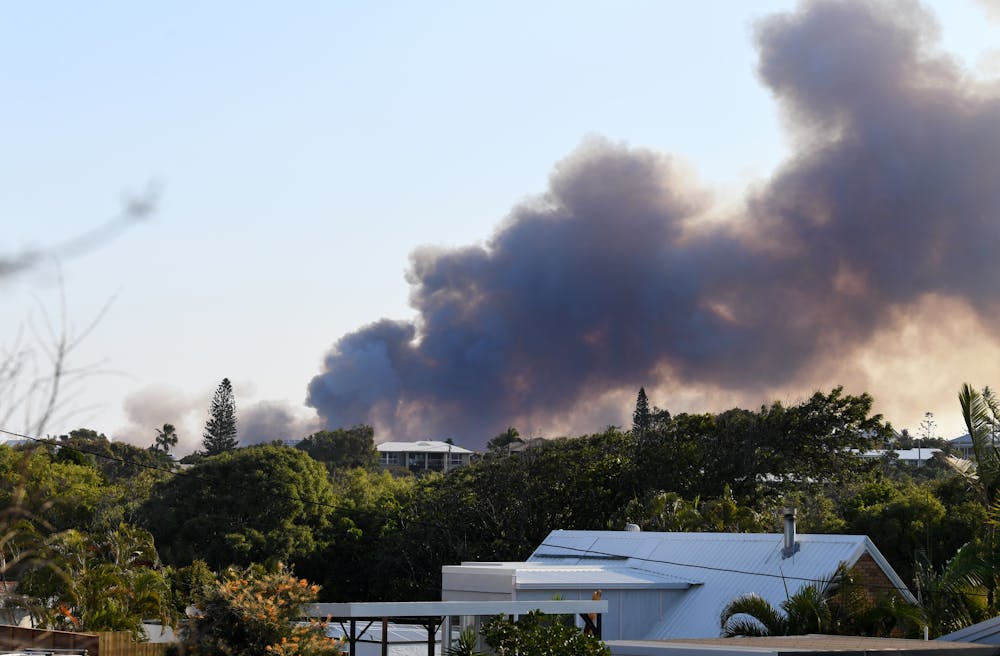 About 70 blazes are still burning across Queensland.
AAP Image/Dan Peled
About 70 blazes are still burning across Queensland.
AAP Image/Dan Peled
Climate change and bushfire risk
To be clear, as previously reported, the current bushfires are not specifically triggered by climate change.
However, as bushfire risk is highest in warm to hot, dry conditions with low humidity, low soil and fuel load moisture (and are usually worse during El Niño situations) – all factors that climate change in Australia affects – climate change is increasing the risk of more frequent and intense bushfires.
Widespread drought conditions, very low humidity, higher than average temperatures in many places, and strong westerly winds driven by a negative Southern Annular Mode (all made worse by human-induced climate change) have collided right now over large areas of the eastern seaboard, triggering extremely unusual bushfire conditions – certainly catching many communities unawares before the start of the official bushfire season.
Read more: The air above Antarctica is suddenly getting warmer – here's what it means for Australia
Different regions of Australia have traditionally experienced peak bushfire weather at different times. This has meant that individual households, communities and the emergency services have had specific periods of the year to prepare. These patterns now seem to be breaking down, and bushfires are happening outside these regular places and times.
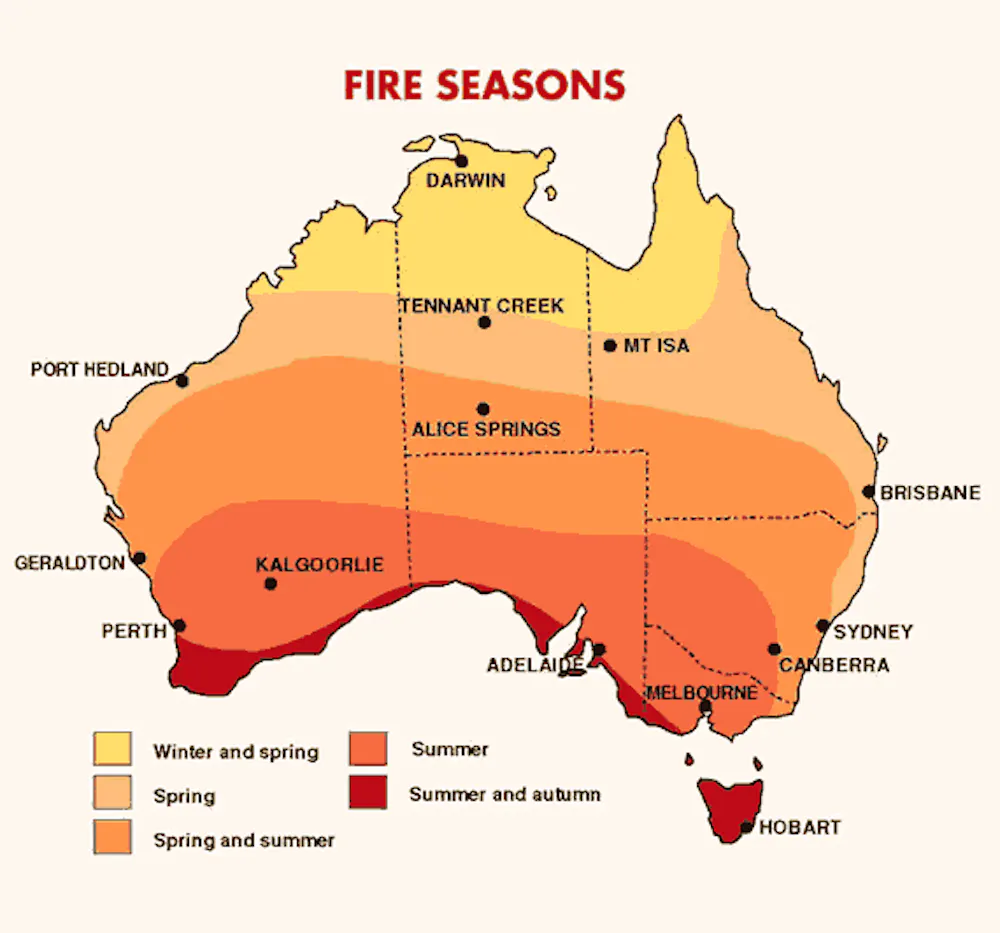 Map of bushfire seasons.
Bureau of Meteorology
Map of bushfire seasons.
Bureau of Meteorology
New challenges for the emergency services
While experts recently forecast a worse-than-average coming bushfire season, the current emergency has essentially exploded out of nowhere.
Many Australian communities do know how to prepare but there is always some apathy at the start of bushfire season around getting households and communities bushfire-ready. When it’s still relatively cold and feeling like the last whisps of winter are still affecting us, bushfire preparation seems very far off.
Compounding our worsening bushfire conditions, we are increasingly building in bushfire-prone areas, exposing people and homes to fire. This tips the scales of risk further in favour of catastrophic losses. Sadly too, these risks always disproportionately affect the most vulnerable.
Read more: Natural disasters are affecting some of Australia's most disadvantaged communities
With such extensive fires over wide areas, the current emergency points to an extremely frightening future possibility: that emergency services become more and more stretched, responding to fires, floods, storms, tropic cyclones and a myriad other natural hazards earlier in each hazard season, increasingly overlapping.
Our emergency services do an amazing job but their resources and the energy of their staff and volunteers can only go so far.
Regularly the emergency services of one area or state are deployed to other areas to help respond to emergencies.
But inevitably, we will see large-scale disasters occurring simultaneously in multiple territories, making it impossible to share resources. Our emergency management workforce report they are already stressed and overworked, and losing the capacity to share resources will only exacerbate this.
Immediate challenges will be to continue funding emergency management agencies across the nation, ensuring the workforce has the necessary training and experience to plan and respond to a range of complex emergencies, and making sure local communities are involved in actively planning for emergencies.
Authors: Dale Dominey-Howes, Professor of Hazards and Disaster Risk Sciences, University of Sydney
Read more http://theconversation.com/climate-change-is-bringing-a-new-world-of-bushfires-123261


 Daily Bulletin


