

Vital Signs: All this overinflated talk about an index-fund bubble is very passive-aggressive
- Written by: Richard Holden, Professor of Economics, UNSW
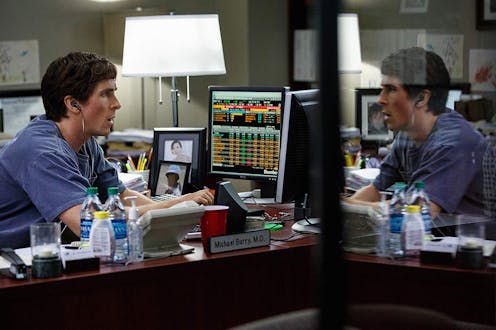
If you’ve seen the movie The Big Short you will remember Christian Bale’s quirky character Michael Burry – the manager of the Scion Capital hedge fund who realises the US mortgage-backed security market is a massive bubble. He goes on to make a fortune by betting on its crash.
Given Burry’s track record, he’s hard to ignore. Last week in an extended (email) interview with Bloomberg News he claimed to have identified the latest bubble: passive investing.
Whereas active investment is about choosing particular stocks based on their potential to outperform the market, passive investing is all matching the market. It’s generally done through index funds, which spread their investments across the stock market.
An index fund might, for example, be based on the S&P500 index, making weighted investments in the top 500 listed companies in the US. An Australian fund might be based on investing in the Australian Securities Exchange’s ASX 200 index. If a given company represents 3% of the index, a passive investor will put 3% of their money into that stock.
Read more: What’s an index fund?
Passive investing has become hugely popular for a couple of reasons. One is that passive funds generally charge very low fees, like 0.2% a year. Sometimes even lower. Another is that that passive funds typically provide higher returns than all but the best active fund managers.
Lower cost, higher returns. What’s not to like?
Passive endorsements
Perhaps that’s why legendary investor Warren Buffett’s general investing advice is to buy an S&P 500 low-cost index fund: “I think it’s the thing that makes the most sense practically all of the time.”
Eugene Fama, a Nobel Prize winner in economics and the father of the “efficient markets hypothesis”, gives the same advice: “The default option in a government-mandated program should be low-fee passive funds.”
Fellow Nobel Laureate Richard Thaler (and colleague of Fama at the University of Chicago) concurs. Interestingly, Thaler’s Nobel award was for documenting how people make irrational decisions, while Fama’s was for the opposite. Even with such different perspectives, they agree passive investing is the way to go.
Read more: In defence of active fund managers
Why then, does Burry think he’s spotted another bubble?
For one thing, passive investment has become a huge part of the market – perhaps partly due to the recommendations of the likes of Buffett, Fama and Thaler. According to Bank of America Merrill Lynch, passive investing now represents 45% of the overall stock market, up from 25% a decade ago.
Burry thinks all that money automatically flowing into stock indices means nobody is doing fundamental analysis of what stocks are good. As he put it in his Bloomberg interview:
This is very much like the bubble in synthetic asset-backed CDOs before the Great Financial Crisis in that price-setting in that market was not done by fundamental security-level analysis, but by massive capital flows based on Nobel-approved models of risk that proved to be untrue.
To Burry, not looking at individual stocks is like not looking at the individual loans that investment banks packaged up into the mortgaged-backed securities. Without that stock-by-stock analysis, he thinks prices aren’t reflecting their “true” value by being bought and sold on their own merits. Economists call this form of price determination through analysis and then buying and selling “price discovery”.
According to Burry:
And now passive investing has removed price discovery from the equity markets. The simple theses and the models that get people into sectors, factors, indexes, or ETFs [exchange-traded funds] and mutual funds mimicking those strategies – these do not require the security-level analysis that is required for true price discovery.
Small discoveries go a long way
If passive funds were 100% of the market, Burry’s argument would have real force. In that case nobody would be looking at fundamentals, and there would be no reason to believe a large market capitalisation stock deserved to be so. There would be all herding and no price discovery.
But the crucial point is that even a small amount of price discovery can go a long way in getting market prices to reflect underlying value.
Burry ought to know this. It was in no small part due to his own analysis and price discovery that led to the correction (crash) in prices of supremely overvalued mortgage-backed-securities in 2008.
Moreover, those markets were extremely opaque. Burry’s strategy to “short” them required using credit default swaps (a type of derivative) in non-exchange or “over the counter” markets (basically just contracts with investment banks). This allowed mispricing to persist for even longer than it should have.
Markets for equity securities, on the other hand, are incredibly large and incredibly liquid. Anybody who spots mispricing can easily profit from that information through buying and selling stocks. That is what drives stock prices toward their “true” value.
Burry is right about there having been a huge increase in passive investing. But that’s a good thing. It’s helping individual investors get higher returns at lower cost. But at 45% of the market, there is no danger of passive investing creating a bubble.
Authors: Richard Holden, Professor of Economics, UNSW


 Daily Bulletin


