

Over-the-top policing of bike helmet laws targets vulnerable riders
- Written by: Julia Quilter, Associate Professor of Law, University of Wollongong
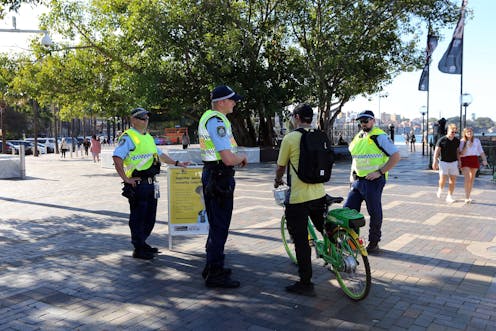
Cycling is often held up as a model of healthy and sustainable urban transport. So why have bike laws become more, not less, draconian? Our ongoing research shows mandatory helmet laws have become a tool of disproportionate penalties and aggressive policing.
Along with an up-surge in enforcement, fines have increased massively. And some police are using bike helmet laws to expand their powers to stop and search riders. The impacts on already disadvantaged groups – particularly young, poor and Aboriginal people – are profound and troubling.
Australia was the first country in the world to introduce bike helmet laws: Victoria in 1990, with other jurisdictions following. Like compulsory seat belt laws and random breath testing in the 1970s and ’80s, helmet laws were seen as part of gold-standard commitments to safety, backed by public education campaigns.
Read more: Helmet churn adds to challenges of e-scooter disruption
In New South Wales today, though, we see a brazen exercise in revenue-gouging.
How do penalties compare to other offences?
Riding without a helmet is one of many bike-related on-the-spot fines under the NSW Road Rules 2014, but it’s the one most commonly issued by police.
The offence once carried a small fine of A$73. In 2016, ostensibly as part of a package of cyclist safety measures (including making it an offence for a vehicle driver to fail to pass a cyclist at a safe distance), the fine was hiked to A$325 – a 445% overnight increase.
Penalties are indexed annually: the fine is now a whopping A$344. It’s wildly out of kilter with other states and territories: from A$25 in the NT to A$207 in Victoria.
The fine is also out of step with penalties for other, more serious offences. In NSW, only when car drivers exceed the speed limit by more than 20km/h does the fine exceed the A$344 for failing to wear a helmet.
A person who drives in a dedicated bicycle lane faces a A$191 penalty. A cyclist will be slugged almost twice as much for riding in that same lane without a helmet.
Riding a bike without a helmet is minor offending, but it has become a terrific little earner for the NSW government. From 2016-2019, 17,560 penalty notices worth almost A$6 million were issued to cyclists. Over the same period only 95 fines were handed out to drivers for unsafe passing.
Read more: Three Charts on the rise in cycling injuries and deaths in Australia
Cars are a much greater risk to bikes than bikes to cars. Cyclists might reasonably wonder whose welfare is being prioritised.
An excuse to stop and search
Much has been said recently about police use of discretionary powers like “strip searches”. Our ongoing research, yet to be published, also raises serious questions about how police use bike helmet laws.
Read more: Unlawful strip searches are on the rise in NSW and police aren’t being held accountable
We have found enormous geographical disparities in the number of penalty notices issued in NSW for this offence. In 2018-19, nearly half of all the fines were issued in 12 of the 117 local government areas (LGAs). One of the poorest LGAs, Blacktown, accounts for 12% of the total.
Local helmet-wearing behaviours could explain some of the disparity. However, the stories we are hearing from lawyers around the state suggest something much more troubling is at play.
Our interviews reveal the helmet laws are being used for purposes unrelated to safety. These include gathering intelligence about offences and suspects, justifying searches and harassing targeted individuals – particularly young Aboriginal people. Sometimes this involves multiple penalty notices for failing to wear a helmet, including where a child rides both to and from school on the same day.
Enforcement of this kind is likely to lead to resentment and resistance. This can escalate, sometimes leading to confrontations that can result in further offences like resist arrest or assault police, offensive language and goods in custody.
If the real objective is cyclist safety, surely a less punitive and more educative approach would be better. Police procedures should require officers to issue cautions rather than penalty notices for initial breaches. And stopping a person for not wearing a helmet is not justification for questioning or searching unless there are reasonable grounds for suspecting an offence (other than not wearing a helmet) has been committed.
Excessive fines create other problems
Even if things don’t escalate, many cyclists will walk away from a police encounter (they can’t ride away or they risk another fine!) with a debt they can’t afford.
For people who enjoy financial security, a fine is just like another household bill. But more than 12% of Australian households don’t have A$500 in savings for an emergency. For them, a A$344 fine is a major burden.
Read more: Stark divide between young and old as Australian household incomes and wealth stall
Our research suggests many fined for not wearing a helmet are already living in debt traps – permanently living with and trying to pay off debt. Driver licence suspension is a key component of unpaid fine recovery processes in Australia. This means the flow-on effects of (often multiple) bike helmet fines may include secondary offending where a person is caught driving without a licence. And that can land them in serious legal trouble.
Young people are especially vulnerable to overzealous helmet law enforcement. They are fined the same as adults – youth diversion options are not available for penalty notice offences. Debt at a young age can be crippling, seriously hampering job opportunities.
The penalty for riding without a helmet is now ludicrously excessive. Proportionality between penalty and offence has been lost.
The goal is meant to be harm reduction. Piling on the fines does more harm than good.
Authors: Julia Quilter, Associate Professor of Law, University of Wollongong


 Daily Bulletin


