

Why municipal waste-to-energy incineration is not the answer to NZ's plastic waste crisis
- Written by: Trisia Farrelly, Senior Lecturer, Massey University
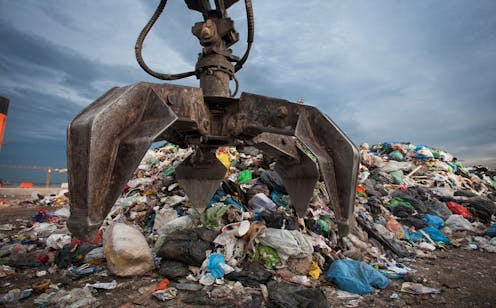
New Zealand is ranked the third-most-wasteful country in the OECD. New Zealanders produce five times the global daily average of waste per person – and they are getting more wasteful, producing 35% more than a decade ago.
These statistics are likely to get worse following China’s 2018 ban on imports of certain recyclable products. China was the world’s top importer of recyclable plastics, but implemented the ban because it could no longer safely manage its domestic and imported waste. Unsurprisingly, in 2015, China was named the top source of marine plastic pollution in the world.
Since the Chinese market closed, 58% of New Zealand’s plastic waste now goes to Malaysia, Indonesia, the Philippines, Thailand and Vietnam — all countries with weak regulations and high rankings as global sources of marine plastic pollution.
Waste-to-energy (WtE) incineration has been raised as a solution. While turning plastic waste into energy may sound good, it creates more pollution and delays a necessary transition to a circular economy.
Read more: We need a legally binding treaty to make plastic pollution history
Dirty plastics
Shipments of plastic recycling often arrive in developing countries unsorted and contaminated. Materials that cannot be easily recycled are commonly burned, releasing dioxins into air, soil and water. In response, South-East Asian countries have started returning dirty plastics to developed countries.
Several New Zealand councils have stopped collecting certain plastics for recycling offshore. They are sending them to landfill instead. Available data suggest that even before the China ban plastics made up roughly 15% of the waste in municipal landfills – about 250,000 tonnes a year. Much of this is imported plastic packaging.
Many New Zealanders are very or extremely worried about the impact of plastic waste. We cannot continue ignoring our role in the global plastic pollution crisis while dumping plastic in homegrown landfills or in developing countries.
Read more: We organised a conference for 570 people without using plastic. Here's how it went
In the scramble to find alternatives, waste-to-energy (WtE) incineration has become a hot topic, particularly as foreign investors look to establish WtE incinerators on the West Coast and [other centres]in New Zealand. Some local government representatives have endorsed WtE proposals, or raised WtE as an election issue.
Less plastic good for climate
Like landfills, WtE incinerators symbolise the linear “take-make-waste” economy, which destroys valuable resources and perpetuates waste generation.
Globally, countries are moving to circular approaches instead, which follow the “zero waste hierarchy”. This prioritises waste prevention, reduction, reuse, recycling and composting and considers WtE unacceptable.
Some New Zealanders say Nordic countries have proven that incineration is the environmental silver bullet to our waste woes. But a recent study found these countries will not meet EU circular economy goals unless they replace WtE incineration with policies that reduce waste generation. Such policies include packaging taxes, recycling and recovery rate targets, landfill bans on biodegradable waste, deposit return schemes and extended producer responsibility.
Rejecting linear approaches is also good for the climate. Actions at the top of the waste hierarchy stop more greenhouse gases than those at the bottom.
In contrast, WtE incinerators can produce 1.2 tonnes of carbon dioxide per tonne of municipal solid waste burnt. New Zealand’s zero carbon act means we have a responsibility to ensure we do not increase our greenhouse gas emissions by investing in WtE incineration.
Incinerators also cannot magic away toxins in plastic waste. Even the most high-tech WtE incinerators [[release dioxins and other pollutants into the air]. Meanwhile, toxin-laden fly ash and slag are dumped in landfills to eventually leach into the environment and contaminate food systems.
Shifting responsibility for plastic waste
To address plastic pollution, it is easy to see how prevention and reduction work better than “getting rid of” plastic once produced. Many WtE proponents argue that incineration technology can be a temporary solution for the plastic waste we have already created.
But incinerators are not short-term fixes. They are expensive to build and maintain. Large-scale incinerators demand about 100,000 tonnes of municipal solid waste a year, encouraging increasing production of waste. Investors guarantee returns on their investment by locking councils into decades-long contracts.
The only real solution to our plastics problem is through regulation that moves New Zealand towards a circular economy. We can start by making the linear economy expensive by increasing landfill levies above the current $NZ10/tonne and expanding it to all landfills. We must also invest in better waste collection, sorting and recycling systems, including a national network of resource recovery centres.
Instead of burning or burying plastic that cannot be reused, recycled or composted, we can prevent or reduce it through targeted phase-outs. The government is proposing to regulate single-use plastic packaging, beverage packaging, electronic waste and farm plastics through mandatory product stewardship schemes. This would make manufacturers responsible for the waste they produce and provide incentives for less wasteful and toxic product design and delivery systems (e.g. refill stations).
All of these circular solutions will provide far more jobs than WtE incineration.
Without a swift, brave shift to a circular economy, New Zealand will remain one of the world’s most wasteful nations. Circular economies are developing globally and WtE incineration will only set us back by 30 years.
Hannah Blumhardt, the coordinator of the NZ Product Stewardship Council, has contributed to this article.
Authors: Trisia Farrelly, Senior Lecturer, Massey University


 Daily Bulletin


