

To restore public confidence in apartments, rewrite Australia's building codes
- Written by: Geoff Hanmer, Adjunct Lecturer in Architecture, UNSW
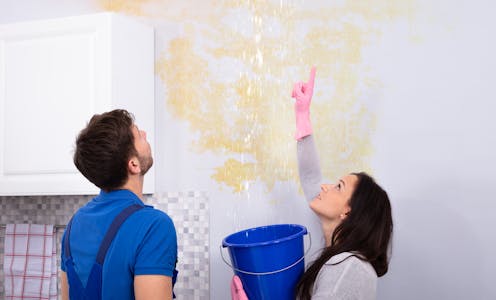
A prestige apartment building in Sydney built by a well-known developer is undergoing a second replacement of a terrace waterproof membrane five years after replacement of the first one, which had leaked from completion. The second membrane almost certainly complied with the National Construction Code (NCC) and was certified as compliant; the first one might also have complied. Yet, for 15 years, owners and tenants living under the terraces have put up with mouldy walls, carpets and ceilings because the code does not adequately control waterproofing materials and methods.
A key assumption made by governments and regulators has been that confidence will return to the market if apartments are built to meet National Construction Code requirements. As the story above shows, complying with the code alone will not be enough to fix many common defects. Public confidence will still be lacking.
Read more: Lack of information on apartment defects leaves whole market on shaky footings
In 2017, the Building Ministers’ Forum, the group of federal, state and territory ministers responsible for building regulation in Australia, commissioned a report from Peter Shergold and Bronwyn Weir. Their report said there was “… diminishing public confidence that the building and construction industry can deliver compliant, safe buildings which will perform to the expected standards over the long term”.
Since then, the high-profile structural failure and evacuation of Opal Tower on Christmas Eve 2018, the cladding fire at Neo200 in February 2019 and the structural failure and evacuation of Mascot Towers in June 2019 have kept this issue in the media spotlight. If anything, the public crisis of confidence has deepened.
Part of the problem is the code itself
The National Construction Code originated as a minimum standard to deliver structural integrity and fire safety. It was never intended to provide effective control over all the aspects of building work that make houses or apartments liveable and durable. This might come as a surprise to many people, including those in government, but it is inherent to the “minimum standard” approach that underpins the structure and objectives of the code.
The objectives on page 9 of volume 1 of the code, which covers apartments, are instructive:
1) ensure requirements have a rigorously tested rationale; and
2) effectively and proportionally address applicable issues; and
3) create benefits to society that outweigh costs; and
4) consider non-regulatory alternatives; and
5) consider the competitive effects of regulation; and
6) not be unnecessarily restrictive.
In attempting to consider “competitive effects”, avoid being “restrictive” and by encouraging “non-regulatory alternatives”, including self-certification and self-regulation, the code has opened the door to an “anything goes” mentality on many fronts.
Waterproofing requirements for houses and apartments under section F of the code are clearly ineffective, for a start.
The relevant Australian Standards, AS 4654.1 and AS 4654.2, were written with a lot of input from the building materials supply industry. The standards permit the use of unsuitable waterproofing membranes in many situations, particularly where ceramic tiles are directly bonded to an inappropriate liquid-applied membrane. As the example at the start of this article shows, this solution rarely lasts longer than four or five years and considerably less in some cases.
Rectification is expensive and inconvenient. It involves hacking up and replacing all the tiles.
In addition, every apartment building built without a step in the slab at the junction between walls and floors will probably develop leaks within a similar timeframe.
These practices are driven by the desire to save a few dollars in construction cost, not by a commitment to deliver a required standard of durability. Durability is not part of the code objectives.
Read more: Would you buy a new apartment? Building confidence depends on ending the blame game
How can the code be fixed?
We could improve the code in a number of simple ways:
Class 1 (houses) and class 2 (apartments) buildings should both be in volume 2, which would be dedicated to housing intended for sale. Houses and apartments should be required to be “fit for purpose” with a clearly stated objective to provide protection to the buyer. These should include a mandatory minimum statutory warranty of seven to ten years, backed by government.
The required durability of waterproofing membranes and details for all housing, and class 2 apartments in particular, must be clearly stated. Waterproofing should be required to last at least 25 years without significant maintenance, and perhaps 40 years for buildings where access to the waterproofing element requires demolition or is fundamentally difficult. Details that are not durable, including slabs without steps at wall junctions, or terrace and balcony tiles directly bonded to liquid-applied waterproof membranes, should be banned.
The structure of an apartment should be required to last with no substantial maintenance for at least 50 to 60 years. The minimum expectation for durability for any envelope component and associated finishes on buildings over three storeys should be 25 years, and perhaps 40 years for taller buildings.
The “performance requirements” of section F of the code, “Health and Amenity”, should be expanded to ensure apartments are comfortable, economical to maintain and sustainable.
Read more: Australia has a new National Construction Code, but it's still not good enough
Some developers are already delivering well-designed apartment buildings that are durable and fit for purpose. They are to be commended. The problem for buyers is identifying these amid a sea of dross.
For new houses and apartments, we need to ensure the National Construction Code matches community expectations on fitness for purpose and durability. This requires a return to more active and interventionist regulatory framework, including putting independent “eyes on the site” to inspect work during construction.
Authors: Geoff Hanmer, Adjunct Lecturer in Architecture, UNSW


 Daily Bulletin


