

The government wants to privatise visa processing. Who will be held accountable when something goes wrong?
- Written by: Marina Khan, PhD Candidate, Western Sydney University
The Department of Home Affairs has begun taking steps to outsource its visa processing to private service providers. This move has sparked an important national debate on transparency, accountability and profiteering in the immigration system.
The proposed changes will involve private service providers processing certain “low-risk” visas, rather than department staff.
Read more: Most migrants on bridging visas aren't 'scammers', they're well within their rights
Home Affairs claims privatisation will improve efficiency and reduce costs. But it also comes with major risks, some we’ve seen already play out in the privatisation of immigration control through commercialised immigration detention, such as on Christmas Island.
These risks include corruption, consumer protection issues and damage to the overall integrity the visa system.
Why privatise in the first place?
Today, migration is big business around the world, with private corporations, contracted by governments, increasingly organising and managing migration across different stages.
The US and Germany, for instance, privatise various functions, including administering visa applications, guarding borders, and organising transport and detention.
Read more: Politics podcast: Peter Dutton on balancing interests in home affairs
Australia first attempted to privatise immigration detention centres in 1996 as part of budget discussions, following an international trend towards arm’s-length management of public services. It was seen as a way to boost efficiency in detention services.
Much of the argument for visa privatisation today is based on similar claims of cost savings and efficiency.
In theory, this model promises greater accountability based on clear economic incentives. If performance falls below agreed standards, private firms risk losing their contracts.
But not only is accountability rarely enforced, several mitigating factors enable under performing companies to remain in business.
Preferential treatment
Close ties between private contractors and government decision makers have kept several detention contractors in business globally. This continues even after reported under-performance and human rights breaches.
What’s more, Home Affairs has already come under scrutiny for preferential treatment in considering the company Australian Visa Processing Consortium (AVP) as a potential contractor.
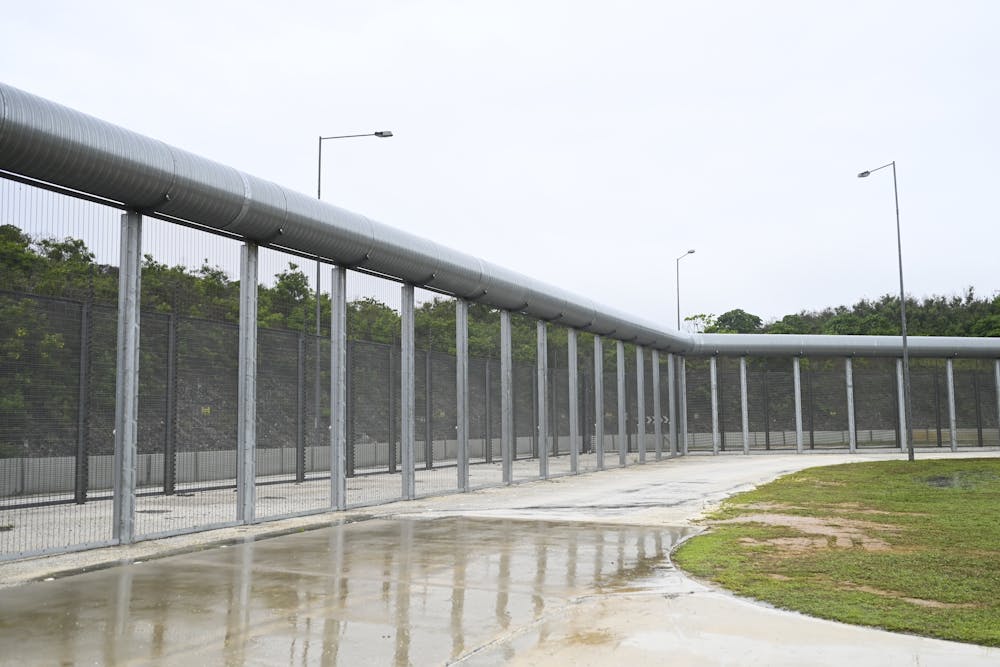 A perimeter fence at Christmas Island. Outsourcing visa processing comes with risks we’ve seen already play out in the privatisation of immigration control.
AAP Image/Lukas Coch
A perimeter fence at Christmas Island. Outsourcing visa processing comes with risks we’ve seen already play out in the privatisation of immigration control.
AAP Image/Lukas Coch
It’s also not clear what measures of oversight and surveillance will be applied to the private corporations. Home Affairs claims visa decision-making will still be centrally controlled, but so far the information released has been scarce.
For an estimated A$1 billion of investment into this visa privatisation project, it’s important the government makes this clear.
Big business risks corruption
So who will be accountable if something goes wrong?
In the case of immigration detention centres, privatisation has meant blame is too often shifted between the government and the private contractors.
And the Migration Institute of Australia has pointed to the possible misuse of a commercialised visa platform – private entities seek to generate multiple revenue streams through add-on and “premium” services, such as accommodation, transportation and deportation.
This, too, has happened with Australia’s commercialised immigration detention centres.
And when these services are run in the interests of profit, rather than border governance – dubbed the “immigration-industrial complex”“ – corrupt tactics can be used to benefit the providers’ bottom line.
One example of this is the deliberate slowing down of asylum processing, keeping immigration detention centres fuller for longer.
A privatised visa regime would similarly be more susceptible to corruption risks.
Regulating private companies isn’t easy
While close regulation and monitoring might seem like an easy way to keep these risks at bay, effective regulation is not that simple.
Read more: Politics podcast: Peter Dutton on balancing interests in home affairs
Private entities in immigration are not just "economic actors”, but become critical players in agenda setting, negotiation, and enforcement.
This means networks and alliances of giant multinational corporations, such as the Australian Visa Processing Consortium, can influence regulatory frameworks through lobbying, providing technical expertise and consulting on policy.
Such a consolidation of companies monopolises the market and eliminates competition. This in turn makes governments overly dependent on private services.
What’s more, the corporate interests of private companies is to protect and expand their business.
For instance, companies involved in the goverment’s visa modernisation bid include Accenture and Oracle. Both have allegedly been involved in tax evasion activities globally. Yet, they continue to secure government contracts worth millions, because of the continued reliance on their services.
Read more: Labor's crackdown on temporary visa requirements won't much help Australian workers
Such contracts also include “commercial-in-confidence”“ arrangements that conceal information on how taxpayer money is spent, the actual value for money to the public, and whether there are adequate protections against conflicts of interest.
The government also hasn’t been clear about the extent to which the privatisation partnership will be scrutinised under consumer protection provisions or government agencies such as the Ombudsman.
While various stakeholders have been involved in the privatisation consultation process, little attention has been paid to more rigorous governmental inquiry. This would involve, for instance, recommendations from the Productivity Commission or the Australian National Audit Office.
For so much investment, Home Affairs must provide sufficient information to the Australian public on their visa modernisation project, and address the many questions around risk mitigation.
Authors: Marina Khan, PhD Candidate, Western Sydney University


 Daily Bulletin


