

No, Australia is not putting teachers in the coronavirus firing line. Their risk is very low
- Written by: Gerard Fitzgerald, Emeritus Professor, School of Public Health, Queensland University of Technology
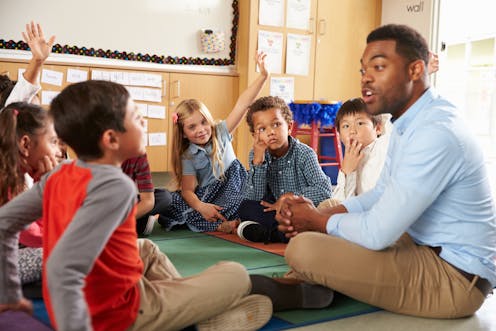
Prime Minister Scott Morrison today confirmed schools across Australia will be staying open for the foreseeable future as the COVID-19 pandemic spreads.
Morrison said this was based on health advice, supported by the federal government, premiers and chief ministers.
I’m telling you that, as a father, I’m happy for my kids to go to school. There’s only one reason your kids shouldn’t be going to school and that is if they are unwell.
But many teachers are concerned the government is ignoring their welfare and exposing them to risk of infection. This is particularly so for teachers who are in high-risk groups, such as the elderly and those with a chronic illness.
So, is the government sacrificing our teachers’s health by keeping schools open? Generally speaking, teachers are at very low risk of being exposed to COVID-19. But schools need to offer support for teachers who fall into high-risk groups.
What is the risk of COVID-19 to the average Australian?
Teachers may be feeling exposed, but it is important to be clear about the current status of this disease in Australia.
At March 17, 512 people have been diagnosed with COVID-19. On the information compiled by the ABC most of those people have either returned from overseas or had contact with someone who returned from overseas.
That means there is currently no evidence of significant and sustained community transmission of COVID-19 in Australia – although this could change rapidly. But for the moment, the risk to those who have not travelled abroad or those who have not had contact with those who have travelled remains very small.
Everyone entering Australia from overseas (except flight attendants and residents from the Pacific Islands) is required to self-isolate for 14 days.
Anyone who has been diagnosed with COVID-19 is asked to self-isolate, and those who have been in contact with them may also be asked to do so. People showing symptoms are being tested.
This further reduces the chance of community transmission.
On top of this, the Australian government has put in place proactive measures to reduce this low chance of community transmission further. This is done by encouraging enhanced personal hygiene and increased social distancing measures.
These include working from home where possible, staying at home unless you need to go out, banning mass gatherings of more than 500 people and indoor gatherings of more than 100 people, and avoiding non-essential travel.
All of this means the risk of anyone coming into casual contact with someone who has COVID-19 is very low. This of course means the risk of a teacher coming into contact with someone at school with COVID-19 is low too.
What if a child has COVID-19 and comes to school?
This risk to students and teachers is increased if someone in the school community has tested positive and potentially infected others.
A number of schools in Australia have shut after some students tested positive for COVID-19. This was to allow time to monitor students and teachers for any signs of infection and for extensive cleaning.
The advice to schools is if a child does present with a heavy cold, sore throat, cough, fever or flu-like symptoms, we’ll be contacting parents to come and collect their children.
Detailed analysis of the outbreak in Hubei province has shown that the majority of patients are adults between 20 and 50. But the severity of the disease and death rate increases with age.
Children are less likely to be diagnosed with the condition or to have severe illness. This makes teachers even less likely to encounter an infected person in the workplace.
Read more: Worried about your child getting coronavirus? Here's what you need to know
And like every other member of the community, children at risk of COVID-19, such as those who have travelled overseas or who have been in contact with someone who is infected, are required to self-isolate for two weeks.
Any child who is ill is being asked to stay home from school. Anyone showing symptoms or who may be a risk is tested for the disease.
Why have other countries closed schools then?
Again we must remember, there is currently no significant and sustained community transmission of COVID-19 in Australia.
It is quite different to the circumstances earlier this year in China (particularly Hubei province) and in Europe where there is uncontrolled spread of the disease. This is particularly the case in Italy, which has shut schools nationwide.
Researchers at Imperial College London have modelled the impact of various public interventions based on data from Hubei, and their previous work with influenza.
They concluded closing schools in the case of influenza will likely reduce further infections. But school closure in the case of COVID-19 is not enough in itself to do so. And the modelling was based on established community transmission which, of course, is not currently present in Australia.
Read more: Australian schools are closing because of coronavirus, but should they be?
Closing schools has consequences as parents need to stay home from work, some of whom will be essential workers including health workers. Or kids will end up gathering in shopping malls or with grandparents who are at particular risk from COVID-19.
Should this disease break out into the community, it may last months and prolonged closure of schools may have significant impacts on the children and their education.
The Australian government’s decision to keep schools open is based on weighing up the risks posed by schools against the health, economic and social costs of their closure.
Are teachers a high risk group because they are older?
COVID-19 is particularly threatening to certain groups of people. This includes the elderly, people with compromised immune systems and those with chronic diseases including hypertension, diabetes, heart and respiratory diseases.
Figures from a 2018 OECD report show Australian teachers are, on average, 42 years old and 30% are above the age of 50.
A government report from 2014 shows around 5% of Australian teachers are above the age of 65 and therefore at increased risk of COVID-19. It is likely many more have chronic diseases that also increase their risk.
Teachers in this group, as with any Australian, are advised to avoid travelling overseas and to avoid contact with anyone who has been diagnosed with COVID-19.
Read more: COVID-19: what closing schools and childcare centres would mean for parents and casual staff
And although the risk is small, teachers aged above 65 or who have a chronic condition, should consider not going to school. It is advisable for schools to have policies in place to ensure people in the higher risk groups are supported if they need to stay away for a period of time.
The situation is very fluid and if COVID-19 does break out further into the community, much more aggressive social distancing measures will need to be taken, including closing schools.
Authors: Gerard Fitzgerald, Emeritus Professor, School of Public Health, Queensland University of Technology


 Daily Bulletin


