

A virtual Australian parliament is possible – and may be needed – during the coronavirus pandemic
- Written by: Anne Twomey, Professor of Constitutional Law, University of Sydney
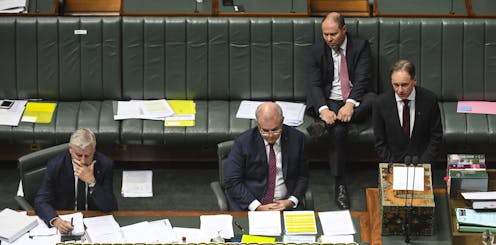
The Commonwealth Parliament has shut down its sittings due to the COVID-19 pandemic and is not scheduled to resume sitting until August. The usual budget sittings of May and June have been cancelled and the budget will not be handed down until October. Supply bills have been passed to ensure ordinary government expenditure is funded until the end of November.
An important consequence is that there will be very little parliamentary scrutiny of the government for nearly five months, a critical period during which extreme powers may be exercised.
Parliaments around the world are adapting to the new circumstances caused by the spread of coronavirus. European Union Parliament will operate with online voting from March 26. Other legislative bodies are contemplating a similar move.
How can we ensure the Australian government remains accountable, while still able to fulfil its functions and without putting the health of MPs and their staff at risk?
Parliamentary committees can still operate
Parliament has only been adjourned, not prorogued. This means its committees can still function.
The Senate Standing Committee for the Scrutiny of Delegated Legislation, for example, can play a very important role in checking and reporting on all regulations that may be made to give effect to emergency measures. The Joint Committee of Public Accounts and Audit can continue to scrutinise government expenditure and efficiency.
Read more: States are shutting their borders to stop coronavirus. Is that actually allowed?
Parliamentary committees can operate using technology, so their committee members, staff and witnesses can remain physically isolated while communicating with each other. Such meetings are still regarded as “parliamentary proceedings” for the purposes of parliamentary privilege.
For example, Standing Order 235(b) of the House of Representatives says:
A committee may conduct proceedings using audio visual or audio links with members of the committee or witnesses not present in one place. If an audio visual or audio link is used, committee members and witnesses must be able to speak to and hear each other at the same time regardless of location.
Senate Standing Order 30 also permits Senate committees to hold meetings electronically so everyone does not need to be in the same place.
There is therefore no reason for parliamentary committees to stop performing their important scrutiny functions while parliament is not sitting. Indeed, there are strong reasons why they should. In addition, the absence of parliamentary sittings will free up more time for such activity.
In New Zealand a special parliamentary committee upon which all parties are represented will meet regularly, sitting remotely, so government scrutiny can continue. Its proceedings will be live-streamed to the public to maintain accountability.
Virtual sittings of parliament?
If a parliamentary committee can engage in parliamentary proceedings with members and witnesses participating by way of technology links, is it possible for parliament to sit in the same manner, as a kind of “virtual” parliament? It may prove necessary in the course of the next few months to enact urgent legislation. Hence some facility to assemble parliament and pass laws in this way would be a safety net in the current circumstances.
It has been suggested the Australian Constitution forbids such action. It is not abundantly clear that this is so.
Certainly, the framers of the constitution did not envisage parliament sitting with members dispersed and communicating by way of technology, but they did recognise that communications technology was quickly changing in the 1890s and that those changes needed to be accommodated.
For this reason they gave the Commonwealth Parliament power to legislate with respect to “postal, telegraphic, telephonic, and other like services”. The phrase “other like services” was intended to pick up future developments in technology, such as radio, television and the internet.
The constitution is commonly interpreted in a manner that accommodates changes in facts and technology, so the absence of such technology in the 1890s is not a barrier.
What does the constitution say about where and how parliament sits?
Section 125 of the constitution says the parliament shall “sit at Melbourne until it meet at the seat of government”, which “shall be in a territory located in New South Wales, not less than one hundred miles from Sydney”.
Parliament therefore needs to “sit” in the “seat of government”, which is now in the Australian Capital Territory. But that could be accommodated by having a minimum number of key personnel, such as the presiding officers and perhaps a minister, at Parliament House, hosting the electronic meeting. Participating members could then log in from elsewhere.
Read more: View from The Hill: A contest of credible views should be seen as useful in a national crisis
The constitution also refers to the “attendance” of members. For example, section 20 provides that a senator’s office shall become vacant if he or she, without permission, “fails to attend the Senate” for two consecutive months of any session. Section 38 provides the same for members of the House of Representatives.
But there appears to be no reason why attendance may not, with the permission of the house, be by electronic means. Similarly, sections 44 to 46 refer to members and senators as “sitting”, but one could still “sit” by participating in parliamentary proceedings via technology.
Most importantly, sections 22 and 39 require, until parliament otherwise provides, the “presence of at least one-third” of senators or members “to constitute a meeting of” the Senate or the House of Representatives “for the exercise of its powers”.
These provisions permit parliament to “otherwise provide”, which it has done by enacting laws permitting a reduced quorum. It is not clear why parliament could not also legislate to permit a virtual presence through participation by electronic means in circumstances such as those now prevailing.
How could this be done?
There are two options. Section 50 of the constitution allows the houses to make rules and orders with respect to their business and proceedings. This is what was done when the houses, through their standing orders, permitted members and senators to participate in parliamentary committees by electronic means. The standing orders would need to be changed by a vote of an absolute majority of the house.
The second option would be to enact legislation to permit it. This would amount to parliament “otherwise deciding” for the purposes of sections 22 and 39 of the constitution. It would be wise to require that the presiding officers be in Parliament House, within the seat of government, to satisfy section 125.
Read more: How Australia's response to the Spanish flu of 1919 sounds warnings on dealing with coronavirus
A key consideration would be to ensure the identity of all participants, making audio-visual technology preferable so there could be certainty about who is participating and voting. Another would be ensuring all members in the virtual chamber can hear and communicate with each other. The best method would need to be ascertained for recording votes, along with ways of resolving any disputes about whether a vote was correctly recorded or how to deal with unintended absences resulting from failures in technology.
What preparations has the parliament made?
On March 23, Attorney-General Christian Porter moved two critical motions. The first changed the House of Representative’s sessional orders so it could
meet in a manner and form not otherwise provided in the standing orders with the agreement of the Leader of the House and the Manager of Opposition Business, with the manner in which Members may be present (including for the purposes of achieving a quorum) to be determined by the Speaker…
This potentially permits MPs to participate in parliament by electronic means, if the major parties and the speaker agree. An assurance was given that this motion was being moved for the purpose of enhancing greater participation in parliamentary proceedings, including from the cross-bench, rather than limiting it.
The second motion was to amend the standing orders so that, with the agreement of the two major parties, the standing orders can be amended without the need for an absolute majority of MPs. This means there will not need to be an absolute majority of MPs available in parliament to change the order of business.
Both measures were wise precautions, and both were passed.
Maintaining public confidence
In an emergency, maintaining public confidence in government is essential. One way of supporting this is to ensure parliament can operate, to scrutinise government action and represent the wishes of the people. If the physical presence of MPs is not possible due to a pandemic, there is good reason to ensure such scrutiny and representation can occur by electronic means.
Authors: Anne Twomey, Professor of Constitutional Law, University of Sydney


 Daily Bulletin


