

How to stay safe in restaurants and cafes
- Written by: Lisa Bricknell, Senior Lecturer in Environmental Health, CQUniversity Australia
Now we have fewer cases of COVID-19, and restrictions are lifting, many of us are thinking of rejuvenating our social lives by heading to our local cafe or favourite restaurant.
What can we do to reduce the risk of infection? And what should managers be doing to keep us safe?
Read more: How cafes, bars, gyms, barbershops and other 'third places' create our social fabric
COVID-19 is an infectious disease spread directly from person to person, carried in droplets from an infected person’s breath, cough or sneeze. If the droplets come into contact with another person’s eyes or are breathed in, that person may develop the disease.
Those droplets can also fall onto surfaces, where the virus can survive for up to 72 hours. If someone touches these surfaces, then touches their face, they can also become infected.
Read more: 7 questions answered on how to socialise safely as coronavirus restrictions ease
Eating out has led to several clusters
We know people around the world have become infected while eating out.
Back in late January and early February, three clusters of COVID-19 cases in China were connected to dining in a single restaurant. A total of 10 people became ill over the next three weeks.
The air-conditioning had apparently carried contaminated droplets from an infectious diner to nearby tables. This prompted the researchers to recommend restaurants increase their ventilation and sit customers at tables further apart.
In Queensland, more than 20 people connected with a private birthday party at a Sunshine Coast restaurant contracted the virus. Four were staff, the rest guests. We don’t know the source of infection.
Other outbreaks have been linked with restaurants in Hawaii, Los Angeles and a fast food restaurant in Melbourne.
Here’s how the coronavirus can spread in a restaurant.The path to infection
Let’s consider the risk of infection from the moment you arrive at a restaurant or cafe.
 Wes Mountain/The Conversation, CC BY-ND
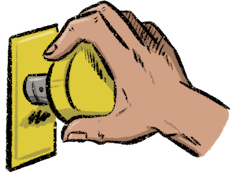
When you open the door, you may have to put your hand on a door handle. If that handle has been touched by a person while infectious, they may leave behind thousands of individual virus particles. If you then touch your face, you run the risk of the virus entering your body and establishing an infection.
Wes Mountain/The Conversation, CC BY-ND
When you open the door, you may have to put your hand on a door handle. If that handle has been touched by a person while infectious, they may leave behind thousands of individual virus particles. If you then touch your face, you run the risk of the virus entering your body and establishing an infection.
 Wes Mountain/The Conversation, CC BY-SA
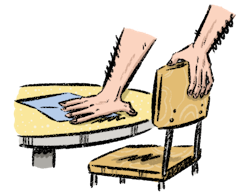
If you avoid the doorknob trap, you may pick up the virus when you take your seat at the table, by touching the chair or the tabletop. Again, if you touch your face, you are risking infection. Similarly, you risk exposure by touching the menu or the cutlery.
When the waiter comes to take your order, they will likely enter your breathing space. This is usually considered to be a circular zone of about 1.5 metres around your body.
Wes Mountain/The Conversation, CC BY-SA
If you avoid the doorknob trap, you may pick up the virus when you take your seat at the table, by touching the chair or the tabletop. Again, if you touch your face, you are risking infection. Similarly, you risk exposure by touching the menu or the cutlery.
When the waiter comes to take your order, they will likely enter your breathing space. This is usually considered to be a circular zone of about 1.5 metres around your body.
 Wes Mountain/The Conversation, CC BY-ND
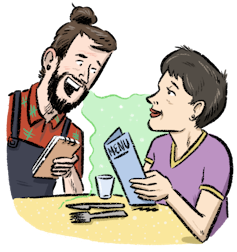
If the waiter is infected but not yet showing symptoms, you may be exposed to droplets containing the virus on their breath or the breath may contaminate the tableware in front of you.
Now, your food is delivered and there’s good news. The virus is not transmitted through food.
Wes Mountain/The Conversation, CC BY-ND
If the waiter is infected but not yet showing symptoms, you may be exposed to droplets containing the virus on their breath or the breath may contaminate the tableware in front of you.
Now, your food is delivered and there’s good news. The virus is not transmitted through food.
 Wes Mountain/The Conversation, CC BY-ND
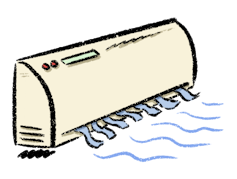
But wait. The air-conditioning can help the virus travel through the air from the infected person at the next table who has just choked on a crumb and is coughing uncontrollably.
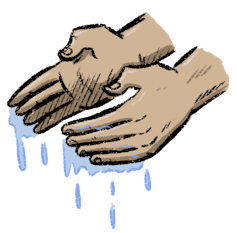
Later, on a quick trip to the bathroom, you again open yourself to the risk of infection by touching the door and other surfaces. However, this trip allows you to take one very important step to prevent infection. You wash your hands with soap, taking care to hum Happy Birthday twice as you scrub and rinse.
Wes Mountain/The Conversation, CC BY-ND
But wait. The air-conditioning can help the virus travel through the air from the infected person at the next table who has just choked on a crumb and is coughing uncontrollably.
Later, on a quick trip to the bathroom, you again open yourself to the risk of infection by touching the door and other surfaces. However, this trip allows you to take one very important step to prevent infection. You wash your hands with soap, taking care to hum Happy Birthday twice as you scrub and rinse.
 Wes Mountain/The Conversation, CC BY-ND
Unfortunately, you fail to dry your hands thoroughly. Wet hands are much more likely to pick up microbes, so you may recontaminate your hands as you open the door and go back to your table.
When you go to pay your bill, you may be worried that cash may be a source of infection. While there were concerns about this initially, there is no evidence to date of any cases linked to handling money. Just in case, you use your credit card, but inadvertently transfer the virus to your finger as you type in your PIN.
Read more:
You don't need to worry about spreading the coronavirus with cash
On your way out the door, you not only pick up more virus from the doorknob, but transfer some of the ones on your hand in return, ready for the next unwary diner.
How can I protect myself?
There are some simple (and familiar) things you can do to protect yourself as venues reopen.
Keep washing and drying your hands, thoroughly and regularly. If you don’t have access to soap and water, use alcohol-based hand sanitiser. Wash or sanitise after handling money, touching surfaces, before eating and after visiting the bathroom. Avoid touching your face, including wiping your eyes or licking juice off your fingers. If you must touch your face, use hand sanitiser first.
Maintain a distance of at least 1.5 metres from other people, unless they are people you share close contact with.
Sit outside if you can. Direct transmission is much more likely indoors.
Finally, think about using a credit or debit card with a contactless transaction, rather than having to enter a PIN.
To avoid infecting other people, stay home if you have any symptoms or suspect you might have been in contact with a person who has tested positive.
What should cafes and restaurants be doing?
Regulations about the number of patrons allowed in cafes and restaurants vary between states and territories. But there are certain common rules of thumb.
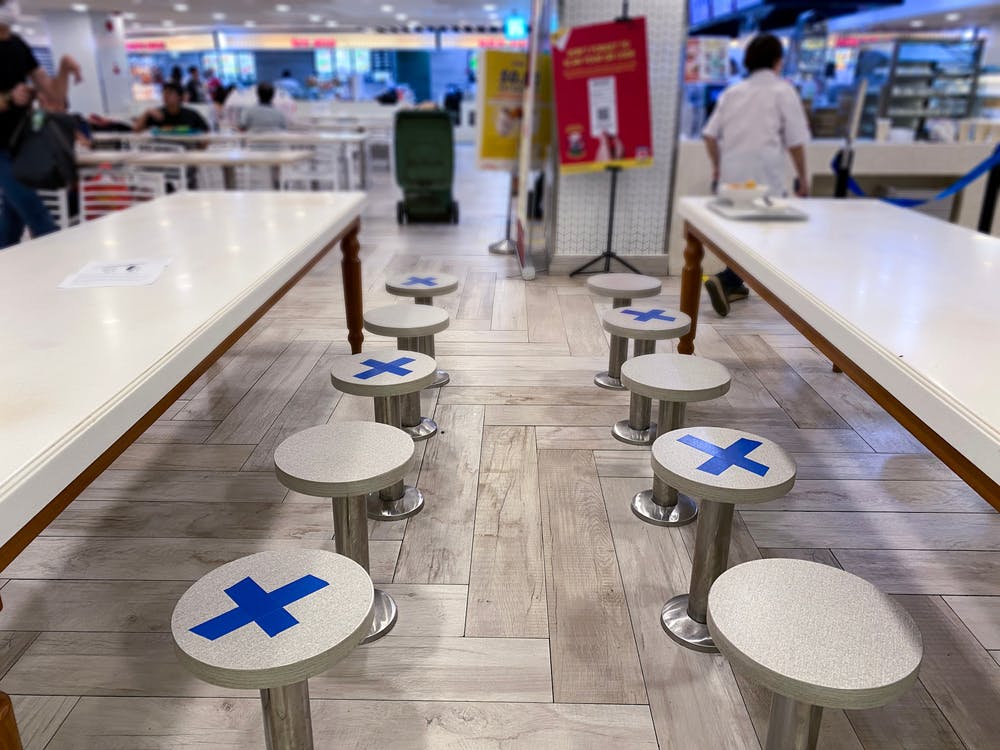
First, tables need to be spaced at reasonable distances. This allows patrons to be outside others’ 1.5-metre breathing zones and also takes into account the potential effect of air conditioning.
While COVID-19 doesn’t appear to be spread through air conditioning systems, they do boost air flow. This means droplets may travel a little further than 1.5 metres. This spacing will also reduce the number of people in the venue at the same time.
Some venues overseas are using plastic screens to separate diners to try to reduce the risk of person-to-person spread. This should not be used as a substitute for correct distancing if there is sufficient space.
Tables and chairs need to be sanitised, using a chemical sanitiser such as diluted bleach, between patrons.
Wes Mountain/The Conversation, CC BY-ND
Unfortunately, you fail to dry your hands thoroughly. Wet hands are much more likely to pick up microbes, so you may recontaminate your hands as you open the door and go back to your table.
When you go to pay your bill, you may be worried that cash may be a source of infection. While there were concerns about this initially, there is no evidence to date of any cases linked to handling money. Just in case, you use your credit card, but inadvertently transfer the virus to your finger as you type in your PIN.
Read more:
You don't need to worry about spreading the coronavirus with cash
On your way out the door, you not only pick up more virus from the doorknob, but transfer some of the ones on your hand in return, ready for the next unwary diner.
How can I protect myself?
There are some simple (and familiar) things you can do to protect yourself as venues reopen.
Keep washing and drying your hands, thoroughly and regularly. If you don’t have access to soap and water, use alcohol-based hand sanitiser. Wash or sanitise after handling money, touching surfaces, before eating and after visiting the bathroom. Avoid touching your face, including wiping your eyes or licking juice off your fingers. If you must touch your face, use hand sanitiser first.
Maintain a distance of at least 1.5 metres from other people, unless they are people you share close contact with.
Sit outside if you can. Direct transmission is much more likely indoors.
Finally, think about using a credit or debit card with a contactless transaction, rather than having to enter a PIN.
To avoid infecting other people, stay home if you have any symptoms or suspect you might have been in contact with a person who has tested positive.
What should cafes and restaurants be doing?
Regulations about the number of patrons allowed in cafes and restaurants vary between states and territories. But there are certain common rules of thumb.
First, tables need to be spaced at reasonable distances. This allows patrons to be outside others’ 1.5-metre breathing zones and also takes into account the potential effect of air conditioning.
While COVID-19 doesn’t appear to be spread through air conditioning systems, they do boost air flow. This means droplets may travel a little further than 1.5 metres. This spacing will also reduce the number of people in the venue at the same time.
Some venues overseas are using plastic screens to separate diners to try to reduce the risk of person-to-person spread. This should not be used as a substitute for correct distancing if there is sufficient space.
Tables and chairs need to be sanitised, using a chemical sanitiser such as diluted bleach, between patrons.
 Social distancing is important and will limit the number of people in a venue.
from www.shutterstock.com
Cutlery and tableware cannot be left ready on the table. They must be stored to prevent contamination in the kitchen and brought to the patron with their meal. Afterward, they need to be cleaned and sanitised as usual.
Disposable cutlery should never be left out for self-service; it should only be provided with food or on request.
All frequently touched surfaces must be regularly sanitised – including door handles, refrigerator and freezer doors, taps, light switches, hand rails, PIN pads and touch screens.
Staff must maintain safe distances from patrons at all times and must never be allowed to work if they have respiratory symptoms or are suspected to have had contact with a COVID-19 positive person.
Read more:
How to lower your coronavirus risk while eating out: Restaurant advice from an infectious disease expert
We need to be vigilant
Coronavirus cases in most states and territories are now very low. So, the chance of coming into contact with an infectious person is unlikely and is why restrictions are now gradually being lifted.
However, we musn’t become complacent. We need to continue to take precautions to reduce the risk of infection via our cafes and restaurants. It only takes one instance of carelessness to start the viral ball rolling again.
Read more:
As restrictions ease, here are 5 crucial ways for Australia to stay safely on top of COVID-19
Social distancing is important and will limit the number of people in a venue.
from www.shutterstock.com
Cutlery and tableware cannot be left ready on the table. They must be stored to prevent contamination in the kitchen and brought to the patron with their meal. Afterward, they need to be cleaned and sanitised as usual.
Disposable cutlery should never be left out for self-service; it should only be provided with food or on request.
All frequently touched surfaces must be regularly sanitised – including door handles, refrigerator and freezer doors, taps, light switches, hand rails, PIN pads and touch screens.
Staff must maintain safe distances from patrons at all times and must never be allowed to work if they have respiratory symptoms or are suspected to have had contact with a COVID-19 positive person.
Read more:
How to lower your coronavirus risk while eating out: Restaurant advice from an infectious disease expert
We need to be vigilant
Coronavirus cases in most states and territories are now very low. So, the chance of coming into contact with an infectious person is unlikely and is why restrictions are now gradually being lifted.
However, we musn’t become complacent. We need to continue to take precautions to reduce the risk of infection via our cafes and restaurants. It only takes one instance of carelessness to start the viral ball rolling again.
Read more:
As restrictions ease, here are 5 crucial ways for Australia to stay safely on top of COVID-19
Authors: Lisa Bricknell, Senior Lecturer in Environmental Health, CQUniversity Australia
Read more https://theconversation.com/how-to-stay-safe-in-restaurants-and-cafes-139117


 Daily Bulletin


