

'Shovel-ready' projects ignore important aspects of community resilience
- Written by: Tom Logan, Lecturer of Civil Systems Engineering, University of Canterbury
Roads, cycleways and housing developments are among 11 projects announced this week as the first tranche of infrastructure developments to kickstart New Zealand’s economic recovery in the wake of the COVID-19 pandemic.
New Zealand is investing at least NZ$3.3 billion into “shovel-ready” infrastructure projects, which will be fast-tracked under a new law currently going through parliament.
But this approach ignores an important aspect of recovery. In our research, we make the case that communities become more resilient to future crises when people have access to basic services such as supermarkets, hospitals and schools.
The people selecting recovery projects should ensure the projects prepare communities for future hazards and reduce future vulnerability.
Read more: We may live to regret open-slather construction stimulus
Vibrant communities
This first set of projects lacks a broad, cohesive vision for future communities; perhaps a consequence of the fast-tracking that limits feedback and innovation.
Instead, we should look at ideas such as Hamilton’s 20-minute city: a city where all residents are within 20 minutes of essential services, without depending on a car. Better yet, Paris and some of Britain’s cities have proposed 15-minute cities.
Explore access to various services in Christchurch and Hamilton. Created by Tom Logan, Mitchell Anderson, Dai Kiddle and Michael Freeman.This is not a call for highways and on-street parking. Instead, it can be achieved by providing new facilities in deprived areas and through smart planning.
Housing projects can bring people back into community centres. Medium-high density and mixed-use housing developments, in or near community hubs, would stimulate local economies long after the projects themselves are completed.
This type of initiative adds incentives for family-owned stores and cafes to return downtown. For example, as Christchurch continues to rebuild after the 2011 earthquake, affordable medium-high density housing in the empty lots of the inner city would invigorate local shopping and hospitality while enhancing safety of the community centre.
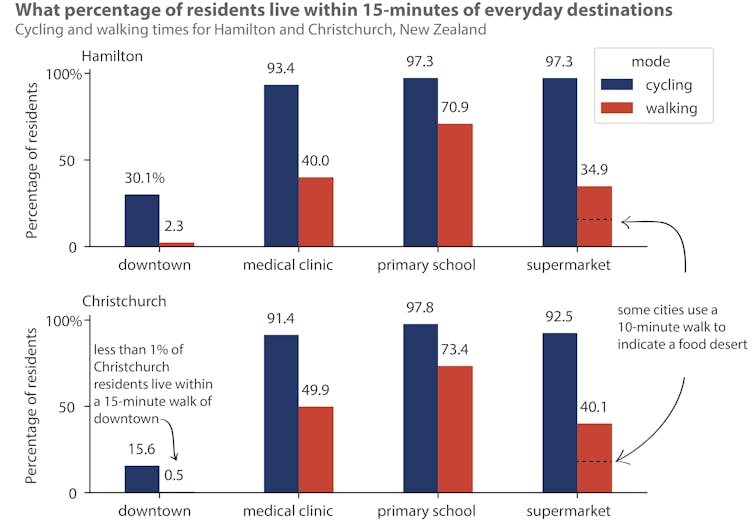 Travel times in Hamilton and Christchurch. Please note, downtown is defined using a single point.
So-called anchor projects (such as stadiums or pools) that bring only occasional pulses of activity continue to fail our communities.
Instead, projects that create higher-density housing near community centres should be funded. Housing projects that relegate people to far-flung sprawling suburbs should not.
Read more: How pandemics have changed American cities – often for the better
A modern approach to resilience
The challenge is to define what community resilience actually means. In the past, it has been characterised through two lenses: community capacity and infrastructure functionality.
Capacity-based resilience seeks to build a community’s ability to prepare, respond, recover and improve when faced with a hazard. The infrastructure functionality approach focuses on ensuring that infrastructure withstands disruptions and can quickly be restored afterwards. But this approach can be limited in its potential to enable necessary change.
Instead of these ideas, we argue that decision-makers should think about community resilience in terms of people’s access to amenities and opportunity. Fundamentally, communities need everyday services such as water, food, education, health care and employment to function.
Access to these resources, specifically equitable access, builds community cohesion, social capital and place attachment.
Read more: Drought, fire and flood: how outer urban areas can manage the emergency while reducing future risks
Evaluating future projects
Given the fast-tracking of consent processes, decisions should at least consider two aspects: hazard exposure and the equitable distribution of amenities.
Investment must consider hazard exposure. But given that essential infrastructure continues to be developed in exposed places - for example, the Buller hospital, Nelson airport and Napier airport are all built near sea level - there are major concerns about decision processes.
As much as NZ$14 billion worth of existing local government infrastructure, in New Zealand alone, is at risk from sea-level rise. Stimulus investment is an opportunity to reduce this exposure.
The second factor is community vibrancy, which can be achieved through equitable access to essential infrastructure and services. This brings benefits to community resilience, physical and mental health and local economic growth.
Today, we have the computational ability to evaluate and improve access and its equity. We can even evaluate how access changes during a disaster like Hurricane Florence, which struck Wilmington, North Carolina, in 2018. We can optimise the location of amenities like supermarkets to reduce food deserts and ensure they’re safe from future disasters.
Building resilience for people
This shift to a more contemporary, people-centric, thinking about community resilience should happen without needing the prompt of a global pandemic.
Before a disruption, we need to improve community well-being and health (the Māori concept of hauora) and social connectedness (whanaungatanga) through equitable access to services. In doing so, we foster the conditions necessary for resilience. It has been devastatingly evident during the Black Lives Matter protests how social injustices undermine community cohesion.
Following disruptions, we should focus on people’s access rather than solely on restoring infrastructure functionality. For example, providing generators may restore access to food or health care more rapidly than focusing on the electricity network.
Communities can be designed and retrofitted to achieve both lower exposure to natural hazards and improved equity in access. This is not the “green nirvana” NZ First MP Shane Jones opposes. Instead, it is a blueprint for invigorating and preparing communities for the next disruption, be that a drop in tourism, a global pandemic or a natural hazard.
Authors: Tom Logan, Lecturer of Civil Systems Engineering, University of Canterbury


 Daily Bulletin


