

Australia has failed miserably on energy efficiency – and government figures hide the truth
- Written by: Hugh Saddler, Honorary Associate Professor, Centre for Climate Economics and Policy, Australian National University
Amid the urgent need to slow climate change by cutting greenhouse gas emissions, energy efficiency makes sense. But as Australia’s chief scientist Alan Finkel last week warned, we’re not “anywhere close to having that nailed”.
Energy efficiency means using less energy to achieve the same outcomes. It’s the cheapest way to cut greenhouse gas emissions and achieve our climate goals. Improving energy efficiency is also vital to achieving so-called “energy productivity” – getting more economic output, using the same or less energy.
But Australia’s national energy productivity plan, agreed by the nation’s energy ministers in 2015, has gone nowhere.
It set a goal of a 40% improvement in energy productivity by 2030. But my analysis, based on the most recent official data, shows that in the three years to 2017-18, energy productivity increased by a mere 1.1%.
Clearly, there is much work to do. So let’s take a look at the problem and the potential solutions.
 Energy efficiency reduces power bills for consumers.
Julian Smith/AAP
Energy efficiency reduces power bills for consumers.
Julian Smith/AAP
Energy efficiency: a low-hanging fruit
Better energy efficiency lowers electricity bills, makes businesses more competitive and helps manage energy demand. Of course, it also means less greenhouse gas emissions, because fewer fossil fuels are burnt for energy.
Business, unions and green groups recognise the benefits. Last month they joined forces to call for a sustainable COVID-19 economic recovery, with energy efficiency at the core, saying:
In Australia, a major drive to improve the energy efficiency of buildings and industry could deliver over 120,000 job-years of employment […] Useful upgrades could be made across Australia’s private and public housing; commercial, community and government buildings; and industrial facilities.
The group said improvements could include:
- more efficient and controllable appliances and equipment, especially for heating and cooling
- improved shading and thermal envelopes (improving the way a building’s walls, ceiling and floors prevent heat transfer)
- smart meters to measure energy use
- distributed energy generation and storage, such as wind and solar backed by batteries
- fuel switching (replacing inefficient fuels with cleaner and economical alternatives)
- equipment, training and advice for better energy management.
Read more: Homes with higher energy ratings sell for more. Here's how Australian owners could cash in
The International Energy Agency (IEA) has suggested other measures for industry and manufacturing, such as:
- installing more efficient electric motors
- switching from gas to electric heat pumps
- more waste and material recycling.
And in transport, the IEA suggests incentives to get older, less efficient cars off the roads and encourage the uptake of electric vehicles.
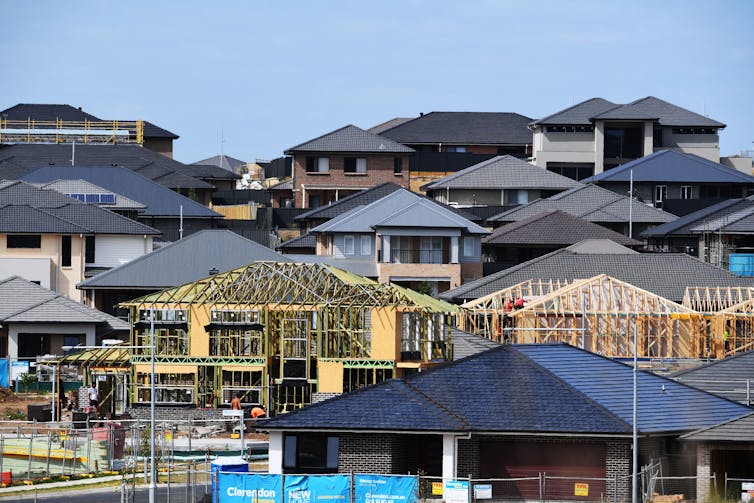 Residential buildings offer big opportunities for energy efficiency improvements.
Brendan Esposito/AAP
Residential buildings offer big opportunities for energy efficiency improvements.
Brendan Esposito/AAP
Governments’ sleight of hand
In 2018 the IEA observed:
the power sector will be at the heart of Australia’s energy system transformation […] International best practice suggests that both energy efficiency and renewable energy are key drivers of the energy transition.
Since then, renewable energy’s share of the electricity mix has increased. But energy productivity has stalled.
To understand how, we must define a few key terms.
Primary energy refers to energy extracted from the environment, such as coal, crude oil, and electrical energy collected by a wind turbine or solar panel.
Final energy is the energy supplied to a consumer, such as electricity delivered to homes or fuel pumped at a petrol station.
Read more: Coronavirus is a 'sliding doors' moment. What we do now could change Earth's trajectory
A lot of energy is lost in the process of turning extracted primary fuels into ready-to-use fuels for consumers. For example at coal-fired power stations, on average, one-third of the energy supplied by burning coal is converted to electricity. The remainder is lost as waste heat.
Until 2015, Australia and most other countries used final energy as a measure of how rapidly energy efficiency was improving. But the national productivity plan instead set goals around primary energy productivity – aiming to increase it by 40% between 2015 and 2030.
This has made it possible for governments to hide how badly Australia is travelling on improving energy efficiency. I analysed national accounts figures and energy statistics, to produce the below table. It reveals the governments’ sleight of hand.
Over the three years from 2014-15 to 2017-18, final energy productivity increased by only 1.1%, whereas primary energy productivity increased by 3.5%.
The reduced primary energy consumption is mostly due to a large increase in wind and solar generation. The efficiency of energy used by final consumers has scarcely changed.
A sustainable future
The lack of progress on energy productivity is not surprising, given governments have shown very little interest in the issue.
As Finkel noted in his address, Australia’s energy productivity plan is absent from the list of national climate and energy policies. The plan’s 2019 annual report has not been released. And those released since 2015 have not monitored progress in energy productivity.
What’s more, the plan makes no mention of previous similar agreements, in 2004 and 2009, to accelerate energy efficiency with regulation and financial incentives. Since 2013, almost all Commonwealth programs supporting those agreements have been de-funded or abolished, and many state programs have also been cut back.
Read more: Switch off your engine, it's not hard: how to cut your fuel bill, clear the air and reduce emissions
The IEA’s sustainable recovery plan, released last week, outlined what a sustainable global economic recovery might look like. In particular, it said better energy efficiency and switching to more efficient electric technologies will deliver triple benefits: increased employment, a more productive economy and lower greenhouse gas emissions.
In this carbon-constrained world, relatively easy and cheap opportunities such as energy efficiency must be seized. And as Australia spends to get its post-pandemic economy back on track, now is the time to act.
Authors: Hugh Saddler, Honorary Associate Professor, Centre for Climate Economics and Policy, Australian National University


 Daily Bulletin


