

You've got (less) mail: COVID-19 hands Australia Post a golden opportunity to end daily letter delivery
- Written by: Paul Alexander, Associate Professor, Network analysis, Procurement,Supply Chains, Curtin University
Australia Post delivered more than 3.3 billion items last financial year. That’s almost 14 million deliveries a day (not counting weekends and public holidays).
Its 2019 annual report itemises the massive logistical network required: 15,037 street post boxes, 4,343 post offices, 461 sorting and distribution facilities, 4,845 delivery vans, 2,600 trucks, six airline freighters, rail assets, and 8,992 motorbikes and electric delivery vehicles.
Letters and parcels move in “waves” to 12.1 million addresses daily. Federally legislated service standards oblige Australia Post to deliver a letter within the country in no more than four days at a fixed rate (currently A$1.10). And to do so every week day to 98% of all delivery points.
Or at least Australia Post did so until late April. That’s when the federal government granted a temporary suspension of the services standards, allowing it to deliver letters every second business day in metropolitan areas.
The rationale was to enable Australia Post to divert resources from letter delivery – the part of its business in decline for at least a decade – to the booming demand for parcel delivery driven by COVID-19.
Read more: COVID-19 has changed the future of retail: there's plenty more automation in store
In May, with support from the Senate crossbench, the government passed amendments extending the suspension to June 2021.
That move is not universally supported. Unions fear postal workers will lose jobs. Federal opposition leader Anthony Albanese has signalled Labor Party support for a Senate motion to overturn the changes.
These cuts are to jobs, these cuts are to services that are absolutely essential […] In particular, older Australians really rely upon their postal services.
It’s true Australia Post provides an indispensable service. But its revenues tell a story of people relying on postal services less and less.
Lost letters
The decline of the letter business over the past decade has been relentless.
In 2009 Australia Post made a profit before interest and income tax of A$384.5 million. Of this its letter business generated A$52 million. Parcels and logistics made A$187 million. Other business (such as agency services and merchandise) made about A$146 million.
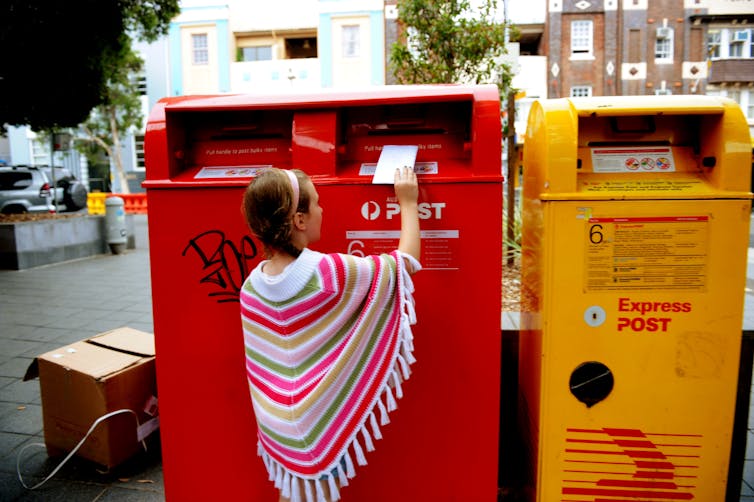 Paris Rieveling, 9, posts a letter at an in Sydney, December 14 2009.
Tracey Nearmy/AAP
Paris Rieveling, 9, posts a letter at an in Sydney, December 14 2009.
Tracey Nearmy/AAP
In 2019 its net profit was down to a razor-thin A$41 million. Profit before interest and tax for its non-letters businesses was almost A$259 million. Its letters business lost almost A$192 million.
Australia Post can still make profits delivering letters in major cities and regional centres, where population density is high and distances short. But not in in rural areas, where per-delivery costs skyrocket. Its commercial competitors, meanwhile, can cherry-pick the most lucrative market segments and avoid the loss-making ones.
Parsing parcels
Australia Post has long yearned to be freed from its obligation to deliver letters daily. In 2015 then chief executive Ahmed Fahour declared letter posting “in terminal and structural decline” and that Australia Post “is a parcels company more than a letters company”.
In March, current chief executive Christine Holgate told a Senate estimates committee:
Our most significant challenge is managing the tipping point of that transformation from letters for our delivery network, which is about 70% of our costs, which is actually now in need really of a significant transformation.
The cost of delivering a $1.10 letter is not much less than a $10 parcel. It makes no commercial sense to utilise resources on loss-making activities at the expense of profitable ones.
Read more: Delivery workers are now essential. They deserve the rights of other employees
But Australia Post is not just another corporation. Profits are not its only measure of success. It is owned by the nation. Its services are essential, particularly to rural communities.
 Fingal Post Office, in north-east Tasmania.
Shuttterstock
Fingal Post Office, in north-east Tasmania.
Shuttterstock
At this time, a strong case can be made it is a better social service to ensure timely parcel delivery.
In the longer term, the issue for policy makers is whether the social good is best served by keeping Australia Post to its historical obligations, or allowing it to meet burgeoning parcel demand and return a bigger dividend to the federal government to help fund other public services.
Read more: Australia Post can't turn back. Here's why
While opinions will vary, the numbers make a compelling case. They show a mail delivery system designed before the advent of the internet doesn’t need to be daily any more – just as the telephone last century helped end the importance of mail being delivered twice a day.
Authors: Paul Alexander, Associate Professor, Network analysis, Procurement,Supply Chains, Curtin University
-mail-covid-19-hands-australia-post-a-golden-opportunity-to-end-daily-letter-delivery&media=https://www.dailybulletin.com.au/https://images.theconversation.com/files/343976/original/file-20200625-33515-1imd1wp.jpg?ixlib=rb-1.1.0&q=45&auto=format&w=754&fit=clip&description=You've%20got%20(less)%20mail:%20COVID-19%20hands%20Australia%20Post%20a%20golden%20opportunity%20to%20end%20daily%20letter%20delivery "Pin It")

 Daily Bulletin


