

Is cancel culture silencing open debate? There are risks to shutting down opinions we disagree with
- Written by: Hugh Breakey, President, Australian Association for Professional & Applied Ethics. Senior Research Fellow, Moral philosophy, Institute for Ethics, Governance & Law, Law Futures Centre., Griffith University
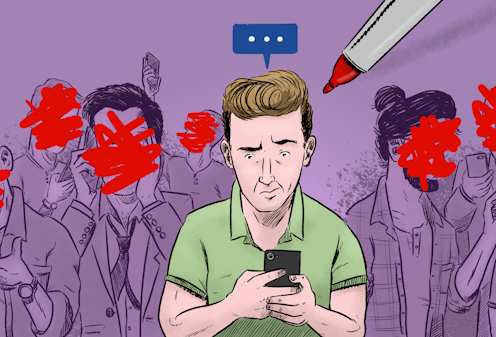
Earlier this week, 150 high-profile authors, commentators and scholars signed an open letter in Harper’s magazine claiming that “open debate and toleration of differences” are under attack. Signatories included JK Rowling, Margaret Atwood, Gloria Steinem and Noam Chomsky.
While prefacing their comments with support for current racial and social justice movements, the signatories argue there has been a weakening of the norms of open debate in favour of dogma, coercion and ideological conformity. They perceive
an intolerance of opposing views, a vogue for public shaming and ostracism, and the tendency to dissolve complex policy issues in a blinding moral certainty.
Sackings, investigations and withdrawn words
The letter’s signing by Rowling comes in the wake of widespread backlash against her controversial comments on transgender issues and womanhood.
Actor Daniel Radcliffe (“Harry Potter” himself) joined a chorus of disapproval of her comments, arguing they erased “the identity and dignity of transgender people”. Employees at Rowling’s publisher subsequently refused to work on her forthcoming book.
The Harper’s letter invoked similar cases of what it saw as punitive overreactions to unpopular views, suggesting they formed part of a larger trend:
Editors are fired for running controversial pieces; books are withdrawn for alleged inauthenticity; journalists are barred from writing on certain topics; professors are investigated for quoting works of literature in class; a researcher is fired for circulating a peer-reviewed academic study; and the heads of organizations are ousted for what are sometimes just clumsy mistakes.
The reference to editors being fired is perhaps the most well-known recent incident. Last month, the New York Times published an opinion piece by Republican Senator Tom Cotton calling for the military to provide an “overwhelming show of force” to restore order in US cities during the protests over the killing of George Floyd.
The piece’s publication attracted immediate criticism for promoting hate and putting black journalists in danger. In response, the editorial page editor emphasised the newspaper’s longstanding commitment to open debate, arguing the public would be better equipped to push back against the senator’s stance if it heard his views.
This defence failed, and within days he resigned.
Read more: In publishing Tom Cotton, the New York Times has made a terrible error of judgment
Push-back against push-back
Perhaps unsurprisingly, the Harper’s letter has received spirited critique. Some commentators noted past cases where the signatories had themselves been censorious. Others argued that any perceived threat was overblown.
Indeed, the link the open letter makes between a repressive government and an intolerant society may seem a long bow to draw. There is a world of difference between the legal prohibition of speech and a wave of collective outrage on Twitter.
Yet, it is nevertheless worth considering whether important ethical outcomes are threatened in a culture of outrage, de-platforming and cancelling.
Some speech requires consequences, but which speech?
Almost everyone would agree some types of speech are beyond the pale. Racial slurs don’t deserve careful consideration. They require “calling out”, social censure and efforts at minimising harm.
Rather than objecting to outrage per se, the Harper’s letter asserts there is a broadening in the scope of views that attract punitive responses. This seems plausible. In recent scholarly work on the tensions between censorship and academic freedom on university campuses, both sides of the dispute acknowledge that in the current environment virtually all utterances offend someone.
Yet, perhaps there are good reasons for this broadening of scope. In each of the cases raised in the letter, there were seemingly sensible reasons for applying social sanctions. These included judgements that:
the speech was morally wrongful
the speech was gravely offensive
the speech would have seriously worrying consequences. It was “unhelpful”, “harmful”, “damaging” or “divisive”.
For someone who is genuinely concerned that speech is wrong in these ways, it will seem not just morally permissible to take action against the speaker. It will feel obligatory.
Read more: No, you're not entitled to your opinion
Caution about consequences
But several concerns arise when we attach punitive consequences to people’s speech based on its perceived moral wrongfulness (as opposed to simply arguing it is mistaken or false).
First, claims of moral wrongfulness in a debate assume immediate urgency and distract from the debate itself. For example, let’s say in a debate about immigration, one person says something that offends another. Discussion of the original issue (immigration) will be bracketed until the issue of moral wrongdoing (the perceived slight or offence) is resolved.
Second (except in obvious cases), claims about wrongfulness, offensiveness and harmfulness are all open to debate. As philosopher John Stuart Mill once observed:
The usefulness of an opinion is itself a matter of opinion: as disputable, as open to discussion, and requiring discussion as much, as the opinion itself.
Third, allegations of wrongdoing create heat. Few people respond constructively to allegations of wrongdoing. They often retaliate in kind, escalating the conflict.
In a less politicised environment, a contentious claim might be treated as a contribution to a debate to be considered on its merits. But in our current climate, the same claim creates only angry allegations flying in both directions. As a result, the claim isn’t considered or debated.
Should this worry us?
If we think a person’s view is wrong and immoral, we might suppose there is no great loss about a debate being derailed. But there are genuine ethical concerns here.
First, public deliberation is a source of legitimacy. The fact that different views are widely heard and inclusively considered provides a reason for accepting collective decisions.
Democracy itself assumes citizens can hear different arguments, evidence and perspectives. If significant parts of the political spectrum are no longer tolerated, then social institutions lose this important type of legitimacy.
Read more: Actually, it's OK to disagree. Here are 5 ways we can argue better
Second, listening to others with different opinions, and engaging with them, can help us understand their views and develop more informed versions of our own positions.
On the flip side, being consistently outraged by opposing viewpoints provides a ready reason not to consider them. This feeds directly into confirmation bias and group-think.
Third, shaming people can cause a “persuasive boomerang” to occur. When people feel others are trying to control them, they can become even more attached to the view others are trying to combat.
None of these concerns categorically rule out attaching punishing consequences to hateful or harmful speech. But they do imply the open letter has a point worth serious attention. Seeing mistaken views as intolerable speech carries genuine ethical costs.
Authors: Hugh Breakey, President, Australian Association for Professional & Applied Ethics. Senior Research Fellow, Moral philosophy, Institute for Ethics, Governance & Law, Law Futures Centre., Griffith University


 Daily Bulletin


