

These dogs are trained to sniff out the coronavirus. Most have a 100% success rate
- Written by: Susan Hazel, Senior Lecturer, School of Animal and Veterinary Science, University of Adelaide
What does a pandemic smell like? If dogs could talk, they might be able to tell us.
We’re part of an international research team, led by Dominique Grandjean at France’s National Veterinary School of Alfort, that has been training detector dogs to sniff out traces of the novel coronavirus (SARS-CoV-2) since March.
These detector dogs are trained using sweat samples from people infected with COVID-19. When introduced to a line of sweat samples, most dogs can detect a positive one from a line of negative ones with 100% accuracy.
Across the globe, coronavirus detector dogs are being trained in the United Arab Emirates (UAE), Chile, Argentina, Brazil and Belgium.
In the UAE, detector dogs – stationed at various airports – have already started helping efforts to control COVID-19’s spread. This is something we hope will soon be available in Australia too.
A keen nose
Our international colleagues found detector dogs were able to detect SARS-CoV-2 in infected people when they were still asymptomatic, before later testing positive.
When it comes to SARS-CoV-2 detection, we don’t know for sure what the dogs are smelling.
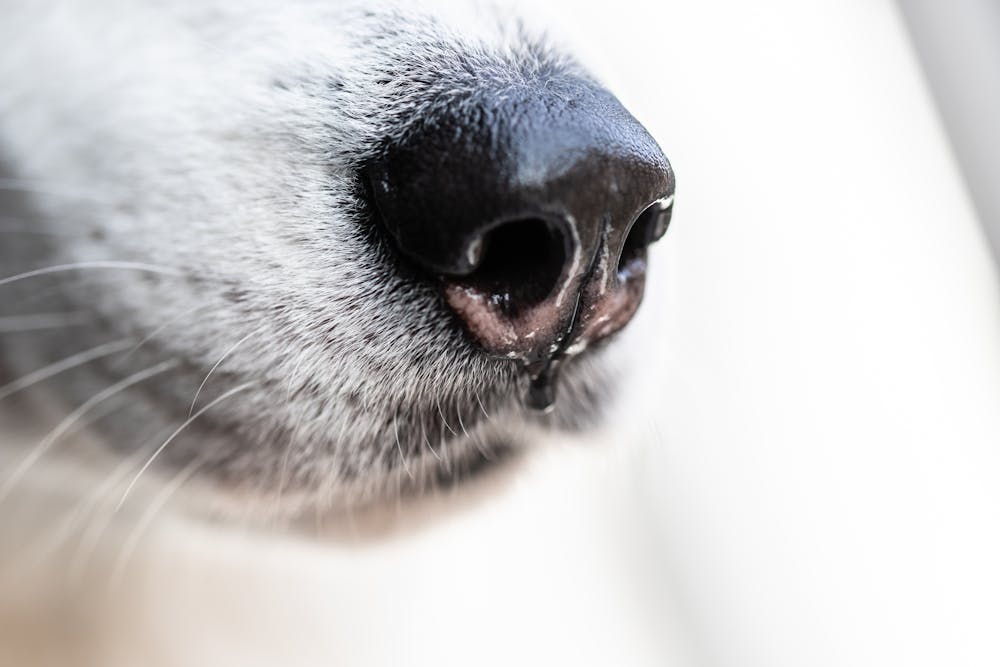 On average, dogs have about 220 million scent receptors.
Shutterstock
On average, dogs have about 220 million scent receptors.
Shutterstock
The volatile organic compounds (VOCs) given off in the sweat samples are a complex mix. So it’s likely the dogs are detecting a particular profile rather than individual compounds.
Sweat is used for tests as it’s not considered infectious for COVID-19. This means it presents less risk when handling samples.
Read more: Explainer: what's the new coronavirus saliva test, and how does it work?
COVID-19 sniffing dogs in Australia
Here in Australia, we’re currently working with professional trainers of detector dogs in South Australia, Victoria and New South Wales. The most common breed used for this work so far has been the German shepherd, with various other breeds also involved.
We are also negotiating with health authorities to collect sweat samples from people who have tested positive to the virus, and from those who are negative. We hope to start collecting these within the next few months.
We will need to collect thousands of negative samples to make sure the dogs aren’t detecting other viral infection, such as the common cold or influenza. In other countries, they’ve passed this test with flying colours.
Once operational, detector dogs in Australia could be hugely valuable in many scenarios, such as screening people at airports and state borders, or monitoring staff working in aged care facilities and hospitals daily (so they don’t need repeat testing).
To properly train a dog to detect SARS-CoV-2, it takes:
6-8 weeks for a dog that is already trained to detect other scents, or
3-6 months for a dog that has never been trained.
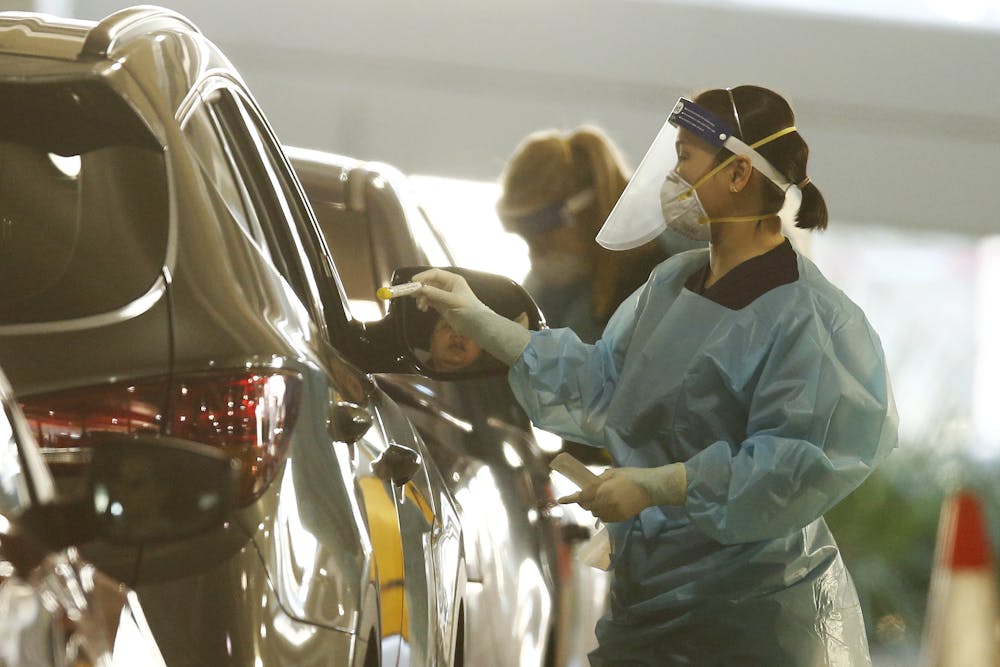 Coronavirus cases recently peaked in Victoria. Having trained sniffer dogs at hand could greatly help manage future waves of COVID-19.
Daniel Pockett/AAP
Coronavirus cases recently peaked in Victoria. Having trained sniffer dogs at hand could greatly help manage future waves of COVID-19.
Daniel Pockett/AAP
Could the dogs spread the virus further?
Dogs in experimental studies have not been shown to be able to replicate the virus (within their body). Simply, they themselves are not a source of infection.
Currently, there are two case reports in the world of dogs being potentially contaminated with the COVID-19 virus by their owners. Those dogs didn’t become sick.
Read more: Hong Kong dog causes panic – but here's why you needn't worry about pets spreading COVID-19
To further reduce any potential risk of transmission to both people and dogs, the apparatus used to train the dogs doesn’t allow any direct contact between the dog’s nose and the sweat sample.
The dog’s nose goes into a stainless steel cone, with the sweat sample in a receptacle behind. This allows free access to the volatile olfactory compounds but no physical contact.
Furthermore, all the dogs trained to detect COVID-19 are regularly checked by nasal swab tests, rectal swab tests and blood tests to identify antibodies. So far, none of the detector dogs has been found to be infected.
 Dogs are not susceptible to the negative effects of the novel coronavirus.
Eyepix/Sipa USA
Dogs are not susceptible to the negative effects of the novel coronavirus.
Eyepix/Sipa USA
Hurdles to jump
Now and in the future, it will be important for us to identify any instances where detector dogs may present false positives (signalling a sample is positive when it’s negative) or false negatives (signalling the sample is negative when it’s positive).
We’re also hoping our work can reveal exactly which volatile olfactory compound(s) is/are specific to COVID-19 infection.
This knowledge might help us understand the disease process resulting from COVID-19 infection – and in detecting other diseases using detector dogs.
This pandemic has been a huge challenge for everyone. Being able to find asymptomatic people infected with the coronavirus would be a game-changer – and that’s what we need right now.
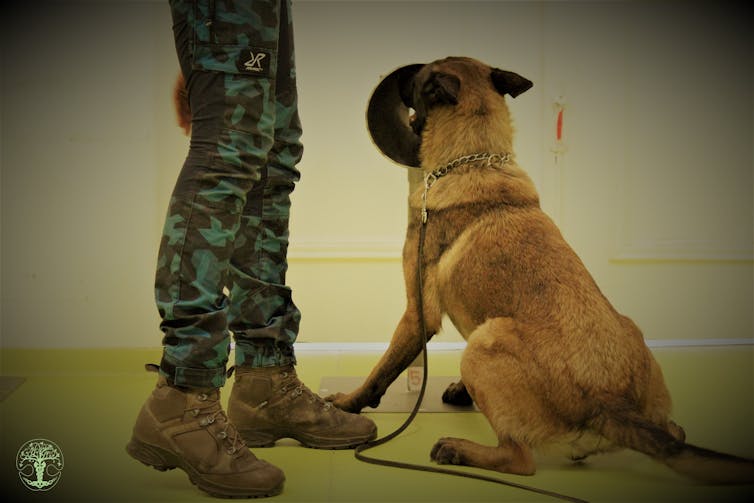 A COVID-19 detector dog enrolled in the NOSAIS program led by professor Dominique Grandjean and Clothilde Julien from the Alfort Veterinary School (France).
A friend to us (and science)
Perhaps we shouldn’t be surprised about dogs’ ability to detect COVID-19, as we already know their noses are amazing.
Dogs can help detect hypoglycaemia in diabetics, warn people who are about to have an epileptic seizure and have been used to sniff out some cancers.
Their great potential in dealing with the current pandemic is just one of myriad examples of how dogs enrich our lives.
We acknowledge Professor Riad Sarkis from the Saint Joseph University (Beirut) and Clothilde Lecoq-Julien from the Alfort Veterinary School (France) for first conceiving the idea underpinning this work back in March.
Authors: Susan Hazel, Senior Lecturer, School of Animal and Veterinary Science, University of Adelaide


 Daily Bulletin


