

We asked kids who their favourite teacher is, and why. Here's what they said
- Written by: Penny Van Bergen, Associate Professor in Educational Psychology, Macquarie University
Most of us can remember a favourite teacher. Some of us can also remember a teacher we didn’t get on with or with whom we always seemed to get in trouble.
Relationships between students and teachers at school are important. They predict students’ motivation, performance, and expectations of future relationships.
We interviewed 96 students from a range of schools in Years 3 to 9. We wanted to find out who students remember as their favourite and least favourite teachers. We also wanted to find out what made those relationships positive or negative.
In our study, published in the journal School Psychology Review, all students described similar factors that made them like their teachers — care, kindness and humour.
What we wanted to find
Past research shows students with disruptive behaviour are more likely to experience negative relationships with their teachers than their less disruptive peers. Teachers often rate relationships with such students to be low in closeness and high in conflict.
But these relationships aren’t always negative. Even self-described troublemakers and class clowns often remember a specific teacher who stood up for them, who took them under their wing, or who changed their perceptions of school for the better.
Read more: Group punishment doesn't fix behaviour – it just makes kids hate school
The first group we interviewed consisted of 54 students who had a history of disruptive behaviour, such as acting out in class or being frequently suspended. Around half were in a special behaviour school for disruptive behaviour, and the remainder attended a mainstream school.
The second group consisted of 42 students with no history of disruptive behaviour. They were often high achieving (such as school prefects or A-students), and all attended a mainstream school.
 Making kids laugh can go a long way.
Shutterstock
Making kids laugh can go a long way.
Shutterstock
We were particularly interested in the “magic ingredients” that would support positive student-teacher relationships, even for disruptive students. We also wanted to determine if there were “contaminating ingredients” that could sour these relationships, even for exemplary students.
Who is your favourite teacher?
We first asked students if they could remember any teachers they’d had a really good relationship with. If the student replied yes, we then asked what made the relationship good.
The reasons students liked teachers were almost identical across groups. Even highly disruptive students bonded with teachers who were caring, kind and funny.
One 13-year-old with disruptive behaviour (in a special school) said of their favourite teacher:
Every time I’d go there without food … Miss H always used to buy me lunch, let me go on excursions. … I was never allowed to go on an excursion [before] because of my ADHD.
A 15-year-old with disruptive behaviour (also in a special school) said of their favourite teacher:
Mr M, he’s just hilarious. He’s the funniest man on earth. He’s always saying this weird stuff […] walking around with this big puffy jacket, like some kind of Russian guard […] pretending his pencil is a cigar […] we just laugh.
These answers show how important it is for teachers to separate student disciplinary matters from relationship matters.
Around 16% of students highlighted teacher helpfulness, while 10% highlighted effective teaching, as a key advantage of their favourite teachers.
One 12-year-old without disruptive behaviour said about their favourite teacher:
She gave me and some of the other smart kids harder work. [I liked that] because it challenges me.
What causes conflicts?
We next asked students if they could remember any teachers they really didn’t get on with or clashed with. If a student replied yes, we asked what sort of things would bring that on.
While not all students could remember a teacher they clashed with, a large proportion of each group could.
Students in both groups overwhelmingly agreed on the key factors contributing to negative relationships.
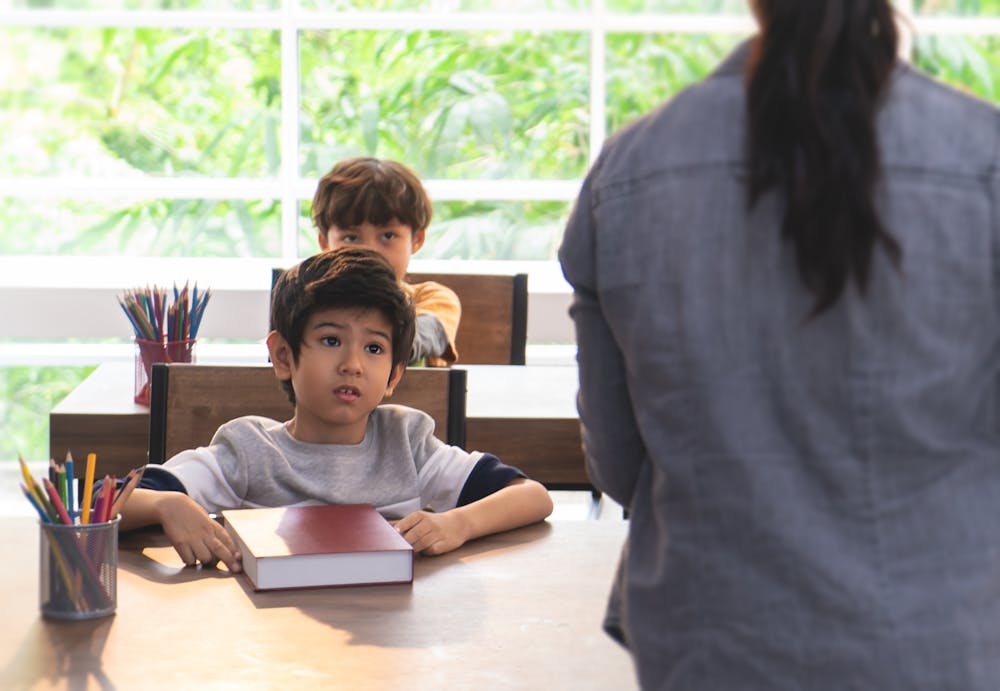 Nobody likes to feel like they’re being treated unfairly.
Shutterstock
Nobody likes to feel like they’re being treated unfairly.
Shutterstock
Across groups, 86% highlighted instances where they had perceived the teacher being unnecessarily hostile towards them, or where they felt they were treated unfairly.
One 13-year-old with disruptive behaviour (in a mainstream school) said:
I usually have my earphones in and I just sit there and just listen to music […] she just like opened the door, seen me listening to music […] She comes up, grabs the earphones, she just rips them out of my ear [pretend shouting] ‘Listen to the teacher!‘
A 16-year-old with disruptive behaviour (in a special school) said:
She just used to pin stuff on me. If I done the littlest thing wrong and someone done somethin’ major wrong, she would […] go for me first […] She just hated me, and I hated her.
Another 10-year-old with no disruptive behaviour said:
She was always yelling […] Because she gave us a real hard book, and we were only in Year 1, and we couldn’t really read it that good […]
Frequently, students’ descriptions of unfair treatment included pre-emptive punishments and reprimands:
One 15-year-old with disruptive behaviour (in a special school) said:
Well, I remember one time that, like, I went inside the classroom and she just, like, came up to me and she was like, you had better not talk this lesson and I wasn’t even talking at all.
Another 15-year-old with disruptive behavior (in a mainstream school) said:
Well, she always picked me out, as well, for misbehaving, so I got in a lot of trouble for that, but […] like, a lot of people were just doing a lot worse than I was doing, but she was like, no, no, you’ve been bad before.
A 12-year-old with no disruptive behavior (in a mainstream school) said:
Every time I did something in the playground that was good, someone told her I’d done something bad and [Miss C] always believed them.
What teachers can take from this
Based on our research, below are some things teachers and parents can do to promote positive relationships with teachers for the young people in their care.
remember empathy and humour go a long way to building positive relationships with students. Caring about students as individuals genuinely does break down barriers. Most teachers already report caring deeply for their students. It may simply be a matter of making one’s acts of kindness and care more visible
consider how warnings are given. Students benefit when they are allowed to start the day with a clean slate, and when reprimands are held back until an offence has actually been committed
separate classroom management from relationship building. Students who are most disruptive are also often the ones who could use a positive relationship the most
parents can help by encouraging students to reflect on their relationships with teachers. Sometimes situations are ambiguous, and understanding a teacher’s perspective may help in interpreting situations that would otherwise feel unreasonable to a young person. Students and teachers both win when they work on the same team.
Read more: How teachers are taught to discipline a classroom might not be the best way
Authors: Penny Van Bergen, Associate Professor in Educational Psychology, Macquarie University


 Daily Bulletin


