

Phytonutrients can boost your health. Here are 4 and where to find them (including in your next cup of coffee)
- Written by: Clare Collins, Professor in Nutrition and Dietetics, University of Newcastle
Coffee is regularly in the news for its potential health benefits and drawbacks.
A review of the research found drinking a few cups of coffee a day was associated with a lower risk of dying from any cause. Coffee drinkers had a lower risk of developing heart disease, type 2 diabetes, liver disease, depression, Alzheimer’s disease, Parkinson’s disease, and prostate, endometrial, liver and skin cancers.
However, the review also found evidence of negative effects related to pregnancy and fracture risk in older women, even after results were adjusted for possible confounding factors, like smoking.
Some of coffee’s positive effects have been attributed to food components called “phytonutrients”. But if you’re not a coffee drinker, don’t worry — you can find phytonutrients in other foods too.
What are phytonutrients?
Phytonutrients, or phytochemicals, are chemical compounds plants produce that help them grow well. They can deter predators or help fight off pathogens.
Research is shedding light on their potential benefits for human health, too. When we digest and absorb foods and drinks that are rich in phytonutrients, these compounds become active in our bodies’ biochemical pathways that affect our health and infleuence whether we develop disease.
Scientists have identified thousands of phytonutrients in plants including nuts, beans, seeds, vegetables, fruit and grains.
Research to identify those with potential for use in disease prevention and treatment is accelerating.
Read more: Health Check: four reasons to have another cup of coffee
Four phytonutrients
Two of the phytonutrients found in coffee beans are caffeic acid and chlorogenic acid. You’ll also find them in a range of fruit, vegetables, herbs and spices.
Caffeic acid is found in dates, prunes, olives, potatoes, sunflower seed meal, cinnamon, cumin, nutmeg, ginger, star anise, spearmint, caraway, thyme, oregano, sage and rosemary.
Chlorogenic acid is found in prunes, blueberries, apples, pears, peaches, globe artichokes, potatoes, sunflower seeds, spearmint, sage and oregano.
Most of the research on caffeic acid and chlorogenic acid has been in laboratory studies, so the results cannot be applied directly to people. But laboratory studies suggest these compounds act on signalling pathways that contribute to the development of chronic diseases, including cancer.
They may prevent cancer development by neutralising free radicals that can damage cell walls, and by converting potential cancer-causing substances into less toxic compounds.
Further, in studies in mice, caffeic acid and chlorogenic acid suppressed the rise in blood sugar levels after eating. These results suggest a mechanism for lowering the risk of developing type 2 diabetes, though we’ll need research beyond laboratory studies before we can move towards any conclusions.
 Coffee is one source of phytonutrients — but it’s not the only source.
Shutterstock
Coffee is one source of phytonutrients — but it’s not the only source.
Shutterstock
Among other phytonutrients with similar anti-inflammatory and protective properties are quercetin and glucosinolate.
Quercetin compounds give flowers, vegetables and fruit some of their colour. Quercetin helps plants adapt to local growing conditions and regulates the hormones that influence their growth and development.
Food sources include asparagus, black olives, cocoa, cranberries, buckwheat, prunes, broad beans, plums, apples, red and brown onions, shallots, blackberries, raspberries, strawberries, broccoli, red lettuce, red wine, green beans, zucchini, oregano, marjoram, cloves and capers.
While most studies of quercetin have similarly been in cells or animals, and not humans, they show quercetin has anti-inflammatory, antioxidant and anti-cancer effects. Quercetin alters the way cancer cells develop, grow and spread, and helps kill the cancer cells. So more research on quercetin as a potential therapeutic agent for cancer is warranted.
Quercetin supplements have been tested in humans for their effects on blood pressure. In a review of seven randomised controlled trials, both systolic and diastolic blood pressure were significantly reduced among patients taking quercetin.
Read more: Seven things to eat or avoid to lower your blood pressure
Glucosinolates give certain plants their pungent flavour. They’re found in brocolli, cabbage, Brussels sprouts, cauliflower, daikon radish, kale, wasabi, bok choi, rocket, horseradish, radish, turnip, watercress and mustard greens.
Food processing influences glucosinolate content, with steaming preserving more compared to boiling or blanching.
The bioactivity of glucosinolate is likely to have evolved as part of the plants’ defence systems against disease and insect pests. Laboratory studies in cells, mice and rats have shown glucosinolates exert antimicrobial activity, as well as anti-cancer activity by deactivating potential carcinogens.
We need more research to evaluate whether glucosinolates could be used to increase the effectiveness of current cancer therapies.
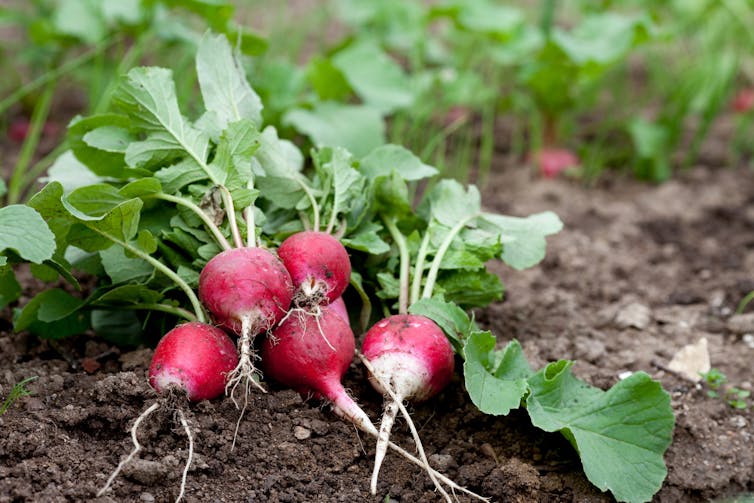 Radishes are among the plant foods that contain glucosinolates.
Shutterstock
Radishes are among the plant foods that contain glucosinolates.
Shutterstock
Putting it all together
While research progresses to identify how phytonutrients could help prevent disease and improve our health and well-being, eating a variety of phytonutrient-rich foods is part of having a balanced diet.
These foods have the highest total phytonutrient content:
Here are some ideas to include more of these foods in your meals and snacks:
buy a new herb or spice next time you’re at the supermarket — and use them in cooking regularly
try a spiced fruit compote. Simmer a mix of fresh, canned, dried or frozen fruit, including apples, peaches, apricots, or mixed berries with spices such as cinnamon, ginger, cloves or star anise. Store in the fridge and spoon over cereal or yoghurt
make a spice base by browning chopped onions in a frying pan with a splash of olive oil, crushed garlic and a teaspoon of dried herbs such as cumin, caraway, oregano, thyme or marjoram. Add to soups, sauces and casseroles
finely chop peppermint, spearmint or parsley and add to cooked peas, mashed potato and salads.
Read more: What is a balanced diet anyway?
Authors: Clare Collins, Professor in Nutrition and Dietetics, University of Newcastle
&media=https://www.dailybulletin.com.au/https://images.theconversation.com/files/357799/original/file-20200914-20-1023zd7.jpg?ixlib=rb-1.1.0&q=45&auto=format&w=754&fit=clip&description=Phytonutrients%20can%20boost%20your%20health.%20Here%20are%204%20and%20where%20to%20find%20them%20(including%20in%20your%20next%20cup%20of%20coffee) "Pin It")

 Daily Bulletin


