

We could be doing more to prevent vision loss for people with diabetes
- Written by: Clare Villalba, Service Designer and Researcher (PhD), Queensland University of Technology
Diabetes-related vision loss is the leading cause of blindness for working-aged Australians. Yet it’s almost entirely preventable.
A recent Australian study found only half of people with diabetes get the recommended annual eye checks.
We could be doing things better.
One of many complications
Around 1.7 million Australians have diabetes. Aboriginal and Torres Strait Islander people are three times more likely to develop diabetes than non-Indigenous Australians.
Diabetes occurs when glucose (sugar) in your blood is not converted into energy, so its level becomes too high. Blood glucose is our main source of energy and mostly comes from the food we eat.
Diabetes can be managed, for example through lifestyle modifications, medication, or insulin. Diabetes management will be a different experience for each person, and depend on the type of diabetes they have.
But the central aim is keeping blood sugar levels within a healthy range. When they’re not, people with diabetes are at higher risk of complications, which can affect all parts of the body.
The most common complication of diabetes — globally and for Australians — is eye disease.
Diabetes-related eye disease affects more than one in three people with diabetes. When left undiagnosed and untreated, it can cause vision loss and blindness.
What causes it?
Diabetes-related eye disease can occur when there is damage to the blood vessels on the retina, a thin layer at the back of the eye. This damage limits oxygen and other nutrients reaching the eye.
We need a healthy retina to be able to see.
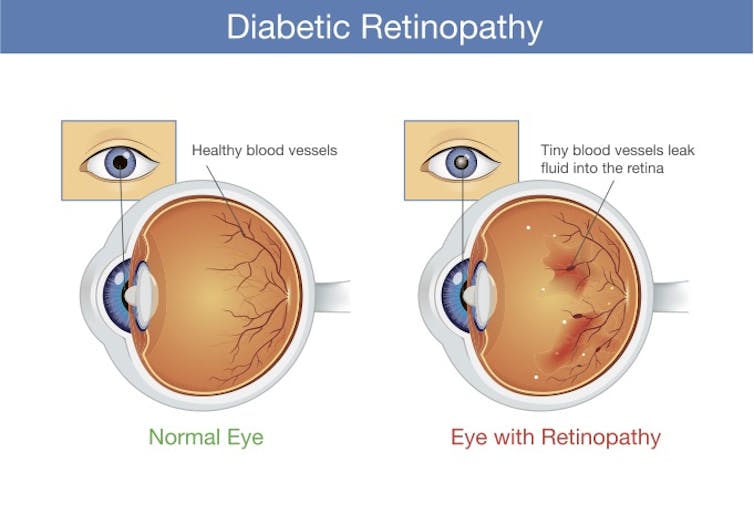 Diabetes-related eye disease can occur when the blood vessels at the back of the eye become damaged.
Shutterstock
Diabetes-related eye disease can occur when the blood vessels at the back of the eye become damaged.
Shutterstock
The chance of developing diabetes-related eye disease is higher for some people, including those who have high blood pressure, high cholesterol, or who have had diabetes for many years.
Worryingly, the study we mentioned above found people who had been living with diabetes for ten or more years were even less likely to get regular eye checks. Almost 80% of people in this group didn’t have the recommended annual eye check.
Prevention and treatment
When diabetes-related eye disease becomes more advanced, it can cause blurred or distorted vision and blindness. But we can prevent most diabetes-related vision loss before it reaches this stage.
Special cameras allow us to look at the retina and see if irregular spots or blood vessels are developing.
At this early stage the disease has no impact on a person’s vision. Once we detect it, we can provide timely treatment with laser therapy or injections.
But without regular eye checks, we might not know until it’s too late.
Read more: How Australians Die: cause #5 – diabetes
We have made progress
Strong social impact work from the government, not-for-profits and local health services is already preventing diabetes-related eye disease from developing into vision loss and blindness in many people.
2020 Australian of the Year, ophthalmologist James Muecke, cofounded the not-for-profit Sight For All and has brought attention to the issue of preventable vision loss for people with diabetes.
The federal government is investing in a national diabetes eye screening program, as well as primary health-care technology and training to embed retinal care in 105 existing health services across Australia. But national programs can put a blanket solution over the population.
When one Aboriginal and Torres Strait Islander health-care service introduced cameras in 2008, they screened 93% of regular clients with diabetes for eye disease — a significant improvement on 16% the previous year. But we found these rates subsequently declined and by 2016, only 22% had an eye check.
We can see just having the technology in primary care is not enough. Ongoing quality improvement is integral to a successful service in the long term.
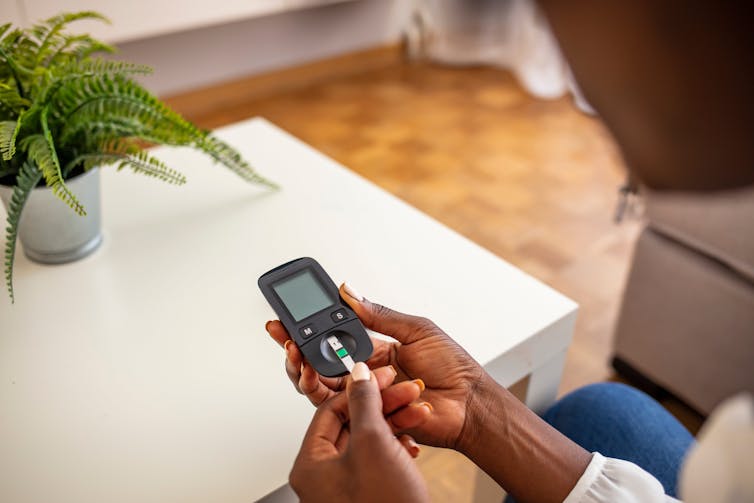 About 1.7 million Australians have diabetes.
Shutterstock
About 1.7 million Australians have diabetes.
Shutterstock
What else can we do?
In the case of diabetes-related eye disease, the science supporting early detection is advancing every day. But it’s not reaching those who need it the most, including Aboriginal and Torres Strait Islander people.
Having the technology, policy or medicine alone is not sufficient. We need to unlock the potential of communities, empowering everyone to have joint responsibility.
Read more: Words from Arnhem land: Aboriginal health messages need to be made with us rather than for us
A model of person-centred eye care would involve:
making screening and treatment easy to access for people with diabetes. This means addressing physical barriers, such as distance and cost, but also cultural, emotional and social barriers that might stop people from getting their eyes checked
-
thinking about the screening experience, including:
- before: how will we motivate people to get their eyes checked, especially if they’re not experiencing any problems with their vision?
- during: how can eye checks be streamlined with regular diabetes care, and how can we make the process as seamless as possible for patients?
- after: how do we ensure they come back every year?
considering the experience of the diverse teams providing this care, including keeping staff well equipped, trained and motivated
investing in researching, developing and testing the non-medical components of eye care services. For example, the reminder system, the workflow of each eye check, and how the results are delivered to patients.
We must pursue ongoing improvement of eye care that involves and empowers people with diabetes, their health teams and communities to develop services, systems, new technology and policies that meet their needs.
There is potential for us to prevent blindness in more people with diabetes.
Authors: Clare Villalba, Service Designer and Researcher (PhD), Queensland University of Technology


 Daily Bulletin


