

Ships moved more than 11 billion tonnes of our stuff around the globe last year, and it’s killing the climate. This week is a chance to change
- Written by: Christiaan De Beukelaer, Senior Lecturer, University of Melbourne
The shipping of goods around the world keeps economies going. But it comes at an enormous environmental cost – producing more CO₂ than the aviation industry. This problem should be getting urgent international attention and action, but it’s not.
This week, all 174 member states of the International Maritime Organisation (IMO) will discuss a plan to meet an emissions reduction target. But the target falls far short of what’s needed, and the plan to get there is also weak.
As other industries clean up their act, shipping’s share of the global emissions total will only increase. New fuels and ship design, and even technology such as mechanical sails, may go some way to decarbonising the industry – but it won’t be enough.
It’s high time the international shipping industry radically curbed its emissions. The industry must set a net-zero target for 2050 and a realistic plan to meet it.
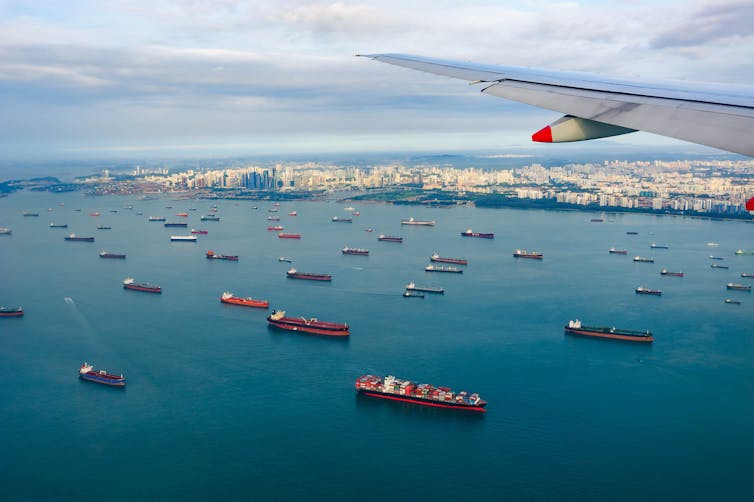 The shipping industry accounts for more carbon emissions than aviation.
Shutterstock
The shipping industry accounts for more carbon emissions than aviation.
Shutterstock
Shipping: by the numbers
Globally, more than 50,000 merchant ships ship about 11 billion tonnes of goods a year. In 2019 they covered nearly 60 trillion tonne-miles, which refers to transporting one tonne of goods over a nautical mile.
Per tonne-mile, carbon dioxide emissions from shipping are among the lowest of all freight transport options. But in 2018, shipping still emitted 1,060 million tonnes of CO₂ – 2.89% of global emissions. By comparison, the aviation industry contributed 918 million tonnes of CO₂, or 2.4% of the total.
And as international trade increases and other sectors decarbonise, global shipping is expected to contribute around 17% of human-caused emissions by 2050.
An emissions pariah
The IMO, which regulates the global shipping industry, did not set meaningful emissions reduction targets until April 2018. This is despite being requested to reduce emissions as far back as 1997 under the Kyoto Protocol.
The IMO has pledged to halve shipping emissions between 2008 and 2050 while aiming for full decarbonisation. By 2030, the carbon intensity (or emissions per tonne-mile) of individual ships should fall by 40%, compared with 2008 levels.
The IMO’s Marine Environment Protection Committee, is devising binding rules for the industry to achieve these emissions goals. Draft measures being considered this week focus solely on reducing the carbon intensity of individual ships. The plan has been slammed by critics because emissions reductions are not in line with Paris Agreement commitments of limiting global warming to 1.5℃ or 2℃ by 2100.
Read more: The shipping sector is finally on board in the fight against climate change
There are two main issues with the 40% emissions intensity target.
First, it’s not ambitious enough. Research suggests limiting warming to 1.5℃ requires the shipping industry to reach net-zero emissions. Merely reducing the carbon intensity of ships will barely make a dent in current emissions. Worse, even the best-case scenario will likely lead to a 14% emissions increase compared to 2008.
Second, the IMO has yet to say how it will meet its targets. The plan up for discussion this week is weak: not least because it lacks enforcement mechanisms.
 The IMO dragged its feet on setting an emissions target for the industry.
Shutterstock
The IMO dragged its feet on setting an emissions target for the industry.
Shutterstock
So how do we fix the problem?
Earlier this year, I sailed on the Avontuur. This 100-year-old two-masted schooner under German flag sailed from Germany to the Caribbean and Mexico to load 65 tonnes of coffee and cacao, then ship it under sail to Hamburg.
The round-trip took more than six months and 15 crew members. Roughly 169 million ships like the Avontuur would be needed to transport the 11 billion tonnes of goods moved by sea each year. It would require 2.5 billion crew, compared with 1.5 million today. Clearly, that is not realistic.
So how, then, do we solve the international shipping problem? Clean transport advocates say we must reduce demand for cargo transport by using what’s locally available, and generally consuming less and moving to a post-growth economy.
Read more: Plain sailing: how traditional methods could deliver zero-emission shipping
Some scientists concur, arguing either carbon intensity or shipping demand must come down – and probably both.
Ships can significantly reduce their emissions simply by slowing down. Carbon emissions increase exponentially when ships travel above cruising speed. But the industry seems unwilling to pick this low-hanging fruit, perhaps because it would compromise just-in-time supply chains.
Ships commonly burn huge amounts of heavy fuel oil. Emerging fuels, such as hydrogen and ammonia, have the potential to cut emissions from ships. But producing these fuels may create substantial emissions, and adopting new fuels would require building new ships or retrofitting existing ones.
Existing vessels can also be retrofitted with more efficient propulsion mechanisms. They could also be fitted with wind-assist technologies such as sails, rotors, kites, and suction wings. Research suggests these technologies could reduce a ship’s emissions by 10–60%.
And new designs for sail-powered cargo vessels are emerging. But these ships are yet to be built and it may be a long time before they are widely used.
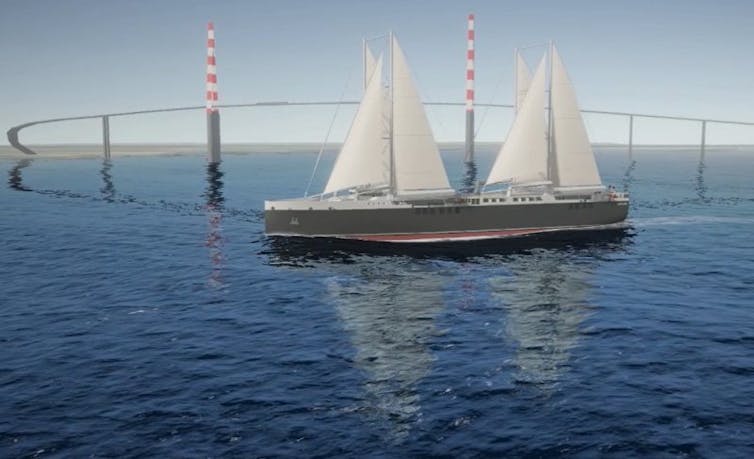 Sail-powered cargo vessels can help slash global emissions.
Neoline
Sail-powered cargo vessels can help slash global emissions.
Neoline
Looking ahead
Technological solutions on their own will not bring the necessary emissions reductions. New technologies must be embraced immediately, and ambitious regulation is necessary. Industry and consumer demand for shipped goods must fall as well.
Earth’s remaining carbon budget is fast shrinking and all industry sectors must do their fair share. At this point in the climate crisis, further delays and weak targets are inexcusable.
Authors: Christiaan De Beukelaer, Senior Lecturer, University of Melbourne


 Daily Bulletin


