

A year without NAPLAN has given us a chance to re-evaluate how we gauge school quality
- Written by: Ilana Finefter-Rosenbluh, Lecturer, Faculty of Education, Monash University
This has been a year of schools closing and a rapid switch to online learning. It’s also been a year with no NAPLAN. The cancellation of the National Assessment Program – Literacy and Numeracy due to COVID marked the first interruption of the annual testing cycle since 2008.
NAPLAN is a standardised test, conducted yearly for students across the country in Years 3, 5, 7 and 9. It has been used by teachers, schools, education authorities, governments and the broader community to see how children are progressing against national standards in literacy and numeracy — and over time.
After the changes COVID brought to education, policymakers have an opportunity to rethink our national “high-stakes” testing system that focuses on literacy and numeracy skills. It often leads teachers to “teach to the test”, rather than ensuring students leave school with a well-rounded set of skills.
NAPLAN scores are used to gauge the quality of schools. But the overemphasis on only literacy and numeracy scores stands in the way of providing a more holistic education. We need a system that delivers confident citizens and creative problem solvers. And that means re-evaluating what we mean by a good quality school.
A history of NAPLAN and My School
Over a decade ago, Australian leaders envisioned a national system that assesses school quality. In 2010, led by Education Minister Julia Gillard, the Australian Curriculum, Assessment and Reporting Authority (ACARA) launched the My School website.
The move was influenced by countries such as the US and UK, which employ formal and non-formal school rankings to show the quality of schools. My School did this by reporting NAPLAN data, accompanied by up-to-date information such as schools’ missions and finances.
Julia Gillard still stands behind her controversial decision, while acknowledging the system’s serious problems. These include its overemphasis on the test, rather than a focus on the processes of learning and inquiry.
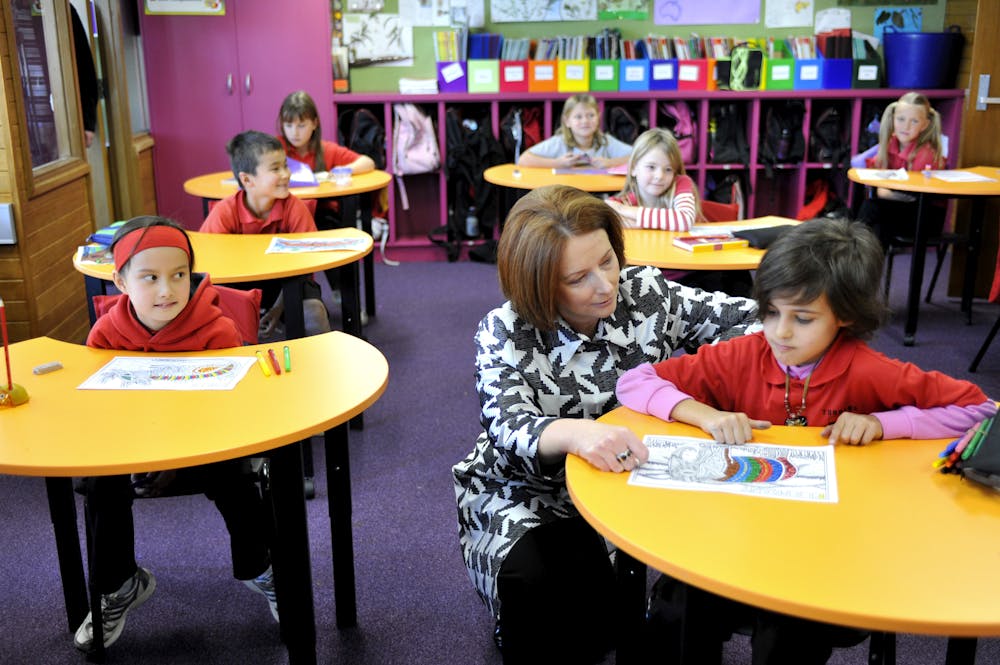 Julia Gillard still stands behind her decision to introduce NAPLAN and My School.
AAP/ALAN PORRITT
Julia Gillard still stands behind her decision to introduce NAPLAN and My School.
AAP/ALAN PORRITT
Research shows the “teach to the test” approach can narrow the curriculum focus and make it harder to cater for students’ various needs. It can limit opportunities for students to engage with the materials in ways that develop their learning and critical thinking skills.
Read more: Too many adjectives, not enough ideas: how NAPLAN forces us to teach bad writing
A change to the My School website
While educators lamented the negative impacts of NAPLAN, parents have constantly complained the My School system left them confused, feeling as if they were sitting in a test themselves. The Council of Australian Governments (COAG) commissioned a review of NAPLAN.
The very long review process consisted of public submissions, focus groups and interviews with stakeholders, parents and unions. The resulting report showed a relatively unified confusion around the purpose of NAPLAN and My School.
It also showed concerns about displaying test scores alongside the school’s socioeconomic index. This amplified the fact students in the most disadvantaged areas were substantially more likely to score below the national minimum standard for each of the test’s three domains than those in more advantaged areas.
Read more: Not all parents use NAPLAN testing in the same way – and it may be related to their background
ACARA simplified the website, noting the changes agreed to by education ministers after the review’s report came out.
Before, it compared a school’s NAPLAN result against the average result of 60 similar schools. Now, a school’s results are benchmarked against the average NAPLAN score of all students across the country with a similar background.
The website seeks to provide a greater focus on student progress (using NAPLAN results), rather than on statistical comparisons. So, before entering My School, the user must accept a list of terms, which acknowledge:
the content on this site about the performance of a school on any indicator including the National Assessment Program ─ Literacy and Numeracy (NAPLAN) tests is only one aspect of the information that should be taken into consideration when looking at a school’s profile.
This statement is followed by another about the importance of speaking to “teachers and principals to get an understanding of what each school offers”. Both of these suggest there has to be more to a national system to provide meaningful information that supports transparency and accountability of Australian schools.
This notion is clearly reflected in other Australian education policies, including in the report from the Review to Achieve Educational Excellence in Australian Schools (also known as Gonski 2.0). The report urges the education system to be more creative in the curriculum, assessment and reporting.
How can the system be improved?
It would be foolish to say there is an easy silver bullet assessment solution. But it may be worthwhile to consider some international initiatives.
All 50 US states have established educational measurement systems based on standardised testing. These have been heavily criticised for hurting schools and students. Criticisms include concerns over widespread cheating issues and schools’ inflating test scores to create the illusion of improved equity and school quality.
Read more: What makes a school good? It's about more than just test results
US scholars lamented the nation’s “testing charade” and its measuring too little about schools and too much about families and neighbourhoods. They sought to look beyond a single test, suggesting a novel assessment framework that paints a more nuanced picture of schooling.
The framework explores what many would agree are crucial aspects of education. Aside from literacy and numeracy scores, they include:
student-teacher relationships
physical and emotional safety
a sense of belonging
student engagement and achievement
problem solving
relationships between the family and school
cultural responsiveness
social and emotional health
community involvement.
These are measured through the use of tools such as administrative data and student and teacher surveys. One such alternative system can be found, among others, in Massachusetts, US.
Research on pilots of such a framework show a less deterministic relationship between school quality and students’ socio-economic status.
Standardised tests can be useful for educators and policymakers who seek to track some student progress and allocate resources. But these tools are limited in what they tell us and can be misleading.
Creating a new schooling framework that has a less deterministic relationship between school quality and students’ socio-economic status will be challenging. But it is possible and worthwhile in the long run.
Authors: Ilana Finefter-Rosenbluh, Lecturer, Faculty of Education, Monash University


 Daily Bulletin


