

Australia needs a national approach to combat the health effects of climate change
- Written by: Stephen Duckett, Director, Health Program, Grattan Institute
Australia has just recorded its hottest November on record, only months after the devastating bushfires of last summer that ruined the lives and livelihoods of thousands.
Climate change is doing its deadly work. Australia is already about 1.5℃ warmer than it was 100 years ago, and there is worse to come.
As our continent continues to warm, we will have to endure harsher heatwaves and more severe storms. The cyclones in our far north will be more intense, causing floods that will destroy homes, businesses and lives.
Health authorities need to do more. The federal health department says its vision is “better health and wellbeing for all Australians, now and for future generations”. Yet there is little mention of the greatest health risk facing our future generations: climate change.
Currently, what the World Health Organisation calls one of the world’s greatest health risks doesn’t rate a mention in Australia’s Long Term National Health Plan, or the Department of Health’s forward-looking Corporate Plan.
The department’s A$5 billion investment plan for the Medical Research Future Fund describes 20 funding initiatives for the next decade and identifies “areas of national priority”. But it doesn’t once mention climate change.
Why the silence?
At the national level, there is an evident unwillingness to speak about the damage climate change is already doing to Australians’ health. And things are only going to get worse.
The Grattan Institute has today released a report that identifies ways the health sector should adapt to the changing climate in Australia.
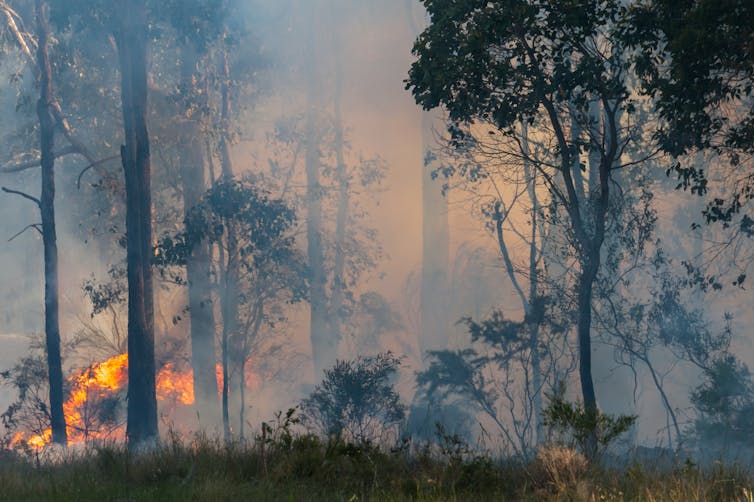 Bushfires can have many and varied effects on human health.
Shutterstock
Bushfires can have many and varied effects on human health.
Shutterstock
The coronavirus pandemic provides a model. Australia’s response to COVID-19 was led by a national cabinet and informed by the national and state chief medical and health officers, meeting as the Australian Health Protection Principal Committee (AHPPC).
Our political leaders listened to the science presented by these expert advisers. They used this evidence and advice to make unprecedented decisions in unprecedented times to protect the lives and livelihoods of millions of Australians.
They must do the same with climate change. Governments should establish a “climate change and health” subcommittee of the AHPPC, tasked with generating research and providing advice on climate change adaption and mitigation.
The new subcommittee should incorporate research that touches on climate change and is already done by existing committees such as the Communicable Diseases Network Australia, the Environmental Health Standing Committee, and the National Health Emergency Standing Committee. Officials on the climate change and health subcommittee should meet regularly, share strategies, and encourage coordinated and consistent national action where appropriate.
Read more: The rise of 'eco-anxiety': climate change affects our mental health, too
Time to step up
More must be done at the national level. The Commonwealth Department of Health must add the health risks posed by climate change to its priority list. Climate change should feature prominently in its Long Term National Health Plan and in its National Preventive Health Strategy, currently in development, to ensure proper resources are made available.
All governments should ensure the health sector incorporates climate change into risk assessments and disaster planning. This could be done by mandating a new requirement in the National Safety and Quality Health Service Standards for health services to assess climate change risks.
 Australia should take lessons from its COVID response in addressing the impact of climate change on health.
James Ross/AAP
Australia should take lessons from its COVID response in addressing the impact of climate change on health.
James Ross/AAP
With the world’s sixth-largest landmass spanning a wide variety of climates, Australia faces a unique combination of climate-related health challenges. Our research institutions must get more support to pursue climate-health knowledge. Between 2013 and 2020, the National Health and Medical Research Council (NHMRC) awarded less than A$2 million out of A$6.3 billion to climate-and-health research topics — just 0.03% of the total.
After years of little interest, the NHMRC has just announced A$10 million in dedicated funding to “improve Australia’s preparedness and responsiveness to human health threats from changing environmental conditions and extreme weather events”, to begin in 2021. This is a step in the right direction, but Australia will need to provide much more support for climate change and health research.
The Medical Research Future Fund investment plan should have a dedicated focus on climate change and health research, so Australia’s researchers can help us all better understand our problem.
In the coming years and decades, Australia’s climate will become more dangerous and destructive. In 2020, with strong leadership and evidence-based decision-making, Australia had remarkable success in confronting the challenges of COVID-19. Now we must do it again on climate change.
Read more: Car accidents, drownings, violence: hotter temperatures will mean more deaths from injury
Authors: Stephen Duckett, Director, Health Program, Grattan Institute


 Daily Bulletin


