

Home-delivered food has a huge climate cost. So which cuisine is the worst culprit?
- Written by: Robert Crawford, Associate Professor in Construction and Environmental Assessment, University of Melbourne
Over the past few years, Australians have embraced online food delivery services such as UberEats, Deliveroo and Menulog. But home-delivered food comes with a climate cost, and single-use packaging is one of the biggest contributors.
Our research found Australians placed 27 million online food orders in 2018. By 2024, this number is projected to increase to 65 million.
The increasing use of take-away food packaging associated with online meal deliveries is making the food sector’s already massive carbon footprint even larger. Of the five cuisines we examined, packaging from burger meals was responsible for the most emissions, followed by Thai meals.
Last year, lockdowns related to COVID-19 led to a 20% increase in household solid wastes due in part to increased food deliveries. The climate crisis and problems facing Australia’s waste management sector mean we must urgently reduce waste from meals ordered online.
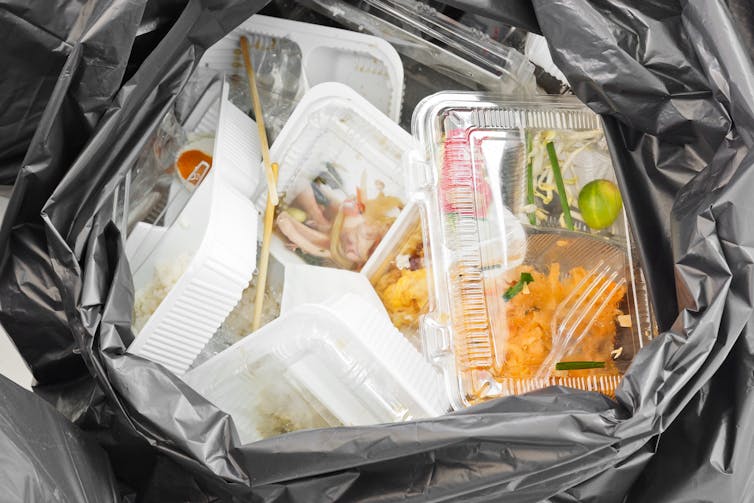 Australians have embraced online food deliveries, but this has caused a waste problem.
Shutterstock
Australians have embraced online food deliveries, but this has caused a waste problem.
Shutterstock
A growing problem
Technology, income and lifestyle changes mean fewer people are cooking at home or dining in restaurants, and more are having food delivered to their door. Some 9.4 million Australians are now registered users of online food delivery services, according to business data platform Statista.
In most cases, online food deliveries require single-use packaging. Producing, transporting and disposing of this packaging requires large quantities of energy and raw materials. Those materials release emissions as they break down in landfill or the environment, or are burned.
Read more: Using lots of plastic packaging during the coronavirus crisis? You're not alone
Our research found in 2018, the disposal of single use packaging from online food orders in Australia led to 5,600 tonnes of carbon dioxide-equivalent (CO₂-e) emissions. The sector is growing by more than 15% each year, which means the packaging emissions will reach 13,200 tonnes of CO₂-e in 2024.
 Online food deliveries are set to increase in coming years.
Shutterstock
Online food deliveries are set to increase in coming years.
Shutterstock
Emissions by cuisine
Our study quantified how much greenhouse gas is emitted over the life of food packaging used in online food delivery. Specifically, we examined five popular cuisine types: pizzas, burgers, Indian, Thai and Chinese.
The results, from lowest to highest, are presented below, in terms of carbon dioxide equivalent (CO₂-e):
Chinese: 0.16kg CO₂-e for a plastic container and plastic bag
Indian: 0.18 kg CO₂-e for a plastic container, paper bag and cling film
Pizza: 0.20g CO₂-e for a cardboard box
Thai: 0.23 kg CO₂-e for a plastic container and paper bag
Burger meal: 0.29 kg CO₂-e for a paper bag, paper boxes, plastic straw, liquid paperboard cup with plastic lid and cardboard cup holder.
The typical meal from each restaurant was determined, and the packaging assessed. Obviously, the exact packaging used varies according to the specific order, restaurant and customer preferences, and individual meals may have a carbon footprint higher or lower than average for that cuisine.
We also found a brown paper delivery bag produces far more emissions than a plastic bag, due to the carbon released when it breaks down. However plastic bags generally create more litter and are more toxic to the environment than paper bags.
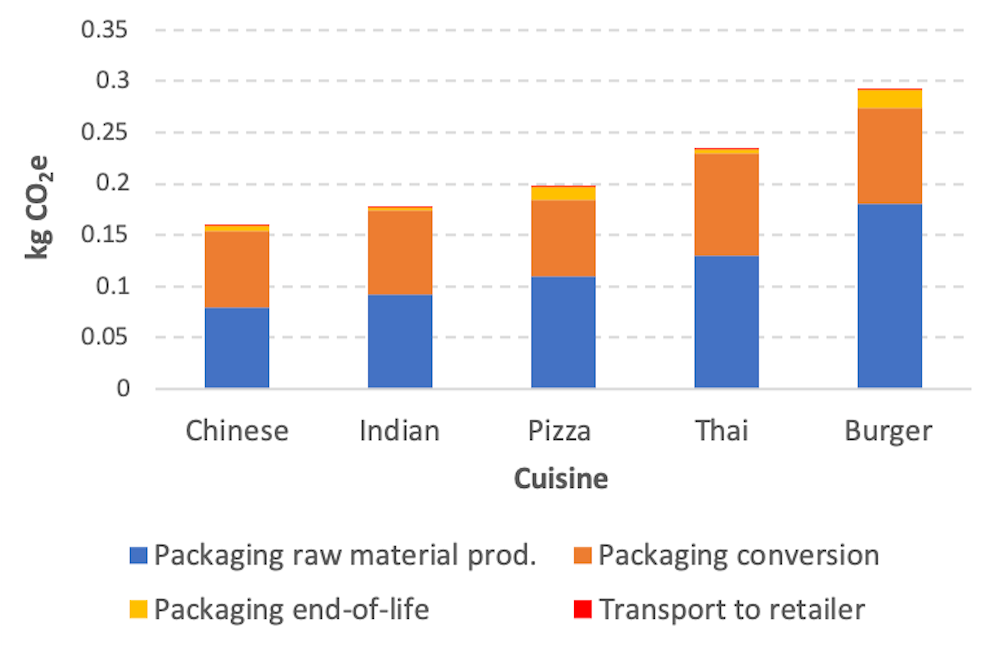 Greenhouse gas emissions associated with packaging per order, by cuisine and life cycle stage.
Worst packaging culprits
Our study found the production of the raw materials used in packaging – that is, fuels for plastic and wood pulp for paper and cardboard – contributes more than 50% of the total packaging emissions. Converting the raw materials into packaging products is the next highest contributor, at between 32% and 48%.
Replacing virgin raw materials with recycled content can reduce production emissions, but only by about 10%, due to the energy required in the recycling process. So reducing packaging use is more important than increasing the recycled content of materials.
Read more: Australia's waste export ban becomes law, but the crisis is far from over
We also found the packaging disposal method can dramatically influence emissions. We assumed typical recycling rates of between 18% and 77%. However, if all packaging is sent to landfill, disposal-related emissions may increase by up to 15 times compared to the typical disposal scenario.
Paper-based packaging had the greatest disposal emissions due to its high carbon content. If all packaging materials are incinerated, then disposal emissions can be up to 49 times higher than the typical disposal scenario.
Plastics produce least emissions when disposed in landfill as opposed to recycling or incineration. And organic material such as paper and paperboard produce more emissions when disposed to landfill than if recycled or incinerated. So a material-specific approach to waste disposal and processing is important.
 Organic packaging materials are not a panacea for the waste problem.
Shutterstock
Organic packaging materials are not a panacea for the waste problem.
Shutterstock
The way forward
The task of reducing single-use packaging has been made more urgent by new federal laws banning the export of unprocessed waste from Australia.
Increasing and improving waste recovery and processing infrastructure will help divert waste from landfill. However, packaging production – with both virgin and recycled raw materials – is very emissions-intensive. So producing less packaging in the first place is key to significant emissions reduction.
Online food delivery service providers should make it easier for customers to opt out of certain packaging products, such as bags and utensils. Investment in more environmentally friendly packaging options is also crucial.
Customers have a role to play, and consumer awareness and education campaigns will be important here. Refusing packaging where possible or choosing more eco-friendly options will also help to reduce single-use packaging emissions.
This article draws on research by former University of Melbourne Masters student Indumathi Arunan.
Read more: Recycling is not enough. Zero-packaging stores show we can kick our plastic addiction
Authors: Robert Crawford, Associate Professor in Construction and Environmental Assessment, University of Melbourne


 Daily Bulletin


