

Crimes at sea: when we frame illegal fishers as human and drug smugglers, everyone loses
- Written by: Britta Denise Hardesty, Principal Research Scientist, Oceans and Atmosphere Flagship, CSIRO
Illegal, unreported and unregulated fishing costs economies up to US$50 billion globally each year, and makes up to one-fifth of the global catch. It’s a huge problem not only for the 59.5 million people who depend on fisheries for their livelihoods, but also for the environment.
Many philanthropic and environmental organisations think of illegal fishing as a “transnational crime”, involving organised criminals operating vessels on the high seas, smuggling drugs, weapons and people.
But our research found this depiction is, by and large, not true.
When illegal fishing is falsely represented like this, it can lead to ineffective investments and misguided policies, such as the requirement of over-the-top transparency and the criminalisation of desperate fishers.
The reality at sea looks very different
Most crimes associated with fishing are actually related to increasing fishing revenues or decreasing operating costs — not human, weapons and drug trafficking.
We looked at more than 300 events of illegal fishing reported in the media across the Asia-Pacific region, where over 50% of the world’s seafood comes from. And we found only six events involved additional associated crimes like drug possession.
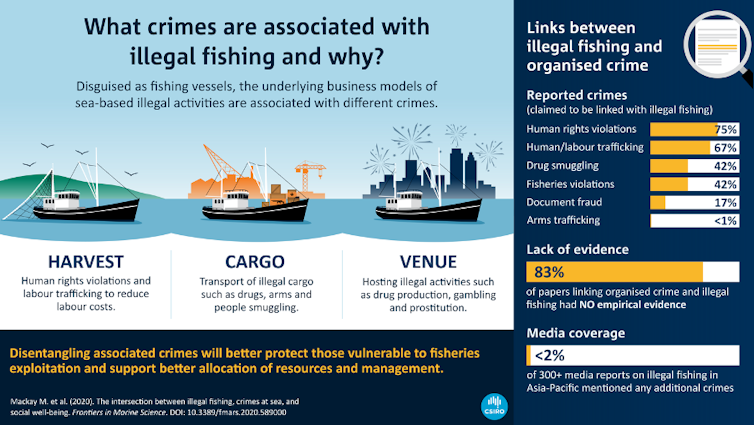 The crimes associated with fisheries at sea. There are separate business models linked to different crimes with minimal evidence of mixing across them.
Visual knowledge
The crimes associated with fisheries at sea. There are separate business models linked to different crimes with minimal evidence of mixing across them.
Visual knowledge
Serious crimes still do occur on fishing vessels, such as human rights abuses linked to reducing labour costs, or the use of illegal gear to increase catches and revenue. However, these crimes fall within a fishing business model where, ultimately, a lack of profitability drives illegal behaviour.
This lack of revenue is a result of the over-exploitation and mismanagement of fish stocks, and is exacerbated by the effects of climate change on the distribution of fish.
Read more: It might be the world's biggest ocean, but the mighty Pacific is in peril
Such illegal behaviour does have serious consequences, as shown in Buoyancy, a 2019 film about forced labour on Thai fishing boats.
While the film is fictional, it’s inspired by the true conditions and events that can happen at sea, after the writer-director interviewed fishers who’d been trafficked on trawlers. He said while the ill treatment of workers portrayed in the film is extreme, it’s a mild version of the reality.
Buoyancy is inspired by the real-life plight of workers sold into Southeast Asia’s fishing industry.We surveyed Vietnamese fishers for our research. They told us fish stock depletion in domestic waters and their displacement from disputed waters in the South China Sea means they’re driven as far afield as Palau and Australia in search of catches.
This is illegal, as these fishers are not permitted to catch fish in these countries.
The fishers say they are aware of the high chance of being caught, and feel shame at home when they’re convicted for illegal fishing. Still, the need to make a living forces these marginalised people to make risky choices.
When transparency is too radical
A popular proposal for addressing illegal, unreported and unregulated fishing has been increasing the transparency of fisheries. For example, environmental NGOs are pressing countries to share vessel tracking data and, in some cases, making this data publicly available.
While transparency can help reduce illegal fishing, the key question is: transparency at what cost?
Public ship-tracking data reveals fishing locations to competitors. For fishers, knowledge of these locations informs their business, and being forced to share it undermines their competitive advantage.
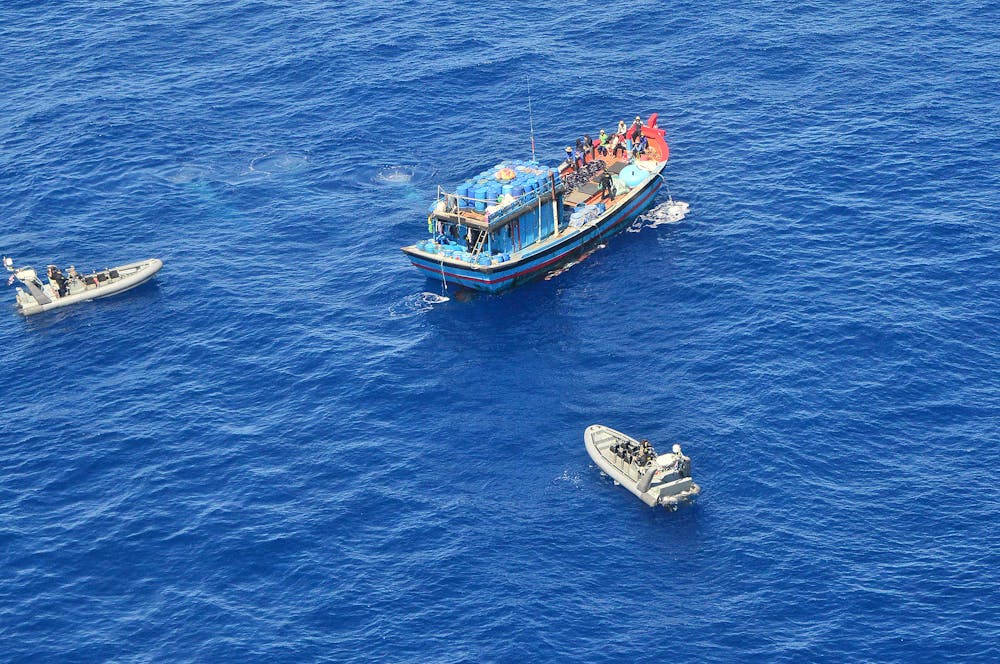 A Vietnamese illegal fishing vessel in the Coral Sea being intercepted by Australian Border Force.
AAP Image/Department of Immigration and Border Protection
A Vietnamese illegal fishing vessel in the Coral Sea being intercepted by Australian Border Force.
AAP Image/Department of Immigration and Border Protection
Likewise, the use of surveillance also comes with big caveats. Organisations working to fight illegal fishing commonly use anti-collision messages that vessels send each other to track vessels without their consent.
Re-purposing this safety system for the surveillance of fishing vessels may undermine its effectiveness for increasing safety at sea. Even vessels operating legally may not want their positions posted on publicly available websites.
Read more: Poor Filipino fishermen are making millions protecting whale sharks
Yes, data sharing and oversight is necessary among consumers, the supply chain and the regulators. But it’s unclear why outside parties, indeed the public, need access to this data.
Compare this to online fraud: web servers aren’t required to make all data on users and content publicly available. Just as e-commerce is a legitimate activity, and those in the system are entitled to protect their commercial advantages, so is fishing a legitimate activity with similar rights, within a well-regulated system.
In the end, oversight is essential for a well-functioning regulatory system, but so-called “radical transparency” is counterproductive.
Investing wisely
The member countries of the United Nations have committed to address illegal fishing as a component of the UN Sustainable Development Goals. But as the clock is ticking toward the 2030 delivery date, a clear-eyed assessment of the link between the problem and solutions is needed.
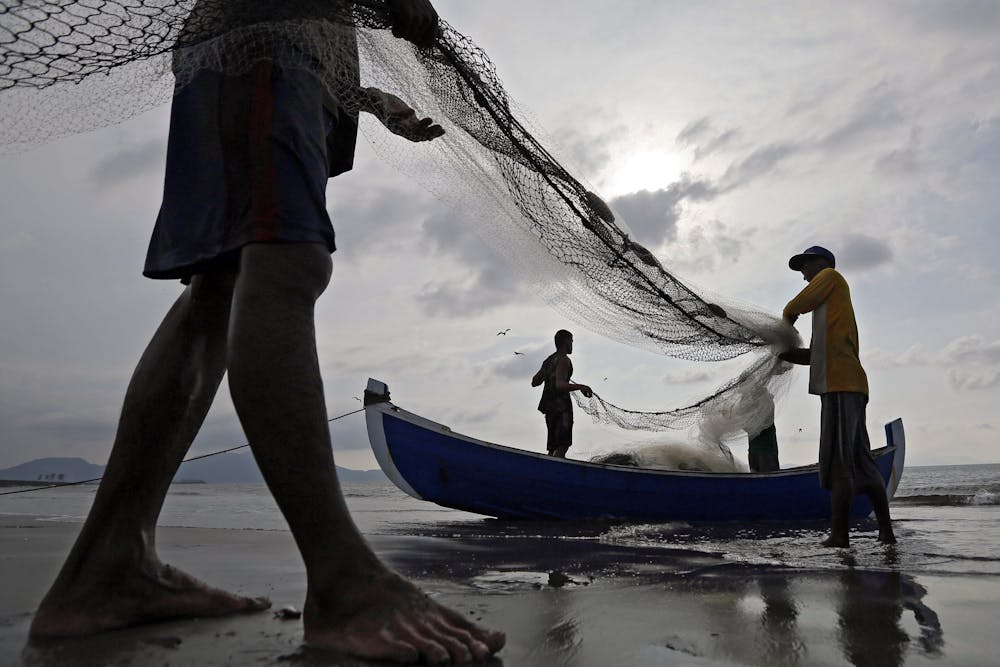 Oversight is essential for a well-functioning regulatory system, but so-called ‘radical transparency’ is counterproductive.
EPA/HOTLI SIMANJUNTAK
Oversight is essential for a well-functioning regulatory system, but so-called ‘radical transparency’ is counterproductive.
EPA/HOTLI SIMANJUNTAK
All those involved in combating illegal, unreported and unregulated fishing should have a clear understanding of what illegal fishing is, its drivers and participants, what crimes are likely associated with it, and what the most effective solutions are.
Confusing smugglers using former fishing vessels with fishers, or making investments in radical transparency and surveillance that make enforcement more complicated, are counterproductive.
Read more: US-China fight over fishing is really about world domination
To help government and industries across the world address illegal fishing, we need more investment in better targeted data analysis and technologies and to build the skills of surveillance officers to improve identification of illegal fishing.
This would allow us to focus money and time to understand and solve the complex challenge illegal fishing poses. Given the limited scale of funding for combating illegal fishing and meeting the UN Sustainable Development Goals, it’s critical the global community invests wisely.
Authors: Britta Denise Hardesty, Principal Research Scientist, Oceans and Atmosphere Flagship, CSIRO


 Daily Bulletin


