

As the world's attention and money are absorbed by the COVID pandemic, peacebuilding suffers
- Written by: Eleanor Gordon, Senior Lecturer in Politics and International Relations, Monash University
Resources critical to peacebuilding and to countries vulnerable to conflict have been significantly reduced as a result of COVID-19.
In conflict zones from Ukraine to Syria, hundreds of thousands of people are “suffering in silence”. These conflicts risk becoming “forgotten crises”, and are intensifying as states and non-state armed groups utilise the pandemic and a distracted international community for their own strategic advantage.
The figures are alarming. For instance, foreign direct investment “collapsed” in 2020, according to the UN Conference on Trade and Development (UNCTAD), falling by 42% to an estimated US$859 billion (compared with US$1.5 trillion in 2019). Many humanitarian organisations have also recorded a dramatic drop in donations from private individuals and fundraising activities, or expect private donations will decline as the global recession hits.
Profound cuts to foreign aid are anticipated as countries continue to invest heavily in COVID-19-related activities while facing severe economic recession.
Already, several governments, including the UK, have announced major cuts to aid budgets in light of COVID-19. A decline in public support for foreign aid, typical in times of financial crisis, is also likely to encourage cuts. This in turn is likely to have a negative effect on peacebuilding, which is already underfunded.
Evidence suggests that committed foreign aid being redirected from peacebuilding programs into efforts to deal with COVID-19 is likely to have even more of an impact on the ground than a decrease in foreign aid. The UK, US, France andAustralia, for instance, have announced a reorientation of their aid commitments to medical infrastructure.
A further reduction in funding and troops for UN peacekeeping missions is also likely. This is in turn predicted to reduce the capacity of peace operations by 30-50% over the next year or two.
Declining funds hit aid organisations hard
A global survey of organisations engaged in peacebuilding was conducted to assess the impact of these cuts on the ground. In the survey, 62% said they or their organisation had experienced a reduction in funding for peacebuilding work. In addition, 71% said COVID-19 had, or was likely to have had, a negative impact on the financial security of their organisation. Other global surveys have had similar results.
Reduced funds will also inevitably affect employment and job security for these organisations. The survey found 74% felt their work was more precarious, while 56% knew of someone in the sector who had lost a job as a result of the pandemic.
On top of this, 75% said the focus of their work has changed. They referred to “strong signals” given by donors to “pivot” activities towards COVID-19-related issues, even if other needs were perceived to be more pressing.
Impact on conflict zones
The reduction in resources comes when they are most needed. This is because COVID-19 and its effects (economic shocks, unemployment, extreme poverty and vaccine inequalities) worsen conflict situations. These negative impacts are likely to intensify as the pandemic persists.
Following a short decline after the pandemic was declared in March 2020, conflicts in several countries increased again. This notably often takes the form of violence against civilians by state forces and militias.
Escalating insecurity has already been witnessed in several conflict zones – Syria, Colombia, Somalia, Yemen, Nigeria, Burkina Faso, Afghanistan, Philippines and Myanmar – as states and non-state armed groups exploit the pandemic to their own strategic advantage.
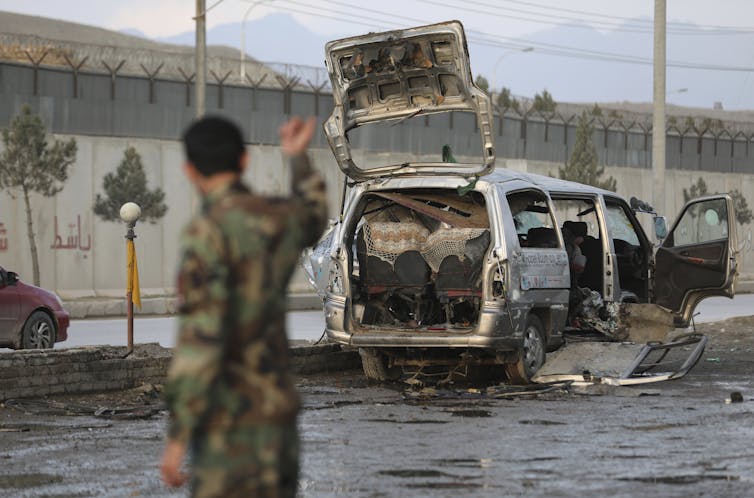 Countries where there is conflict, such as Afghanistan, are suffering as other countries divert funds away from foreign aid to fighting the pandemic.
AAP/AP/Rahmat Gul
Countries where there is conflict, such as Afghanistan, are suffering as other countries divert funds away from foreign aid to fighting the pandemic.
AAP/AP/Rahmat Gul
Many of the ceasefires declared in response to the United Nations secretary-general’s call for a global ceasefire in March 2020 have fallen apart.
Read more: UK government's foreign aid cuts put girls' education at risk
From pivoting to preparedness
COVID-19 has exposed weaknesses in global governance, especially in terms of preparedness and threat mitigation. To address these weaknesses, countries need to invest in preparedness, be aware of the complex interconnectedness of security threats, and avoid knee-jerk reactions to singular risks that divert attention and resources away from longer-term threats.
There is also a need to communicate more effectively to the public about how aid budgets are spent. This includes stressing how aid programs benefit donor as well as recipient countries, given public opinion can be a key factor in determining whether aid budgets are reduced.
The increased risk of armed conflict, as a result of the diversion of resources and attention towards COVID-19, has global repercussions. So, too, does the difficulty in controlling COVID-19 within conflict zones and beyond their often-porous borders, until a widely accessible vaccine becomes available to the most disadvantaged people.
Authors: Eleanor Gordon, Senior Lecturer in Politics and International Relations, Monash University


 Daily Bulletin


