

'Fortress Australia': what are the costs of closing ourselves off to the world?
- Written by: Natasha Kassam, Director, Lowy Institute's Public Opinion and Foreign Policy Program, and Fellow, National Security College’s Futures Council, Australian National University
Prime Minister Scott Morrison said on the weekend Australia’s borders will remain closed for the foreseeable future, only reopening “when it is safe to do so”. He told the Daily Telegraph:
We sit here as an island that’s living like few countries in the world are at the moment. We have to be careful not to exchange that way of life for what everyone else has.
It is true life in Australia has been unlike most places in the world for the past few months, even the past year. But what are the costs of becoming “Fortress Australia”?
As border closures have remained in effect for 15 months and counting, there are mounting concerns this is having implications for Australia’s national character. And serious questions need to be asked about the message Australia is sending to the rest of the world by shutting everyone out.
Only half of Australians say the country is more united now
There has been broad acceptance in the Australian community of stringent public health measures — including restrictions on outbound travel — as the price to pay for beating COVID-19. And almost all Australians (95%) say Australia has done a good job handling the pandemic. This stands in contrast to Australians’ view of how most other countries have handled the pandemic, especially the United States and United Kingdom.
And Australians have generally been patient about closed borders. Four in ten say they support the government’s current policies, though the same number say vaccinated Australians should be able to leave the country. Only 18% say all Australians should be able to leave the country now.
Australians have been similarly pragmatic about their fellow citizens being stranded overseas. The majority of Australians (59%) say the government has done the right amount in getting Australians home. Only a third say Australia has not done enough.
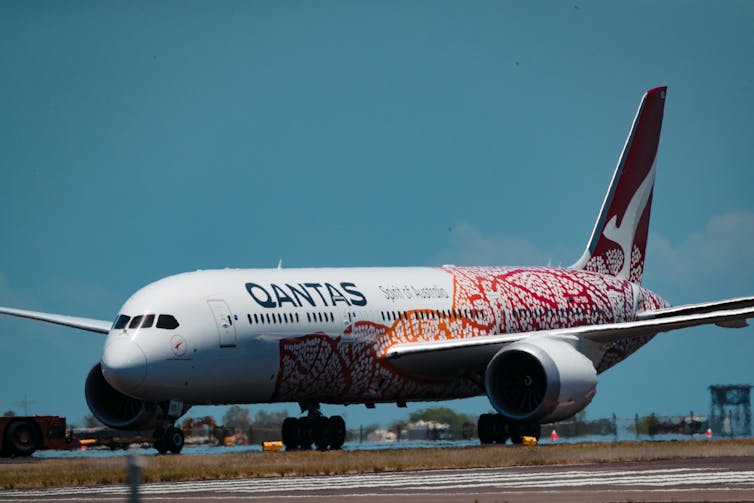 Nearly 40,000 Australians based overseas have registered with the government saying they want to return urgently.
Charlie Bliss/AAP
Nearly 40,000 Australians based overseas have registered with the government saying they want to return urgently.
Charlie Bliss/AAP
But we are split as to whether the pandemic has been a boon for national unity and social cohesion. Half of Australians say the country is more united than before the outbreak, while four in ten say the country is more divided.
For much of the world, COVID-19 may have marked the end of peak globalisation. Domestic politics around the world have centred on a growing hostility to global institutions and trade competition, which were beginning to be evident long before the pandemic.
Yet, even a pandemic borne in part by international connections hasn’t shaken Australia’s belief in globalisation. During the national lockdown in 2020, seven in ten Australians said they believed globalisation is mostly good for the country.
In addition, Australians have historically been supportive of free trade and immigration. Even during the pandemic, the vast majority of people agreed that accepting immigrants from many countries makes Australia stronger, and that multiculturalism has been good for the country.
Read more: Australia's mishmash of COVID border closures is confusing, inconsistent and counterproductive
Duelling images of Australia
At the same time, tough borders have always been good politics. In part, this plays off the anti-migration sentiment that exists within a minority of the country, and a bipartisan need to demonstrate national security credentials.
When WA Premier Mark McGowan said early in the pandemic, “we will be turning Western Australia into its own island, within an island - our own country”, he was rewarded mightily with some of the highest approval ratings in Australia.
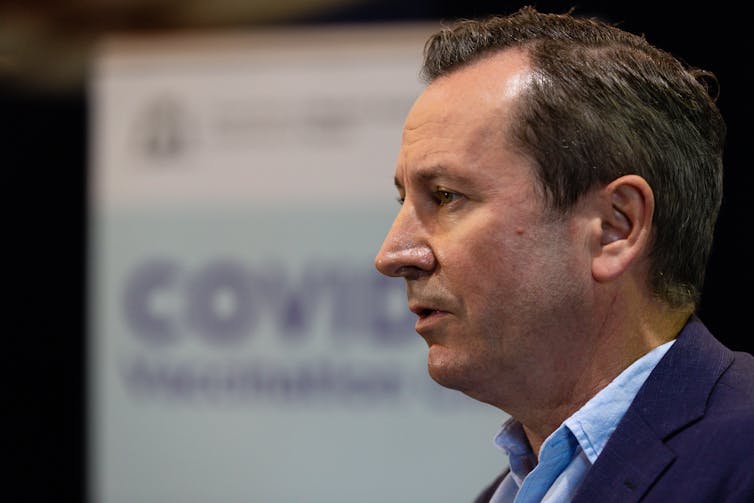 McGowan defended his state’s border policies after NSW Premier Gladys Berejiklian called such closures an ‘embarrassment’.
Richard Wainwright/AAP
McGowan defended his state’s border policies after NSW Premier Gladys Berejiklian called such closures an ‘embarrassment’.
Richard Wainwright/AAP
So, what does it tell the world as Australia proudly projects its image as quite literally that of an island? Or is this outweighed by the soft power advantage of telling the world that we have, for all intents and purposes, defeated COVID-19?
Perhaps the answer is somewhere in between: it is a sign something has gone awry that these two propositions have become mutually exclusive.
Australians have been told by their leaders they can have safety and security from the virus while being closed off from the world, or they can open up to the world and face the same risks everyone else does.
But this stands in contrast to the open trading nation we have always portrayed ourselves to be.
There are concerns Australia is also at risk of being left behind as the rest of the world gets vaccinated and back to normal.
A recent McKell Institute report says Australia’s current vaccination rate will see international border restrictions remain in place for an additional 81 days, at a cost of A$16.44 billion to the economy.
Countries that have struggled through the pandemic, meanwhile, are on track to reopen their borders thanks to their vaccination rollouts. The United Kingdom, for instance, has introduced a traffic light system for international travel and the European Union expects to resume leisure travel by June.
Isolation not the only path to success
Australians’ views on “Fortress Australia” may well have shifted in the past month. The decision to lock out Australian citizens from India as the nation was engulfed in a tragic second wave drew criticism from all sides of the political landscape. It was a rare moment of unity for both the left and the right.
These concerns have only grown as the country has learned that 9,000 Australians are stuck in India, 173 of them unaccompanied children. An Australian permanent resident has already died in India during the crisis.
Read more: It's not surprising Indian-Australians feel singled out. They have long been subjected to racism
Isolationism is not the only pathway to pandemic success. Take Taiwan for example. It is very similar to Australia: it has a population of 24 million on an island and it has had similar success combating COVID-19, in part through strict border controls and a hotel quarantine system.
While Australia announced criminal penalties could be enforced on Australians attempting to return home from India, however, Taiwan sent a plane to New Delhi to retrieve its citizens.
And at no point have the Taiwanese been prevented from leaving their own country, or returning to it.
Australians have been vigilant for over a year and have complained little about being trapped inside the country. For their efforts, they have been able to live close to a pre-pandemic life. But with no end in sight for border closures and restrictions, that patience may be wearing thin.
Authors: Natasha Kassam, Director, Lowy Institute's Public Opinion and Foreign Policy Program, and Fellow, National Security College’s Futures Council, Australian National University


 Daily Bulletin


