

'Boys and their toys': how overt masculinity dominates Australia's relationship with water
- Written by: Anna Kosovac, Research Fellow in Water Policy, The University of Melbourne
In Australia over recent months, the fury of women has been hard to ignore. The anger, much of it directed at the toxic masculine culture of Parliament House, has sparked a national conversation about how these attitudes harm women.
The movement has led me to think about how masculine cultures pervade our relationship with water. I worked as a civil engineer in the water industry for nine years, managing projects from planning through to construction. I’m now a water policy researcher, and in a recent paper I explored how dominant masculinity is limiting our response to dire water problems.
Overly masculine environments affect the way decisions are made. In particular, a reliance on technological and infrastructure “fixes” to solve problems is linked to masculine ideas of power.
Under this way of thinking, water is to be controlled, re-purposed and rerouted as needed. I believe we must reassess these old methods. Does it really need to be all about control and power? Managing water in tandem with nature may be more prudent.
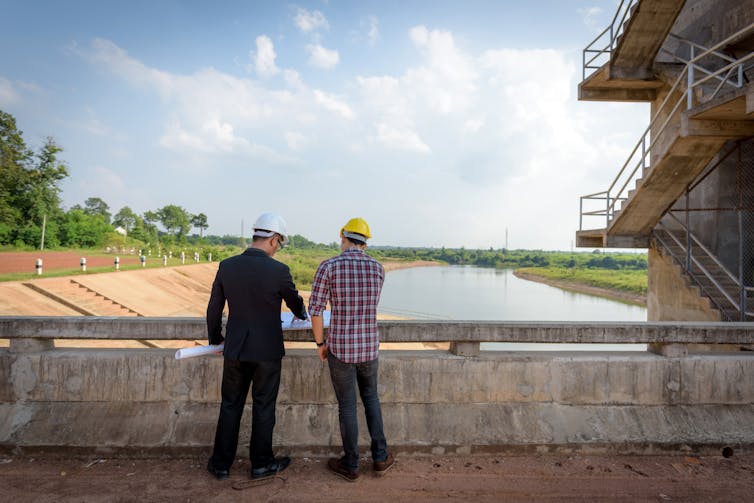 Dams and other major water infrastructure are a mainstay of male-dominated water management.
Shutterstock
Dams and other major water infrastructure are a mainstay of male-dominated water management.
Shutterstock
Hiring women is not enough
In the case of federal parliament, the toxic masculinity problem has partly been blamed on a lack of women in senior roles. Similarly, in the area of water supply, sewerage and drainage services, only 19.8% of the workforce comprises people who identify as women (compared to 50.5% across all industries). The sector include state government departments, water authorities and consultancies.
Globally, the lack of women in water engineering has primarily been addressed by increasing the representation of women in the field, on boards and in management.
However creating a more diverse workforce does not automatically lead to a diversity of thinking. In the case of water management, hiring women, or others such as LGBTI and Indigenous employees, does not necessarily mean their contributions are valued. Very often, a masculine culture prevails.
Read more: Our national water policy is outdated, unfair and not fit for climate challenges: major new report
 Hiring women is not enough - their contribution should be valued.
Shutterstock
Hiring women is not enough - their contribution should be valued.
Shutterstock
Pipelines and gadgets aren’t always the answer
Toxic masculinity doesn’t just refer to overtly sexist cultures or allegations of sexual assault. It can also refer to male-dominated decision making where other ideas are undervalued.
Take, for example, the dominant “technocracy” approach to water management, in which infrastructure and technology is relied on to solve problems.
In Australia as elsewhere, this can perhaps be seen in the emergence of “smart water management” which uses gadgets such as smart meters and other technology to gather and communicate real-time data to help address water management challenges.
As other researchers have argued, this “boys and their toys” approach perpetuates a mindset that sustainability problems - often caused by deep-seated structural and behaviour faults such as over-consumption - can be solved with engineering and technology.
Read more: We can’t drought-proof Australia, and trying is a fool's errand
The idea that technology is a symbol of masculinity has been explored by many feminist theorists.
Technical prowess, being “in control” and rationality have historically been seen as typically male characteristics. And senior technological roles are usually occupied by men.
There’s nothing inherently wrong with using technology to solve water issues. But when technocratic thinking is “monolithic” and ignores wider societal issues, it can become a problem.
Take, for example, Victoria’s North-South pipeline built during the Millennium Drought. This A$750 million piece of infrastructure connected to Melbourne in 2010 but has lain idle ever since – largely due to fears from farmers that taking water from rural areas will hurt agricultural output.
Similarly, desalination plants in many parts of Australia are an expensive technological approach that solve one problem, yet can create many others. They use a lot of energy, which contributes to climate change if drawn from fossil fuels, and can damage marine life.
 Most technology jobs in water management are occupied by men.
Shutterstock
Most technology jobs in water management are occupied by men.
Shutterstock
Finding another way
Global water scarcity is inescapable. Water use is growing at a rate faster than population growth while climate change is diminishing clean water suppies in many areas.
We need look no further than Australia’s trouble-plagued Murray Darling Basin to know it’s time to reassess the old methods and explore new ways in our relationship with water.
Exerting control over water – say, building an extensive sewer network and water supply system – may have been needed when Australia was modernising. But now it’s time to take a more humble approach that works in tandem with the environment.
A different approach would incorporate valuable knowledge in the social sciences, such as recognising the politics and social issues at play in how we manage water.
For example, in 2006 residents in the Queensland town of Toowoomba rejected the prospect of drinking recycled wastewater after a highly politicised referendum campaign. Residents had just three months to consider the proposal, which divided the community. A non-masculine approach might involve better public consultation and an effort by authorities to understand community attitudes prior to planning.
Read more: Water injustice runs deep in Australia. Fixing it means handing control to First Nations
Australians are the world’s greatest per capita consumers of water. A new approach might also involve questioning this consumptive behaviour and reducing our water use, rather than relying on technological fixes.
Such approaches are likely to require giving up some control. And it may require working closely with traditional owners to incorporate Indigenous understandings of water.
In 2017 for example, the New Zealand government passed legislation that recognised the Whanganui River catchment as a legal person. The reform formally acknowledged the special relationship local Māori have with the river.
This different approach may also mean moving to community decision making models or even programs to increase youth involvement in water management.
An over-reliance on technology and infrastructure papers over the need to understand the behaviours that lead to water problems. We must seek new, sustainable approaches that recognise the role of water in our social, political and cultural lives.
Authors: Anna Kosovac, Research Fellow in Water Policy, The University of Melbourne


 Daily Bulletin


