

The carbon footprint of Airbnb is likely bigger than you think
- Written by: Mingming Cheng, Senior Lecturer, School of Management and Marketing, Curtin University
In its 13 years of existence, Airbnb has grown from a minnow to a whale in holiday accommodation. Today, it offers more than 5.6 million active listings across 220 countries and regions. In Australia, Airbnb lists 346,581 spaces — that’s 4% of Australia’s total housing stock.
Tourists often perceive Airbnb as having a relatively small environmental footprint compared with other forms of holiday accommodation. Airbnb reinforces this view, saying “home sharing promotes more efficient use of existing resources and is a more environmentally sustainable way to travel”.
But our study, published in the Journal of Sustainable Tourism, suggests Airbnb has a bigger carbon footprint than many realise.
Assessing Airbnb’s direct, indirect and induced carbon footprint in Sydney
We focused our study on the Sydney Airbnb market. Our calculations factored in things like electricity, household equipment, water and other energy, transport, communications, goods and services and so on.
In Sydney, we calculated Airbnb.com and its hosts generate direct and indirect carbon emissions of between 7.27 and 9.39 kilograms of carbon dioxide equivalent (CO₂e) per room and night – about the same as an economy hotel.
The carbon footprint increases when we include what’s called “induced carbon emissions”. They result from Airbnb hosts spending their extra Airbnb income on purchasing additional goods and services to improve customer service for their guests, and to improve their own living standards.
Our study modelled various induced carbon emissions scenarios.
If Airbnb hosts put all their extra income into a savings account rather than spending it on goods and services, the carbon footprint of Airbnb ranges from 11 to 13 kg CO₂e per room per night.
But if hosts spend all their extra income from Airbnb, the total carbon emissions can reach 602 kg CO₂e per room and night – as much as is generated by taking a flight in economy class from Sydney to Auckland.
When you include direct, indirect and induced carbon footprint, the average carbon footprint for an Airbnb room is 44-46kg CO₂e per room and night – about as much as is generated by driving a large petrol car from Sydney to Wollongong.
Global environmental impacts
This analysis shows most tourist accommodation — be it Airbnb or traditional hotel accommodation — comes with sizeable greenhouse emissions. Collectively, accommodation accounts for about 1% of global emissions and 20% of tourism emissions.
The Sustainable Hospitality Alliance suggests hotels reduce their carbon emissions by 90% per room to be consistent with the 2℃ threshold under the Paris Agreement.
 Our analysis shows most tourist accommodation — be it Airbnb or traditional hotel accommodation — comes with sizeable greenhouse emissions.
Shutterstock
Our analysis shows most tourist accommodation — be it Airbnb or traditional hotel accommodation — comes with sizeable greenhouse emissions.
Shutterstock
The impact of COVID-19
COVID-19 has been the single most effective “intervention” in terms of reducing tourism-related carbon emissions: aviation-related emissions alone dropped by 60%.
COVID-19 resulted in a 90% income loss for Airbnb hosts in Sydney between January and August last year. Airbnb listings dropped from 12,067 to 2,196.
To cover their ongoing expenses, many Airbnb hosts sought shelter in the long-term rental market. Investor hosts, who purchased or were renting a property to make money in the short-term rental market, were particularly hard-hit.
In some areas, many are now slowly returning to hosting. As nations around the world achieve high population vaccination rates, travel restrictions will eventually be lifted and travel will boom again. So it’s important to think carefully about the environmental impact of the tourism sector.
A sustainable tourism future
There’s no obvious pathway to a truly environmentally sustainable future for tourism in general, and peer-to-peer accommodation specifically. Airbnb is here to stay. For its part, Airbnb has vowed to “set a new standard for sustainable travel”, saying:
We are measuring the carbon footprint of both Airbnb’s corporate operations and the carbon footprint of travel facilitated by the Airbnb platform. Measuring our impact informs our efforts to reduce our carbon footprint and set a new standard for sustainable travel.
Carbon emissions are an inevitable consequence of the Airbnb industry, but there’s a lot Airbnb hosts can do, including:
investing their income into sustainability measures in their property, such as rainwater tanks, solar panels, solar batteries and composting systems
opting into carbon neutral certified electricity or gas
providing small appliances such as toasters, sandwich makers or air fryers and a meal ideas book to entice people to make waste-free food instead of ordering take-away
encouraging their guests to reduce, reuse and recycle.
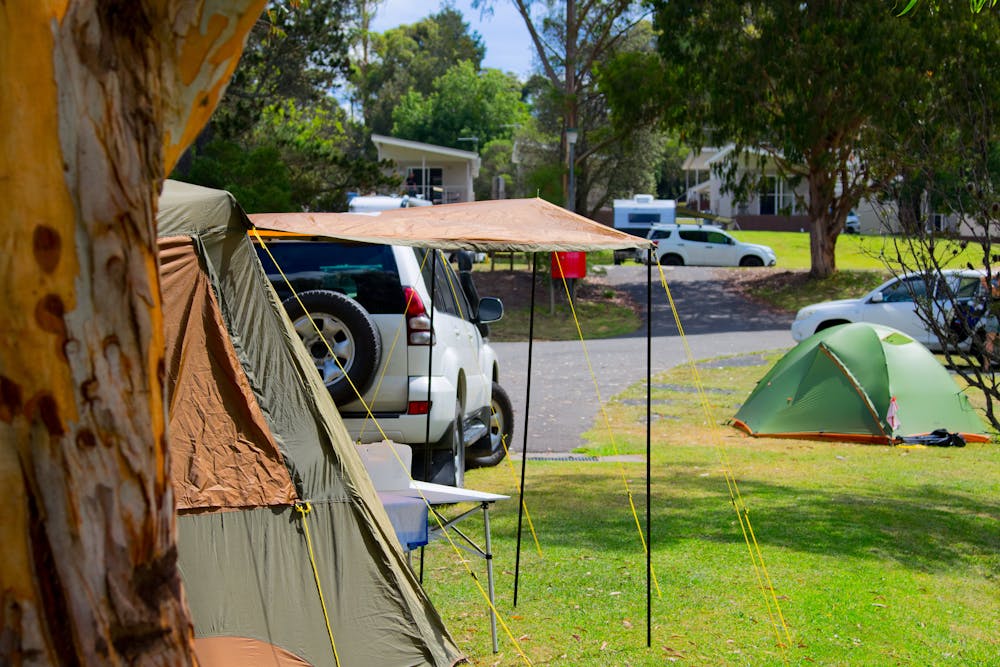 Camping makes an excellent lower emissions alternative to staying in a hotel or Airbnb.
Shutterstock
Camping makes an excellent lower emissions alternative to staying in a hotel or Airbnb.
Shutterstock
And if you’re a holidaymaker, consider ways to make your own tourism more sustainable. Camping makes an excellent lower emissions alternative to staying in a hotel or Airbnb, and holidaying closer to home also lowers your carbon footprint.
Airbnb has 5.6 million active listings worldwide. That’s 5.6 million opportunities to reduce carbon emissions. It’s also worth noting Airbnb.com is a highly effective communication platform. Airbnb could use it to give hosts simple ideas on how to reduce their carbon emissions, many of which would likely save hosts money in the long run.
Read more: What did COVID do to rental markets? Rents fell as owners switched from Airbnb
Authors: Mingming Cheng, Senior Lecturer, School of Management and Marketing, Curtin University
Read more https://theconversation.com/the-carbon-footprint-of-airbnb-is-likely-bigger-than-you-think-159544


 Daily Bulletin


