

Children, teens and COVID vaccines: where is the evidence at, and when will kids in Australia be eligible?
- Written by: Christopher Blyth, Paediatrician, Infectious Diseases Physician and Clinical Microbiologist, Telethon Kids Institute, The University of Western Australia
Adolescents in North America are beginning to roll up their sleeves for the Pfizer-BioNTech vaccine after it was approved for 12-15-year-olds this month.
The Canadian drug and therapeutic regulator Health Canada approved Pfizer-BioNTech’s mRNA vaccine for children aged 12-15 on May 5, and the United States Food and Drug Administration (FDA) expanded its emergency use authorisation to include this age group last week. The European Medicines Agency is reviewing similar applications.
COVID vaccines are currently not registered for use in children younger than 16 in Australia, but this prospect is getting closer.
Research has demonstrated the Pfizer-BioNTech COVID-19 vaccine is effective and well-tolerated in adolescents. Research into younger children is ongoing.
Do children need to be vaccinated?
Children rarely develop severe forms of COVID-19, and death from the disease is even rarer.
But children and especially teenagers can spread SARS-CoV-2, the virus that causes COVID-19.
There’s increasing evidence the vaccines impede transmission of SARS-CoV-2, so vaccinating children is expected to benefit the wider community, even though children themselves are at lower risk of COVID-19 complications.
The emergence of rapidly spreading variants makes it even more important to have as many people vaccinated and protected as possible.
Read more: Worried about your child getting coronavirus? Here's what you need to know
Are COVID vaccines effective for kids?
Pfizer-BioNTech reported phase 3 clinical trial data involving 2,260 adolescents aged 12-15 years, in which half received two doses of the Pfizer vaccine and half received a placebo.
There were 18 cases of COVID-19 reported among those who received the placebo, and none reported in the group which received the vaccine. So the efficacy of the vaccine was 100% in this study.
The immune responses one month after the second dose, which the researchers measured by looking at antibody levels, were very good in this age group (and actually higher than those seen in the 16-25 year age group).
Other clinical trials involving adolescents are in the pipeline, including for the Moderna vaccine, the other mRNA vaccine Australia has recently signed up for.
Meanwhile, Pfizer-BioNTech and Moderna vaccines are now being trialled in children as young as six months. Other pharmaceutical companies have either commenced or are planning paediatric studies too. We expect to start receiving results of these studies in younger children in the second half of this year.
Are vaccines for children different?
The approval of any vaccine for use in children and adolescents involves the same stringent processes as the approval process for adults, if not to a greater extent. The vaccine must successfully pass through all clinical trial phases and meet important safety, efficacy and quality standards prior to regulatory approval.
One aspect of vaccine trials in children is deciding on the right dose and schedule. This is particularly important given differences in body size and immune responses to vaccines between children and adults.
Most of the time, vaccines in children and adults will use the same dose and the same schedule. For most vaccines, administering the same dose is safe, effective and logistically much easier. But sometimes, like in the case of the pertussis (whooping cough) and hepatitis B vaccine, the dose needs to be different for children and adults to produce the best results.
Read more: We asked children around the world what they knew about COVID. This is what they said
In the case of the Pfizer-BioNTech vaccine, the dose and the schedule (three to six weeks between the first and second doses) indicated for adolescents is the same as for adults.
The ongoing trials of COVID vaccines in younger children are trialling different doses to see what will be most suitable.
Are they safe?
Pfizer-BioNTech has reported side effects in adolescents similar to what we see in young adults aged 16-25 years. Injection site pain, headache, fever, chills and fatigue are most common. The side effects should be brief, lasting about 24-48 hours.
The participants in Pfizer’s trial will be followed up for two years to understand long-term protection and safety.
Once the vaccine is rolled out, we continue to assess vaccine safety. Active surveillance for adverse events following immunisation is ongoing in Australia.
The Therapeutic Goods Administration (TGA) monitors rare or serious side effects, to ensure any additional safety concerns not picked up in clinical trials are identified and investigated.
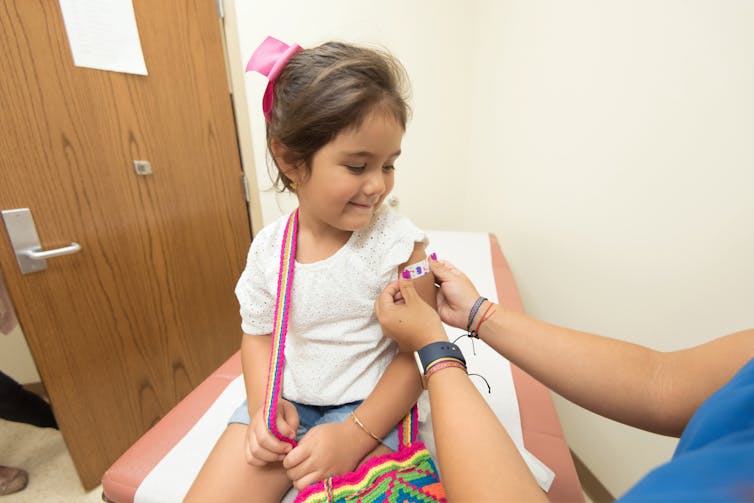 Clinical trials looking at the safety and efficacy of COVID vaccines for younger children are ongoing.
Unsplash/CDC
Clinical trials looking at the safety and efficacy of COVID vaccines for younger children are ongoing.
Unsplash/CDC
When will children get vaccinated in Australia?
Authorisation of the Pfizer-BioNTech vaccine for adolescents in North America signals vaccination programs will extend to children. Although there are no licensed COVID-19 vaccines for use in this age group in Australia at this stage, we anticipate applications to the TGA in the coming months.
Children under 16 have been considered in Australia’s COVID-19 vaccination rollout strategy, and will constitute phase 3.
But adult priority populations are currently being targeted given their greater risk of developing severe disease, risk of exposure and critical role in society’s functioning.
It’s unlikely Australian children will be asked to roll up their sleeves for many months to come. But when they are, parents and caregivers can be assured the evidence indicates COVID-19 vaccines in children are safe and work well.
Access to a safe and effective vaccine for children and adolescents will be important in enhancing community immunity and reducing the overall impact of the global pandemic.
Read more: How do we actually investigate rare COVID-19 vaccine side-effects?
Authors: Christopher Blyth, Paediatrician, Infectious Diseases Physician and Clinical Microbiologist, Telethon Kids Institute, The University of Western Australia


 Daily Bulletin


