

5-metre pedestals, an Anna Wintour puppet... COVID-19 changed fashion shows but the runway will survive
- Written by: Tiziana Ferrero-Regis, Senior Lecturer, Study Area Coordinator, Fashion, Queensland University of Technology
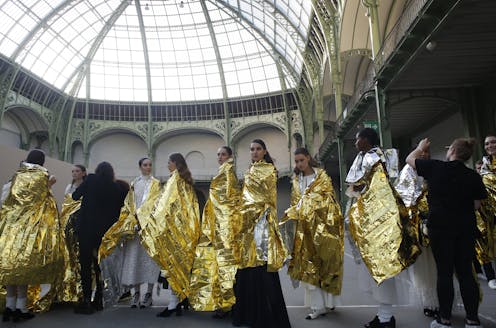
Australian Fashion Week, which starts next Monday, is touting itself as one of the first live fashion shows since the COVID-19 pandemic began. Runway shows will feature labels Romance Was Born and Zimmermann as well as younger designers.
For decades, journalists, editors, buyers, celebrities and taste-makers would descend twice a year on Paris, New York, London and Milan to attend the famous fashion weeks, where global and emerging designers present new collections in runway shows. Tokyo, Shanghai, Seoul and Moscow have joined these four global fashion centres, along with Australian cities.
Fashion shows began in the early 1900s. Their primary purpose has always been about promoting and selling new product. (The fundamental rule of fashion is endless change and newness.) The pandemic has changed things, forcing them online. But the world of high fashion had already been experimenting with technology on the catwalk — from launching handbags and frocks attached to drones to presenting a digital show beamed to viewers with 3D glasses.
Read more: Friday essay: how New York Fashion Week came to be
In the early 2000s, runway shows were grand spectacles. In 2005, Chanel began using Paris’s Grand Palais as a set on which Karl Lagerfeld envisaged grandiose installations recreating microcosms of everyday life. They included a supermarket; an airline desk; a beach, complete with sand and water; and a library.
In 2008-2009, at the height of the financial global crisis, one runway became a giant merry-go-round, carrying oversized pendants, bags and pearl bracelets.
Other luxury brands such as Dior and Dolce & Gabbana organised shows in exotic locations, such as Marrakesh, Mexico City, Capri and Hong Kong, flying visitors in at great expense.
Digital collections and social distancing
Then came COVID-19. It has had a huge economic impact, highlighting fashion’s environmental and ethically unsustainable practices. Brands that have survived moved to digital presentations of their collections with the pandemic forcing designers to think in fresh ways.
Valentino’s Pier Paolo Piccioli, for instance, dealt with rules of social distancing by setting 15 models on pedestals up to 5 metres high and creating elongated silhouettes of white couture dresses. Textile patterns and colours were then projected on these silhouettes.
In September 2020 in Milan, Jeremy Scott, Moschino’s designer, created a COVID-safe fashion show that eliminated both models and audience. Forty miniature marionettes, 76 centimetres tall, walked the runway between two rows of puppets replacing the audience.
In the first row, a puppet version of Vogue editor-in-chief and fashion power broker Anna Wintour stood out.
In October, Chanel returned to a live show with an audience to present the ready-to-wear Spring/Summer 2021, but a new COVID lockdown in Paris prevented any further live shows in 2020. Its 2020/21 Haute Couture collection was a digital show streamed from a chateau in the Loire region.
Drones and 3D
Still, some major global brands had already been presenting digital alongside physical shows, or toying with technology.
Read more: Why STEM subjects and fashion design go hand in hand
In February 2010, Burberry experimented with live streaming its womenswear collection digitally in 3D in five locations. Journalists and celebrities were invited to private screening spaces in Paris, New York, Dubai, Tokyo and Los Angeles where they watched the show with 3D glasses. The show took inspiration from the popularity of James Cameron’s film Avatar (2009).
In 2014, Fendi sent three drones down the runway to film a show. The move created excitement, but also raised concerns related to hyper-surveillance.
In February 2018, meanwhile, Dolce & Gabbana showed their new bag collection attached to drones. Small drones glided down the runway and over the heads of the audience before vacating the stage for models.
Given models are often also celebrities, embodying the designer’s concept for the collection, or even brand, this was a startling move. Will real models be dispensed of in a near future? Will they be replaced by drones, robots or holograms?
In the same year, in Jeddah, Saudi Arabia, fluttering clothes were sent on the runway attached to drones, producing a ghost-like effect. The show prompted outrage on social media. Organisers explained it was about adding novelty. However, it was the first time a fashion show had been opened to an audience of both men and women, instead of just women. This change may have prompted the use of drones.
Fashion is a major industry commanding 2% of the world’s Gross Domestic Product annually. Runway shows are marketing devices and here to stay.
In-person audiences will be allowed during Paris Fashion Week in July, and in June in Milan, for the menswear collections. The British Fashion Council is also preparing to hold COVID-safe, smaller, in-person events. Still, brands will continue to experiment with technologies in the name of novelty.
Authors: Tiziana Ferrero-Regis, Senior Lecturer, Study Area Coordinator, Fashion, Queensland University of Technology


 Daily Bulletin


