

Speeding drivers keep breaking the law even after fines and crashes: new research
- Written by: Laura Mills, PhD Candidate, University of the Sunshine Coast
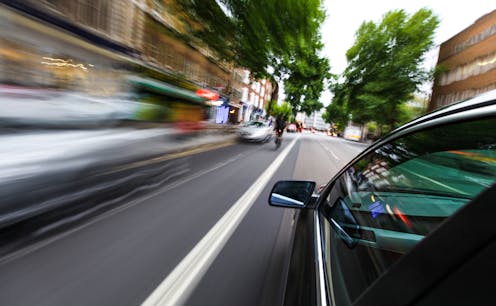
Over 1,000 Australians died as a result of a traffic crash in the past year, with speed being a factor in around 20-40% of crashes.
Historically, many of the attempts to convince drivers to obey road rules have relied on strategies that highlight the risks associated with the offence. However, findings from a Queensland-based study suggest some motorists may acknowledge the risks associated with speeding and continue to offend anyway.
Humans are well designed to recognise and respond appropriately to risk, which is largely connected to our drive to avoid pain and seek pleasure. In other words, if we know the risks and dangers associated with a behaviour, we are expected to not do it.
When it comes to speeding, campaigns typically focus on the negative consequences of doing it, ranging from receiving a ticket to the destruction and loss associated with a fatal traffic injury. It is intended that each time we view one of these campaigns, we are reminded that engaging in these dangerous driving behaviours increases our risk of a negative outcome.
But what if motorists don’t think the risks apply to them? Or what if they acknowledge the risks and continue offending anyway?
Our research explored these questions by looking at motorists’ perceptions of the risks of being involved in a crash due to speeding, and of getting a speeding ticket. We asked what they perceived was the likelihood of these events for them compared to a driver of the same age and sex.
A total of 760 Queensland motorists were involved in the research. Participants were members of the public, recruited in shopping centres, online and at a Queensland university.
Read more: Rising cyclist death toll is mainly due to drivers, so change the road laws and culture
The research found speeding was common, but participants considered their risk of being involved in a crash to be lower than that of other drivers (72% of sample). Importantly, 74% considered their driving ability to be better than other drivers’.
However, a closer look at the factors related to speeding highlighted that those who reported offending more often recognised that, compared to a similar driver (of the same age and sex), they believed themselves to be more likely to be involved in a crash due to speeding, and more likely to get a speeding ticket. However, they considered their driving ability to be better than other drivers’.
Drivers who sped frequently were also more likely to report being involved in a traffic crash in the past and having lost their licence. Therefore, frequent offenders were aware of the dangers of their behaviour but continued to offend anyway.
The challenge of changing behaviour
The research findings suggest those who break the speed limit are aware of the possible risks. For some, these risks remain “hypothetical”, with drivers dismissing them with inflated perceptions of their own driving ability. For others, not even previous crash involvement (or receiving a ticket) is enough to change driving behaviours.
The findings further highlight the challenge of improving road safety, particularly in regard to influencing drivers.
From a different perspective, the perceived risks of speeding might not outweigh some of the benefits or “driving forces” that motivate speeding. Previous speeding research has found:
motorists may be more likely to speed if they have influences (such as peers or parents) that endorse and promote speeding behaviour, so the benefit of peer acceptance may outweigh the risks
some people have a greater tendency towards sensation-seeking and may seek experiences from which they derive sensation (such as dangerous driving)
many mainstream movies portray risky driving behaviours in a glamorised way, which may encourage motorists to adopt similar behaviours
some drivers simply enjoy driving fast.
Read more: Busted: 5 myths about 30km/h speed limits in Australia
Deterring drivers who understand the risks but offend anyway
The findings remind us that biases are common and so is speeding. Both may contribute to the road toll refusing to go down. Put simply, the link between increased speed and crash outcomes is well documented, yet motorists are still willing to take the risks.
While punishing offenders remains a key ingredient, new approaches are badly needed to ensure motorists regularly recognise (and respond appropriately to) road risks. That is, the risk is real and extends beyond one’s own driving ability, as it should not be forgotten that we share the roads with many others.
While humans are considered the apex creature for learning, this capacity does not always extend to the roads. Until the autonomous self-driving machines arrive and potentially save us, we need to enhance our willingness to respond to ever-present risks in order to save ourselves and others.
Authors: Laura Mills, PhD Candidate, University of the Sunshine Coast


 Daily Bulletin


