

Tracking the transition: the ‘forgotten’ emissions undoing the work of Australia's renewable energy boom
- Written by: Hugh Saddler, Honorary Associate Professor, Centre for Climate Economics and Policy, Australian National University
World leaders including Prime Minister Scott Morrison will gather in the UK this weekend for the G7 summit. In a speech on Wednesday ahead of the meeting, Morrison said Australia recognises the need to reach net-zero emissions in order to tackle climate change, and expects to achieve the goal by 2050.
So has Australia started the journey towards deep cuts in greenhouse gas emissions?
In the electricity supply system, the answer is yes, as renewables form an ever-greater share of the electricity mix. But elsewhere in the energy sector – in transport, industry and buildings – there has been little or no progress.
This situation needs to change. These other parts of the energy system contribute nearly 40% of all national greenhouse gas emissions – and the share is growing. In a new working paper out today, we propose a way to track the low-carbon transition across the energy sector and check progress over the last decade.
 Energy emissions from buildings, such as from gas cooktops, have largely escaped scrutiny.
Shutterstock
Energy emissions from buildings, such as from gas cooktops, have largely escaped scrutiny.
Shutterstock
A stark contrast
The energy sector can be separated into three major types of energy use in Australia:
- electricity generation
- transport and mobile equipment used in mining, farming, and construction
- all other segments, mainly fossil fuel combustion to provide heat in industry and buildings.
In 2018-19, energy sector emissions accounted for 72% of Australia’s national total. Transition from fossil fuels to zero-emissions sources is at the heart of any strategy to cut emissions deeply.
The transition is already happening in electricity generation, as wind and solar supplies increase and coal-fired power stations close or operate less.
But in stark contrast, elsewhere in the sector there is no evidence of a meaningful low-emissions transition or acceleration in energy efficiency improvement.
This matters greatly because in 2019, these other segments contributed 53% of total energy combustion emissions and 38% of national greenhouse gas emissions. Total energy sector emissions increased between 2005 (the reference year for Australia’s Paris target) and 2019.
As the below graphic shows, while the renewables transition often gets the credit for Australia’s emissions reductions, falls since 2005 are largely down to changes in land use and forestry.

Let’s take a closer look at the areas where Australia could do far better in future.
1. Transport and mobile equipment
Transport includes road and rail transport, domestic aviation and coastal shipping. Mobile equipment includes machinery such as excavators and dump trucks used in mining, as well as tractors, bulldozers and other equipment used in farming and construction. Petroleum supplies almost 99% of the energy consumed by these machines.
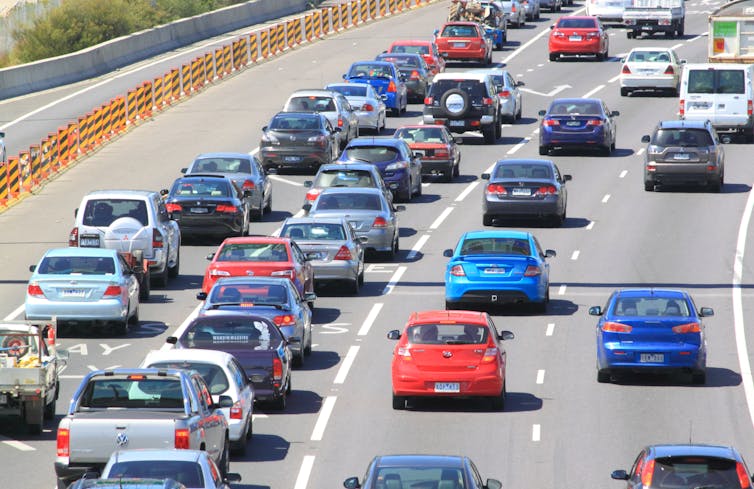
Road transport is responsible for more than two-thirds of all the energy consumed by transport and mobile equipment.
What’s more, prior to COVID, energy use by transport and mobile equipment was steadily growing – as were emissions. The absence of fuel efficiency standards in Australia, and a trend towards larger cars, has contributed to the problem.
Electric vehicles offer great hope for cutting emissions from the transport sector. As Australia’s electricity grid continues to decarbonise, emissions associated with electric vehicles charged from the grid will keep falling.
 Electric vehicles would slash road transport emissions.
Shutterstock
Electric vehicles would slash road transport emissions.
Shutterstock
2. Other energy emissions
Emissions from all other parts of the energy system arise mainly from burning:
- gas to provide heat for buildings and manufacturing, and for the power needed to liquefy gas to make LNG
- coal, for a limited range of heavy manufacturing activities, such as steel and cement production
- petroleum products (mainly LPG) in much smaller quantities, where natural gas is unavailable or otherwise unsuitable.
Emissions from these sources, as a share of national emissions, rose from 13% in 2005 to 19% in 2019.
These types of emissions can be reduced through electrification – that is, using low- or zero-carbon electricity in industry and buildings. This might include using induction cooktops, and electric heat pumps to heat buildings and water.
However the data offer no evidence of such a shift. Fossil fuel use in this segment has declined, but mainly due to less manufacturing activity rather than cleaner energy supply.
And in 2018 and 2019, the expanding LNG industry drove further emissions growth, offsetting the decline in use of gas and coal in manufacturing.
How to track progress
Over the past decade or so, Australia’s emissions reduction policies – such as they are – have focused on an increasingly narrow range of emission sources and reduction opportunities, in particular electricity generation.
Only now are electric vehicles beginning to be taken seriously, while energy efficiency – a huge opportunity to cut emissions and costs – is typically ignored.
Our paper proposes a large set of new indicators, designed to show what’s happening (and not happening) across the energy sector.
The indicators fall into four groups:
greenhouse gas emissions from energy use
primary fuel mix including for electricity generation
final energy consumption including energy use efficiency
the fuel/technology mix used to deliver energy services to consumers.
Our datasets excludes the effects of 2020 COVID-19 lockdowns. They’re based on data contained in established government publications: The Australian Energy Statistics, the National Greenhouse Gas Inventory and the Australian Bureau of Statistics’ national accounts and population estimates.
By systematically tracking and analysing these indicators, and combining them with others, Australia’s energy transition can be monitored on an ongoing basis. This would complement the great level of detail already available for electricity generation. It would also create better public understanding and focus policy attention on areas that need it.
In some countries, government agencies monitor the energy transition in great detail. In some cases, such as Germany, independent experts also conduct systematic and substantial analysis as part of an annual process.
The road ahead
Australia has begun the journey to a zero-emissions energy sector. But we must get a move-on in transport, industry and buildings.
The technical opportunities are there. What’s now needed is government regulation and policy to encourage investment in zero-emissions technologies for both supplying and using all forms of energy.
And once available, the technology should be deployed now and in coming years, not in the distant future.
Read more: Check your mirrors: 3 things rooftop solar can teach us about Australia's electric car rollout
Authors: Hugh Saddler, Honorary Associate Professor, Centre for Climate Economics and Policy, Australian National University


 Daily Bulletin


