

What to look for when choosing a university as the digital competition grows
- Written by: Gabriele Suder, Professor, RMIT University
Online teaching became the norm almost overnight when the pandemic hit. For students, the situation’s complexity was brutal, the shift frustrating but unavoidable.
Prospective students weighing up study options might have been confused too. However, they are now better placed to understand what universities offer in an increasingly competitive digital learning market. They also have more choices.
Incoming University of Sydney vice-chancellor Mark Scott has warned competition for enrolments is intensifying as students’ options grow. “The [news] media experience demonstrated clearly that your competitors in the digital space went well beyond your traditional competitors in the analog space,” said Scott, a former managing editor of the ABC and senior executive at Fairfax Media.
“Digital” education will redefine how students view and select universities. It may allow for more personalised learning paths, lifelong and more accessible learning, upskilling for employment and a more remote and diverse body of students.
Read more: New learning economy challenges unis to be part of reshaping lifelong education
There’s no going back to the old model
As learning became removed from the campus experience last year, learner-teacher engagement and peer networking altered dramatically. The digital transition was a monumental and urgent task.
But time has passed. Fully or partly digitalised university programs have proliferated. And many have become more sophisticated as academics and students receive support to take the leap.
A recent PwC report on higher education digitisation affirms:
“The changes forced by the rapid digitisation of the sector will not be undone.”
“Digital” in education can now mean anything from simple videoed lectures, online documents and tutorials to high-end digital animation and simulation tools.
Just before the current lockdowns, Macquarie University, among others, announced most lectures would continue online while “small group” in-person learning would require students to wear masks. Melbourne University said it was “planning to deliver around 90% of semester 2 subjects on campus”. It is also rolling out “blended synchronous learning” using in-venue microphones and cameras so remote and campus-based students come together in a single class, its DVC (Academic) Gregor Kennedy said.
Read more: Digital learning is real-world learning. That's why blended on-campus and online study is best
RMIT University posted: “Classes that require specialist spaces or equipment will be prioritised for on-campus learning.” At Sydney University, the campus was to remain open during lockdown for critical teaching and research activity only. The University of Queensland and Monash University, among many others, have introduced online invigilated examinations.
The gap between the best and worst of what institutions offer digitally is vast.
In the worst cases, digital learning means students are asked to read scanned textbook chapters and have academics or tutors talk at them through a recording without any interaction. It’s a terribly disengaging experience for the student and hence less effective for learning. But it requires very little investment by universities.
In the best cases, universities offer active learning through digitally driven simulations and well-designed activities. These include peer group activity, networking and technology-enhanced alternatives to on-campus experience. The result is a varied and engaging experience, but it requires substantial investment by the university.
What should students look for?
So, how can prospective students tell which universities provide worthwhile digital education? They should consider the following criteria:
-
Focus on online/blended student experience
What is the value given to students feeling connected, being part of a learning community, having a social dimension in addition to agency over their learning, and being on campus when possible? Do study options suit life and lifestyle needs that the pandemic brought to light as important?
-
Transparency about digital quality
Does the university adequately communicate its definition of “digital” quality? Pay special attention to assessment mechanisms, to avoid having to deal with postponed exams, for example.
The Tertiary Education Quality and Standards Agency (TEQSA) has provided guidelines for online learning quality. Federal Education Minister Alan Tudge has announced a renewed Higher Education Standards Panel with online and hybrid course quality as part of its new tasks.
-
Evidence of agility, convenience and accessibility
What solutions can be adapted to post-COVID educational expectations, both locally and internationally? Are there options for polysynchronous learning: some on one’s own time, some with others? What does inclusive digital education – accessibility for vision-impaired students, for example – look like?
-
Clarity about pricing
Is the program or unit priced to be a low-cost standardised product, or is it priced for high value? Does the university offer financial support options?
-
Ambition of digital design
Does the program and learning design have a focus on long-term COVID-resilient learning and career outcomes? Is there solid evidence of industry relations?
And (for the most ambitious) does the university explore and/or use artificial intelligence (AI) and data analytics to customise learning paths for individuals?
Read more: In a world of digital bystanders the challenge is for all of us to design engaging online education
An emerging digital divide among unis
Some universities are using digital education to tap into new markets. These universities include Melbourne, RMIT (boasting RMIT Online), Adelaide and Griffith. At different price points, their offerings increasingly include demonstrated digital expertise, blended synchronous learning options and well-defined online engagement and connection.
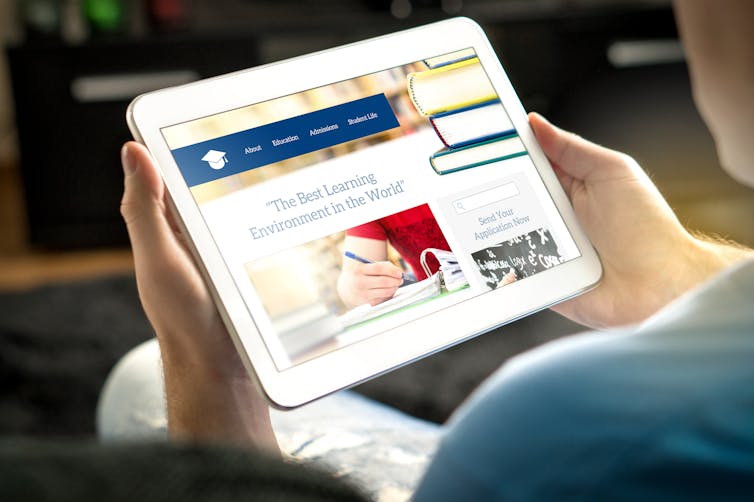 The education market is bigger and more competitive than ever before.
Shutterstock
The education market is bigger and more competitive than ever before.
Shutterstock
Universities are also responding to industry demand for accessible upskilling and enhanced learning (often “micro” qualifications). Again, their offerings vary, especially across disciplines.
The PwC report predicts most universities will compete with mid-range offerings. This group will offer customised learning in parallel to mass offers, keeping revenue streams open, maintaining a brand in a technology-enhanced world and counterbalancing border restrictions on international students.
Some universities will opt for a serious quantum leap into online or blended education programs. These universities are likely to outcompete other providers and diversify their student bodies in ways that enhance the student experience.
Others continue with minimal investment or low-cost solutions. These providers are looking to return to the “old normal” of a strictly face-to-face experience. They aim to manage learners’ frustrations as they arise, rather than invest in long-term quality digital services.
This approach may be understandable for universities with serious cashflow issues. In the long run it’s probably shortsighted and may lead to student and industry dissatisfaction.
We can see the divide between these approaches in submissions from each higher education provider to the federal government in consultations on a new strategy for international education. Interestingly, providers’ views show little correlation with type of institution, whether highly ranked or not, rural or urban. Our discussion above is based on our deep dive into those submissions.
Authors: Gabriele Suder, Professor, RMIT University


 Daily Bulletin


