

As the Tokyo Games begin, the stakes could not be higher for Japan — and the Olympics themselves
- Written by: Jack Anderson, Professor of Sports Law, Melbourne Law School, The University of Melbourne
History shows there nothing in sport quite like an Olympics. Equally, there is nothing in Olympic history quite like what is happening now in Tokyo at the most expensive — and likely the most fraught — summer games of all time.
When Tokyo bid for the games a decade ago, many of the political elite saw the Olympics as a way to promote Japan 2.0. The games would reinvigorate a country beset by nuclear and natural disasters, economic stagnation and geopolitical concerns about China’s rise.
Japan’s leaders were part of its post-second world war generation. They witnessed the benefits in hosting the 1964 Tokyo Games, and thought the same could happen in 2020.
But COVID-19 has seen the anticipation and feel-good factor of the Olympics replaced by anxiety and fear. The city’s stadiums and train lines are empty, as are its coffers, with the lack of ticket sales and tourism income.
Any diplomatic or soft power advantage Japan might have sought over China will be offset by the fact the next Olympics to be held in front of cheering crowds will likely be the 2022 Winter Games in Beijing.
How much faster, higher or stronger can humans go? Listen to The Conversation Weekly to find out from experts.
The most expensive Summer Games on record
Now that attention is about to shift to the spectacle of the opening ceremony and athletic competitions, it’s worth keeping in mind the enormous cost of these games to the Japanese public.
When it won the bid for the games in 2013, Tokyo said they would cost US$7.3 billion (A$9.9 billion). In 2019, a report by Japan’s national auditor said the costs would be nearly twice that amount.
Then, in December 2020, the organisers admitted the official spend would be closer to US$15.4 billion (A$20.9 billion) after factoring in the costs of the COVID postponement. Government audits over the past several years suggest the true cost, however, will actually be US$25 billion (A$33.9 billion).
Read more: Most expensive, greatest gender parity, most sports: Tokyo Olympics by the numbers
Egregious cost overruns have been a feature of most Olympics, but as COVID-related precautions continue to bloat its budget, Tokyo has already surpassed the London games of 2012 as the most expensive summer games on record, according to one study. It is the one gold medal the International Olympic Committee did not want to award.
Under the terms of the host city contract between the Tokyo Organising Committee and the IOC, the costs of hosting the games and underwriting all associated contingencies — including their abandonment, which is still a possibility — lie with the hosts.
This diversion of resources — both in terms of money and healthcare personnel — has annoyed the Japanese public. And yet, the oft-quoted polls suggesting three-quarters of the Japanese public do not want the games to take place should not be taken as anti-sport in sentiment.
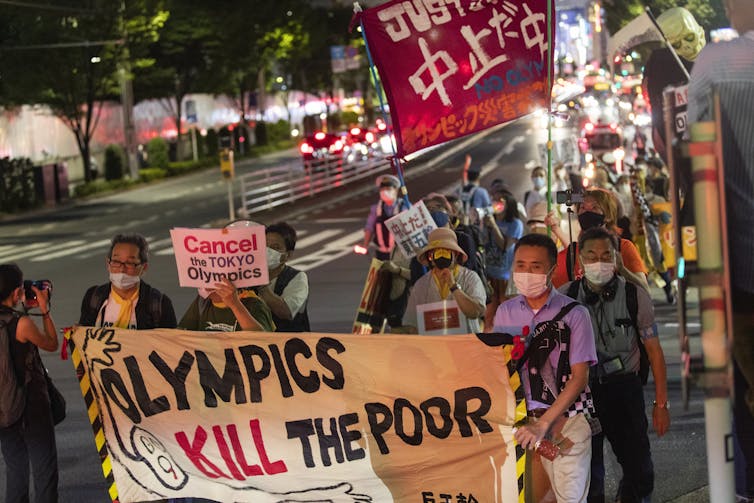 In a new survey, only 21% of Japanese respondents said they believe the games can be held safely.
Hiro Komae/AP
In a new survey, only 21% of Japanese respondents said they believe the games can be held safely.
Hiro Komae/AP
Indeed, well-attended sports events continue to take place in Japan despite various states of emergency, rising COVID infections and sluggish vaccination rates. The polls on the Olympics are an expression of understandable unease among the Japanese public about hosting a global sporting event during a global pandemic and the considerable costs they’ve had to bear.
Unease over the costs is not unusual for Olympic hosts. In the past, this has been quickly tempered by the games themselves. The atmosphere invokes a national pride as the host nation’s best athletes compete against the world and the host city gets to show off its iconic landmarks and newly minted sporting and urban infrastructure.
The tangible benefits promised to the hosts are then realised in the millions spent by visitors on hotels, restaurants, bars and most importantly tickets.
Ticketing is one of the few areas of economic value in an Olympics that the IOC leaves exclusively to the host to exploit. With no tourists or spectators permitted for the Tokyo Games, the organisers will miss out on an estimated US$800 million (A$1.08 billion) in revenue.
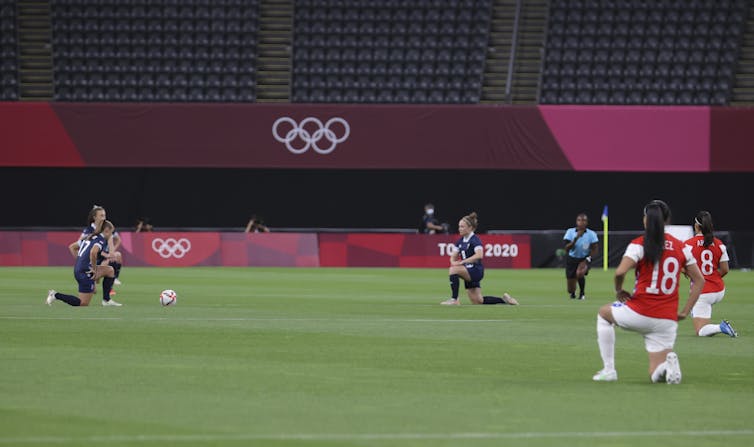 Most events at the games will be held in empty stadiums and arenas.
Keita Iijima/AP
Most events at the games will be held in empty stadiums and arenas.
Keita Iijima/AP
Reputational damage to the IOC
The impact of COVID, of course, could not be helped by the IOC. But the IOC has not helped itself in how it has managed the postponed games. Its adamant insistence that the Olympics go ahead has been seen as arrogant and unsympathetic to Tokyo. The host city contract and insurance policies may mitigate any economic risks to the IOC of pressing ahead, but neither will do much to repair the reputational damage.
Public disquiet over the games has already led Toyota, one of the Olympics’ most important global sponsors, to cancel its Olympic television advertising and decide against sending its executives to the opening ceremony.
Its stance may have a domino effect and see other corporate sponsors follow suit. Approximately 60 Japanese companies have paid a record US$3 billion (A$4.08 billion) to sponsor the games. This had to be topped up by another US$200 million (A$272 million) to extend contracts after the Olympics were postponed. Goodwill among such sponsors towards the IOC is running low.
The vast bulk of the revenue generated by the IOC is not from sponsorship, but television broadcasting deals. In the last Olympic cycle (2013-16), broadcasting rights raised four times more in revenue (US$4.1 billion or A$5.6 billion) than the IOC’s official sponsorship program.
The importance of the broadcasters, especially the US television networks, is reflected by the fact that in making the decision to postpone the games, little to no consideration was given to the option of spreading it out over a longer period of time. This would have provided scheduling flexibility to allow for COVID-related spikes (like the one Japan is currently experiencing).
Read more: Tokyo 2020 – how Japan's bid for soft power victory has been roundly defeated by the pandemic
But this has not happened. The games are only viable (financially) if they fit a tight window dictated by the US networks. And given the fact crowds have now been banned at most events in Tokyo, this means the games will now almost exclusively be a made-for-TV event.
The main bulk of those allowed to attend events will be members of the IOC executive elite. The image of such executives looking down on competing athletes may reinforce the view that, while the predominately amateur participants have had to endure disruptions to their lives and training schedules and isolate for weeks in order to get to the Olympics, the IOC elite lives in a permanent bubble.
Moreover, as the number of COVID infections among athletes and officials increases, the risks and responsibilities that the IOC has assumed in pushing ahead with the games become more onerous.
Getting athletes to sign waivers may absolve the IOC from its narrow legal responsibility to ensure the health and safety of athletes, but not its moral obligations.
Where does the Olympic movement go from here?
In the longer term, the legacy of the Tokyo games may be quite complex for the IOC. International sports federations will surely have to rethink whether it is wise to rely so heavily on the redistribution of revenue generated by one event every four years and controlled by one dominant, highly political entity - the IOC.
As for future games — even for Brisbane in 2032 — who knows what impact climate change will have on a country’s capacity or willingness to host an event that is responsible for large amounts of carbon emissions through air travel, energy use and construction.
Read more: Leaner, cost-effective, practical: how the 2032 Brisbane Games could save the Olympics
As the games begin, the spotlight rightly focuses on the diverse array of talented athletes from around the globe. For many of us, our love of sport began by watching an Olympics. As a 10-year-old, I sat transfixed when John Treacy of Ireland won silver in the marathon at the 1984 Los Angeles games. As he entered the final straight, the local commentator listed Irish medallists of the past. I still know them by heart.
But if the Tokyo games have made clear, the IOC’s slogan of “Citius, Altius, Fortius” is no longer as potent as it once was. For future hosts, there might be an alternative version to reflect the rather more circumspect view of the IOC and its games – “caveat emptor”, or buyer beware.
Authors: Jack Anderson, Professor of Sports Law, Melbourne Law School, The University of Melbourne


 Daily Bulletin


