

Orangutans, gibbons and Mr Sooty: what the origins of words in Southeast Asia tell us about our long relationships with animals
- Written by: Wayan Jarrah Sastrawan, Research associate, University of Sydney
Forest creatures include some of humanity’s closest biological relatives. Due to human threats, they are also some of the most endangered animals on our planet.
Southeast Asia hosts many unique forest species, and many of our English words for forest creatures have their origins in Southeast Asian languages. What sound to English speakers like exotic loanwords are meaningful in their original languages.
By exploring the Southeast Asian etymologies of these names, we can understand how humans have maintained relationships of respect and affinity with forest creatures over the centuries. And, as these ecosystems are under grave threat, it is important to recognise a different way of relating to our most endangered relatives is possible.
Here, then, are the names of four of my favourite Southeast Asian forest species, and what we know about the origins of their names.
Orangutan
Orangutans belong to the great ape family, our closest biological relatives. This familial link is reflected in the word orangutan itself, which Malay speakers today can still recognise as deriving from the phrase orang hutan, which means “forest person”.
My recent research shows this term goes back over a thousand years, contrary to the conventional belief it was coined by European visitors to Indonesia in the 17th century.
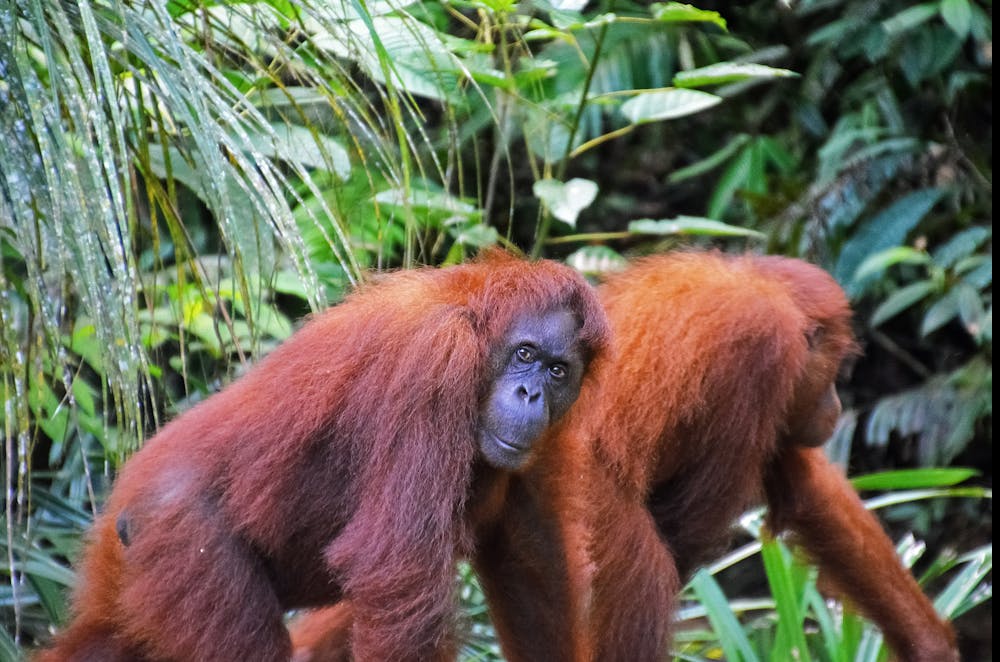 Orangutans are one of our closest relatives, as reflected in the Malay word orang hutan, or ‘forest person’.
Jeremy Zero/Unsplash
Orangutans are one of our closest relatives, as reflected in the Malay word orang hutan, or ‘forest person’.
Jeremy Zero/Unsplash
Surprisingly, the oldest surviving texts to use the word orangutan do not come from Sumatra or Borneo, where orangutans live today, but from the neighbouring island of Java. One of the oldest texts to mention orangutans is the 9th-century poem Rāmāyaṇa. Written in the Old Javanese language, the poem describes “the orangutans, all bearded, climbing up”.
The word orangutan came into Old Javanese from another archaic language related to modern Malay. These early appearances show the word was circulating among the archipelago’s languages well over a thousand years ago.
This origin as the phrase “forest person” shows for many centuries Southeast Asians have viewed orangutans as human-like creatures residing in the forest.
Read more: Orangutans have been adapting to humans for 70,000 years
Gibbon
Gibbons are a type of ape ideally suited to swinging through the trees of Southeast Asia’s forests. The word gibbon entered European languages through French in the 18th century.
The French adopted it from the Malay word, kebon. But recent research shows this Malay word originally came from a group of languages called Northern Aslian, spoken by indigenous communities in peninsular Malaysia. In Northern Aslian, it was probably pronounced kebong.
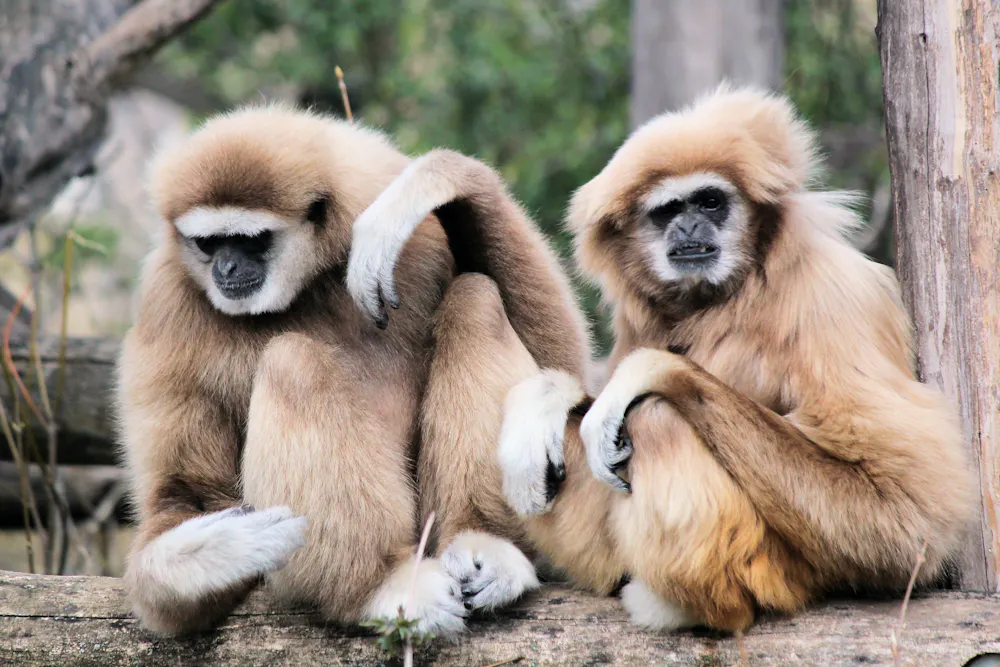 Called gibbons in English, many Southeast Asian languages call this creature a wak-wak.
Dušan veverkolog/unsplash
Called gibbons in English, many Southeast Asian languages call this creature a wak-wak.
Dušan veverkolog/unsplash
Gibbon is a relatively rare term in Southeast Asia itself. It even fell out of use in Malay after the 18th century. More common in the region’s languages is the word wak-wak. Like orangutan, this word appears in the Old Javanese language as early as the 9th century and seems to derive from the crow-like sound gibbons make.
Through my research, I suggest the word wak-wak may have inspired the Middle Eastern legend of the Wakwak Tree: a fantastical tree from a far eastern land whose fruits produced human heads and bodies which cried out “wak wak”. Folk memories of the gibbon’s piercing cry may have been transmitted across the Indian Ocean many centuries before the animal was identified by European science.
Read more: Gibbon song may be music to the ears of human language students
Binturong
Binturongs, also known in English as bearcats, are long and heavy tree-dwellers with large tails which they use to communicate. The word binturong first appeared in English in the 19th century as a borrowing from Malay.
Binturong also appears in a wide variety of languages from Sumatra and Borneo. This shows the word was coined early in the history of the region: probably several millennia ago, before these languages began to diverge.
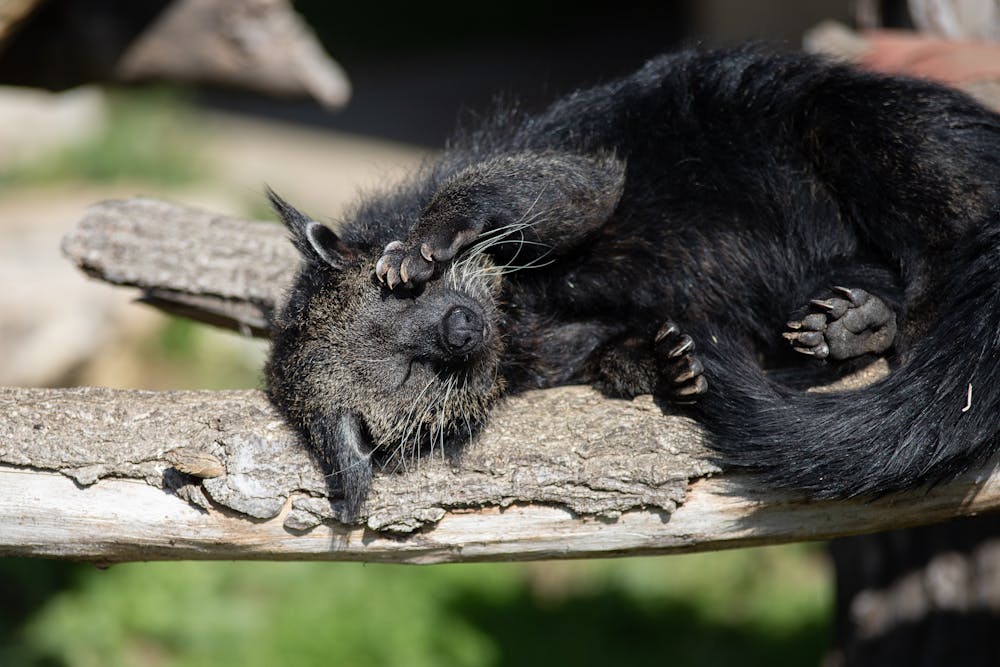 The binturong does not leap from tree to tree, instead it makes its way along the ground.
Shutterstock
The binturong does not leap from tree to tree, instead it makes its way along the ground.
Shutterstock
The earliest form of this word we know about was maturun, which probably meant “the one who descends”. It was inherited by many languages of Borneo and Sumatra, undergoing a series of regular sound changes. This is how the Malay form benturong evolved, which was later adopted by English.
Unlike many other tree creatures, binturongs do not nimbly leap among the branches. Rather, they tend to descend one tree and walk along the ground to another tree. The aptness of the name maturun shows us these early Southeast Asian communities were close observers of animal behaviour.
Siamang
The endangered siamangs are the largest type of gibbon. They have distinctive black coats and communicate with a complex system of booming calls.
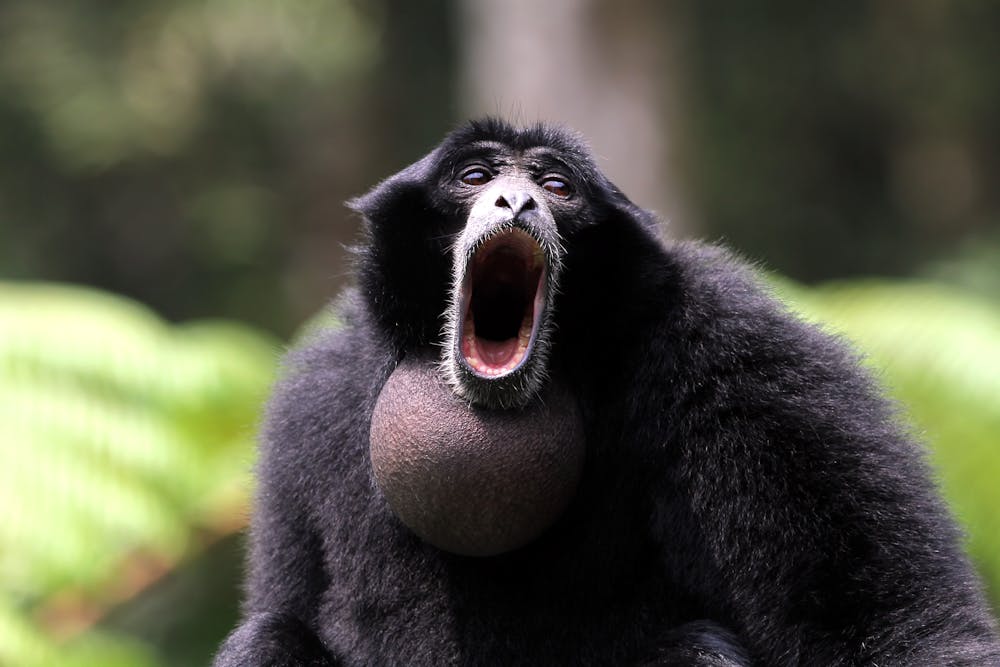 Siamangs communicate with complex booming calls.
Shutterstock
Siamangs communicate with complex booming calls.
Shutterstock
The ultimate origin of the word is probably the word ʔamang (where the ʔ represents a glottal stop), found in several indigenous languages of the Central Aslian group.
When speakers of Malay borrowed the word ʔamang, they added the personal article si. Similar to an honorific like “mister”, si generally applies only to humans, or to animals, spirits or objects that are personified. Malay speakers later interpreted the word amang as “black”, giving rise to a folk etymology of si amang as meaning something like “Mr Sooty”.
The Malay expression was eventually treated as the single word siamang. For the Malays, the charisma exuded by siamangs entitled them to the status of personhood — another recognition of the affinity between humans and our forest ape relatives.
Authors: Wayan Jarrah Sastrawan, Research associate, University of Sydney


 Daily Bulletin


