

I'm training to become Australia's first woman astronaut. Here's what it takes
- Written by: Kim Ellis Hayes, Senior Lecturer in Space Research & Law / In training as Suborbital Spaceflight PoSSUM Astronaut Candidate Graduate, Swinburne University of Technology
I’m currently training to become Australia’s first woman astronaut. I expect to fly my first suborbital mission sometime in 2023 as a payload specialist on a commercial mission. In other words, I’ll be one of few certified crew members who can handle specialised scientific equipment aboard a suborbital spacecraft.
Once we’re up there, my team and I expect to conduct research on Earth’s atmosphere. It’s an opportunity I consider out of this world. But it has taken a lot of effort for this dream to be realised.
My path to PoSSUM
As a female STEM and legal professional, my past jobs included working as a research scientist in mining and metals for BHP-Billiton, Rio Tinto and the Australian Nuclear Science and Technology Organisation (ANSTO) — but I always loved space.
After combining my science degree with two law degrees, I won a scholarship for the International Space University. I eventually received an Australian Government Endeavour Executive Award for a project at the NASA Kennedy Space Centre. With this I pivoted towards a career in the space industry, and have never looked back.
 The International Space University students and teaching teams in 2012, in front of the Shuttle Atlantis at Kennedy Space Center.
Author provided
The International Space University students and teaching teams in 2012, in front of the Shuttle Atlantis at Kennedy Space Center.
Author provided
I was selected as a PoSSUM (Polar Suborbital Science in the Upper Mesosphere) Scientist-Astronaut candidate and global ambassador for 2021. PoSSUM is a non-profit US astronautics research and education program run by the International Institute for Astronautical Sciences (IIAS).
The program uses next-generation suborbital spacecraft to study the upper atmosphere and its potential role in global climate change. Generally speaking, a suborbital spaceflight is any flight that reaches an altitude higher than 80km, but doesn’t escape Earth’s gravity to make it into orbit.
Anything above 80km is deemed “space” under US legislation, although some nations (including Australia) don’t agree with this and the debate about where “space” begins — also called the Kármán line — remains ongoing.
Last month, commercial space tourism companies Blue Origin and Virgin Galactic completed the very first suborbital spaceflights carrying passengers (without research). This was an incredible achievement, which many have said could mark the beginning commercial space tourism.
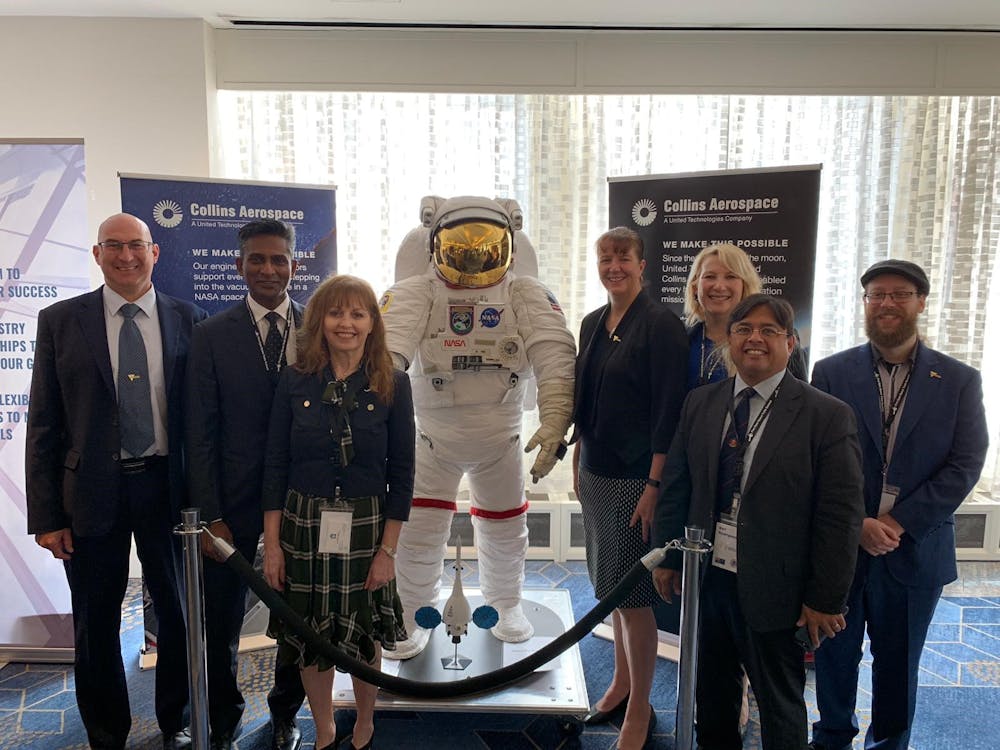 In 2019 I led a Victorian Trade mission for aerospace in the US. This picture was taken in Connecticut at the International Space Trade Summit, where I spoke. I’m pictured here (third from the right) with the Victorian Delegation and Karl Rodrigues from the Australian Space Agency.
Author provided
In 2019 I led a Victorian Trade mission for aerospace in the US. This picture was taken in Connecticut at the International Space Trade Summit, where I spoke. I’m pictured here (third from the right) with the Victorian Delegation and Karl Rodrigues from the Australian Space Agency.
Author provided
Read more: Keen to sign up for space tourism? Here are 6 things to consider (besides the price tag)
Preparing for every possibility
To graduate as a PoSSUM Scientist-Astronaut candidate, there are several academic and flight training components I must complete before I can head into space.
During academic training in 2020, I covered topics such as spaceflight physiology (what happens to the body in space), spaceflight life support, atmospheric science and spaceflight research equipment.
My flight training later this year will involve spending days with former NASA astronaut instructors and PoSSUM team scientists. On day one, we’ll begin to use the spaceflight simulator which is currently set up as the Virgin Galactic Unity 22 vehicle.
In the days that follow, we will receive high-G training, crew resource management training, high-altitude training and equipment training which will be crucial to conduct our research. We’ll learn how to operate a series of instruments to measure physical atmospheric properties.
We will also need to know our way around the spacesuits, which will be similar to those used by NASA. The famous orange suits are a life-support system for astronauts. Astronauts in orbital and suborbital spaceflights must wear them during launch, flight and return in case they have to exit the spacecraft in an emergency, or in case the spacecraft depressurises.
 Me sitting in the captain’s seat of the NASA’s Space Shuttle Endeavour.
Author provided
Me sitting in the captain’s seat of the NASA’s Space Shuttle Endeavour.
Author provided
We’ll need to learn how to manage unexpected events such as decompression, too. This is when the pressure inside a spacecraft or spacesuit is reduced by a leak. If pressure becomes too low, breathing oxygen can be forced out of the suit. The astronaut will then experience hypoxia (a lack of oxygen in body tissues), which can be deadly.
Or let’s say we’re not able to land where we planned to; the training will cover how to manage a water landing and a fast exit from the vehicle. We must be prepared in case one of the electrical or physical systems fails, causing a hazardous environment.
Nobody likes to imagine things going wrong, but planning for emergencies is necessary.
A ‘steep’ learning curve aboard parabolic flights
It’s likely I will complete my first research flight to space on the Virgin Galactic vehicle — but given the rate of spacecraft development, it could be another similar craft.
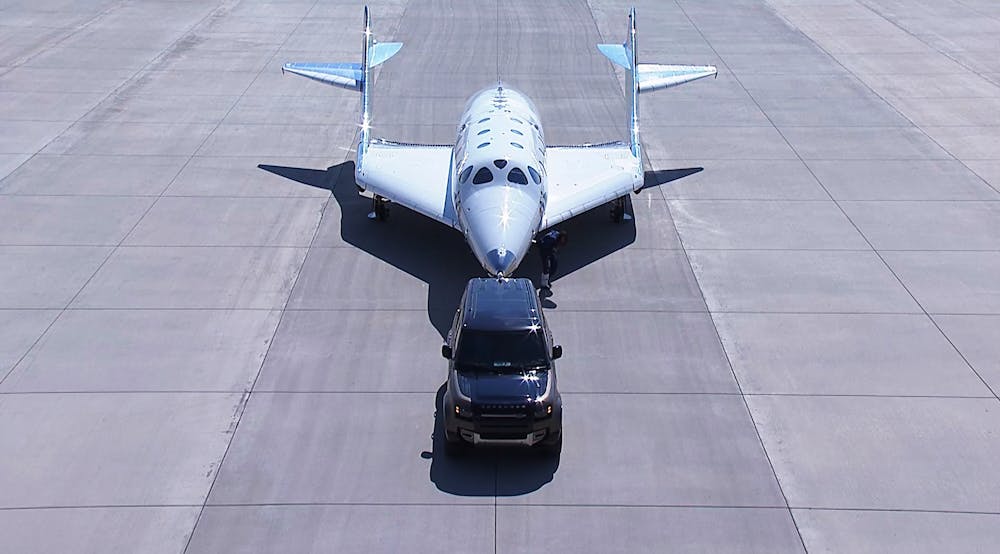 If all goes to plan, my team and I might go to space in a Virgin Galactic Unity 22 vehicle — or potentially in another similar spacecraft.
Virgin Galactic/EPA
If all goes to plan, my team and I might go to space in a Virgin Galactic Unity 22 vehicle — or potentially in another similar spacecraft.
Virgin Galactic/EPA
Launching aboard a spacecraft subjects the human body to a variety of forces. Learning to identify and manage changes caused by these forces is critical. On day four of training I will climb into an aerobatic aircraft with a cruise speed of 317km per hour, in which I will practice using equipment and techniques to avoid blackouts during aerobatic flight.
The final test will be a series of parabolic flights simulating microgravity aboard a different aircraft. In parabolic flights, an aircraft repeatedly climbs steeply, then enters a deep dive, to create weightlessness for up to 40 seconds. This is repeated 20-25 times during the flight to demonstrate weightlessness in space. Experiments are conducted during weightlessness.
The last day of training will involve using virtual and augmented reality to practise planning space missions. We’ll be able to work on any aspect of the training we feel is needed before our final evaluation.
If all goes to plan, I will graduate with FAA (Federal Aviation Administration) qualifications as a spaceflight crew member for any space vehicle in the US (orbital and suborbital). Both my training and the work I will do aboard my first suborbital flight as a payload specialist fall within the guidelines outlined in the FAA’s advisory circular released on July 20.
If there are no further changes to the eligibility requirements or criteria, I could be nominated to receive Astronaut Wings once the mission is complete.
Why do research in space anyway?
But what’s the big deal when it comes to research in space? Well, for one, spaceflight allows researchers to observe how materials behave in the absence of gravity.
Studying how materials behave in weightless environments has proven immensely useful for scientists. For instance, studying how a virus replicates in space could help scientists develop better vaccines and treatments for diseases such as COVID-19.
Most people have heard of the International Space Station (ISS): the football-field sized laboratory in space which constantly orbits Earth. Generally, only space agency astronauts from the US, Russia, Japan and Europe will travel to and from the ISS in various orbital spacecraft (rockets). Doing research on the ISS is expensive, slow and subject to long wait times.
Australian companies can benefit from research opportunities offered by suborbital flights in the USA. Being able to complete human tended research on a suborbital research flight is a much more affordable option, and is therefore a game changer. It means small companies that couldn’t previously afford spaceflight can now get in the game.
It’s an honour for me to be able to train for this mission and hopefully bring the space dream closer to Australia. And by teaching space technology and law, I look forward to playing my part in advancing the next generation’s access to space.
Read more: As if space wasn't dangerous enough, bacteria become more deadly in microgravity
Authors: Kim Ellis Hayes, Senior Lecturer in Space Research & Law / In training as Suborbital Spaceflight PoSSUM Astronaut Candidate Graduate, Swinburne University of Technology


 Daily Bulletin


