

Fossil fuel misinformation may sideline one of the most important climate change reports ever released
- Written by: Christian Downie, Associate professor, Australian National University
This week’s landmark report on the state of the climate paints a sobering picture. The Intergovernmental Panel on Climate Change (IPCC) concluded that, without deep and immediate cuts to greenhouse gas emissions, the world is very likely headed for climate catastrophe.
In November, world leaders will gather in Glasgow for the latest round of United Nations climate talks. It’s the most crucial round of climate negotiations since those which led to the Paris Agreement in 2015.
The question is: will governments around the world now listen to the climate science? Or will misinformation campaigns backed by vested interests continue to delay action?
If we’re to avert a climate disaster, we must not underestimate the power of climate misinformation campaigns to undermine the IPCC findings and ensure governments continue to ignore the science.
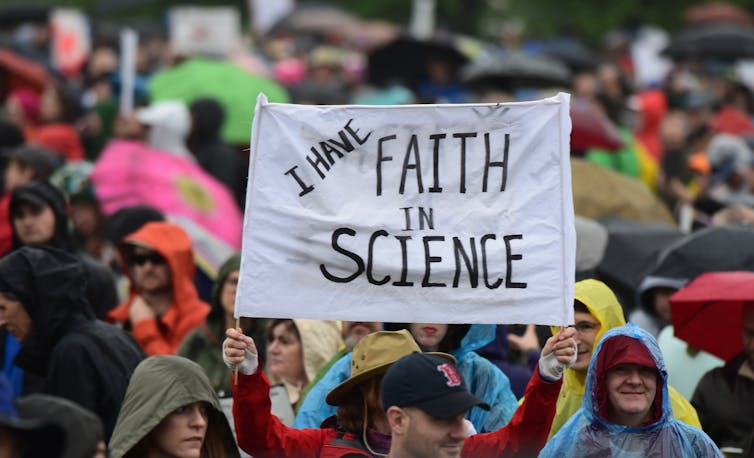 Science must be at the heart of policy-making if climate change is to be addressed.
Shutterstock
Science must be at the heart of policy-making if climate change is to be addressed.
Shutterstock
A history of heeding the science
Scrutiny of Australia’s climate policies will be particularly harsh at the Glasgow meeting, given the Morrison government’s failure to implement substantive policies to reduce emissions. We can expect renewed international pressure on Australia to commit to net-zero emissions by 2050 and set out a national plan to decarbonise the economy this decade.
For those who believe in the power of science, the failure of world leaders to act urgently is frustrating, to say the least.
We have acted on the concerns of scientists in the past. In fact, it was scientists such as NASA’s James Hansen who put climate change on the agenda back in 1988, triggering international negotiations.
Scientific concern over the growing hole in the ozone layer prompted the 1987 Montreal Protocol, an international agreement to curb the use of ozone-depleting substances.
And of course, scientific advice is guiding the government response to the COVID-19 pandemic.
There are many reasons why the calls of climate scientists are not being heeded at present. But one factor has been particularly successful in delaying climate action: scientific misinformation campaigns.
These campaigns damage public understanding of science, erode trust in research findings, and undermine evidence-based policy.
Read more: A brief history of fossil-fuelled climate denial
 Governments heeded scientific warnings over the ozone hole – so why not climate change?
Shutterstock
Governments heeded scientific warnings over the ozone hole – so why not climate change?
Shutterstock
Muddying the waters
Research has shown climate misinformation campaigns are often backed by corporate interests which stand to lose if the world transitions to a cleaner energy future.
Such a future could bring incredible benefits to Australia – a country with some of the world’s best solar and wind resources.
The campaigns have wrought untold damage to the public debate on climate science. These corporations have funded industry associations, think tanks and front groups (even including paid actors) to mobilise a counter movement to climate action.
Examples of the phenomenon abound. In the United States, oil and gas giant ExxonMobil reportedly knew of climate change 40 years ago, but funded climate deniers for decades.
Reports emerged last week that Facebook failed to prevent a climate misinformation campaign by the oil and gas industry during last year’s US presidential election.
The war against climate science has been waged in Australia, too. Researchers and journalists have described the lengths the oil, gas and coal industries have gone to challenge the scientific consensus on climate change, and to kill off policies put in place to limit emissions.
Australian media companies such as News Corp have also been criticised for downplaying the significance of the climate crisis. Little wonder, then, that Australian news consumers are far more likely to believe climate change is “not at all” serious compared to news users in other countries.
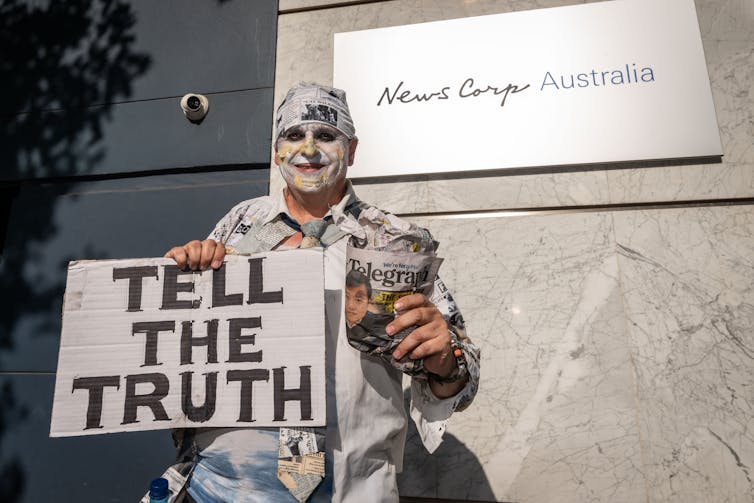 News Corp has been accused of underplaying the seriousness of climate change.
Shutterstock
News Corp has been accused of underplaying the seriousness of climate change.
Shutterstock
Calling out misinformation
The latest IPCC report was five years in the making. It involved 234 leading scientists from more than 60 countries, who rigorously assessed more than 14,000 research papers to produce their synthesis. The result is the most authoritative, reliable report on the state of Earth’s climate since the last IPCC report of its kind in 2013.
But as the history of climate action has shown, incontrovertible science is not enough to shift the needle – in large part due to climate misinformation which deceives the public and weakens pressure on governments to act.
We must call out attempts by those who seek to delay climate action in the name of profit – and then counter those attempts. As the IPCC has shown this week, further delay equals catastrophe.
Read more: We have the vaccine for climate disinformation – let's use it
Authors: Christian Downie, Associate professor, Australian National University


 Daily Bulletin


