

'I feel suffocated': Afghans are increasingly hopeless, but there's still a chance to preserve some rights
- Written by: Nematullah Bizhan, Lecturer in Public Policy at the Development Policy Centre, Australian National University, and Senior Research Associate with the Global Economic Governance Program, Oxford University, Australian National University
Two days ago, a close friend in Afghanistan told me Kabul seems like a graveyard. Silenced. Helpless. And hopeless.
This reminds me of the empty streets and hopelessness during my time under the Taliban’s rule in the late 1990s. People sold their household belongings on the streets of Kabul and other cities to feed their families or pay for their travel costs to leave the country. Education for girls above year six was banned. Women were not allowed to work.
During those five years from 1996-2001, the Taliban established a theocratic totalitarian regime. After the fall of Afghanistan to the Taliban and the rapid demise of the republic this week, Afghans are concerned the group will revert to its old policies and they will lose their guaranteed, fundamental rights.
Perhaps people are right. No sign of change is yet apparent from the Taliban.
Read more: Afghan refugees can no longer wait — Australia must offer permanent protection now
Women are the most concerned. Following the recent fall of Herat, the third-largest city in Afghanistan, women and girls were told by the Taliban to go back to their homes when they went to work or university.
A prominent journalist in a city in the north of Afghanistan told me that a Talib came to his house four times asking where he was. He was safe in a different location, but he was terrified because of concern for the security of his immediate family members. This doesn’t match the “change” narrative of the Taliban’s political leadership, granting amnesty to everyone.
And a well-known activist and analyst told me today, “I don’t have the ability to stay here in this situation. I feel suffocated. God help us. I don’t know what will happen.”
Bleak days, but still a chance to preserve gains
Uncertainty and fear are common among people now in Afghanistan. Many have reacted to Taliban takeover by attempting to leave the country en masse. At Kabul’s airport, thousands rushed onto the tarmac and some were so desperate they held onto an American military jet as it took off. On that day, seven people were killed.
The army, economy and critical public services have all collapsed in a matter of weeks. Afghans feel betrayed by the Biden administration and its allies, and even their own president, who fled the country, leaving them in chaos.
As one source in Afghanistan told me, the Taliban also betrayed Afghans, using the peace process with the US to buy time and capture Afghanistan. Afghans now have no one to trust.
Afghanistan is now in grave danger. Even though we have not lost everything, we will do so soon, especially if the international community and the UN sit idle.
The hard-won gains that were achieved in the last two decades may perish. The fundamental rights of citizens, including freedom of expression and equal access to education and work, are at great risk.
Still, there is a chance to preserve some gains and prevent the humanitarian crisis from deepening.
Many questions have yet to be answered. It is not yet clear whether the new governing arrangement will be a return to the Taliban’s former Islamic emirate. It’s also not clear if there will be a political settlement with the elements of the previous government. Of even if there will be an armed resistance against the Taliban’s rule.
How the international community can help
While the US and its allies have lost much of their leverage in Afghanistan, they still can make a positive contribution in three areas.
First, they can provide protection to vulnerable people and those at greater risk of persecution by the Taliban. This can occur by offering special refugee intakes and granting protection to Afghans who had already applied for protection and are stuck in limbo — as Canada has done.
Second, the international community can put pressure or even impose sanctions on the Taliban and those countries supporting them to preserve the gains achieved in the last two decades.
How the UN responds will be key. The UN, which has more than 3,000 staff working in Afghanistan, will soon have to decide whether to recognise the Taliban government and give it the Afghanistan seat. The Security Council has called for talks on a new government, but stronger action could have a real impact on the Taliban’s actions.
Third, the international community must provide humanitarian assistance to internally displaced people and others affected by the recent war.
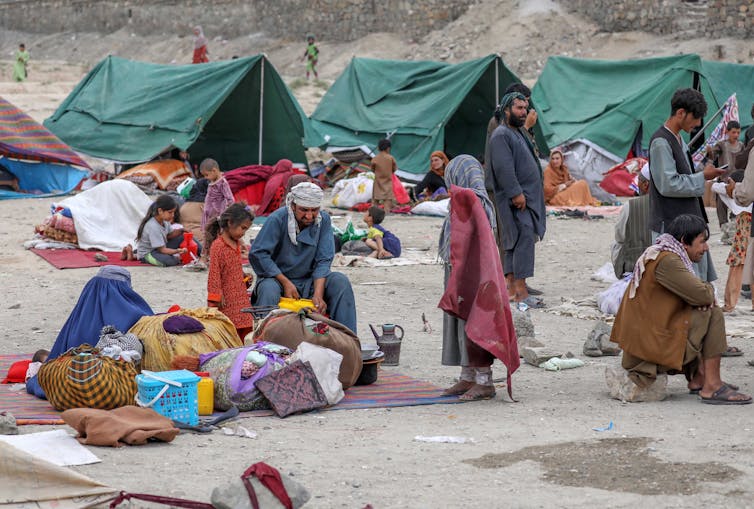 Internally displaced families who fled their homes due to fighting between Taliban and Afghan security forces, now living in a public park in Kabul.
HEDAYATULLAH AMID/EPA
Internally displaced families who fled their homes due to fighting between Taliban and Afghan security forces, now living in a public park in Kabul.
HEDAYATULLAH AMID/EPA
In addition to this, the powers in the region — China, Pakistan, Iran and Russia — can also play a vital role. But their intentions are unclear. Some have tacitly welcomed the Taliban victory, while also increasing their security forces on the border with Afghanistan.
The least they can do is keep their borders open to those Afghans who are vulnerable and are seeking refuge in a third country.
Afghanistan has seen so much fighting and instability over the past four decades, fuelled by great power and regional rivalries. This has caused unparalleled human suffering and tragedy. One day these powers may feel regret for their actions, but now is the time for empathy – for Afghanistan and its people.
Read more: As the Taliban returns, 20 years of progress for women looks set to disappear overnight
Authors: Nematullah Bizhan, Lecturer in Public Policy at the Development Policy Centre, Australian National University, and Senior Research Associate with the Global Economic Governance Program, Oxford University, Australian National University


 Daily Bulletin


