

Who were the Toaleans? Ancient woman's DNA provides first evidence for the origin of a mysterious lost culture
- Written by: Adam Brumm, Professor, Griffith University
In 2015, archaeologists from the University of Hasanuddin in Makassar, on the Indonesian island of Sulawesi, uncovered the skeleton of a woman buried in a limestone cave. Studies revealed the person from Leang Panninge, or “Bat Cave”, was 17 or 18 years old when she died some 7,200 years ago.
Her discoverers dubbed her Bessé’ (pronounced bur-sek¹) — a nickname bestowed on newborn princesses among the Bugis people who now live in southern Sulawesi. The name denotes the great esteem local archaeologists have for this ancient woman.
She represents the only known skeleton of one of the Toalean people. These enigmatic hunter-gatherers inhabited the island before Neolithic farmers from mainland Asia (“Austronesians”) spread into Indonesia around 3,500 years ago.
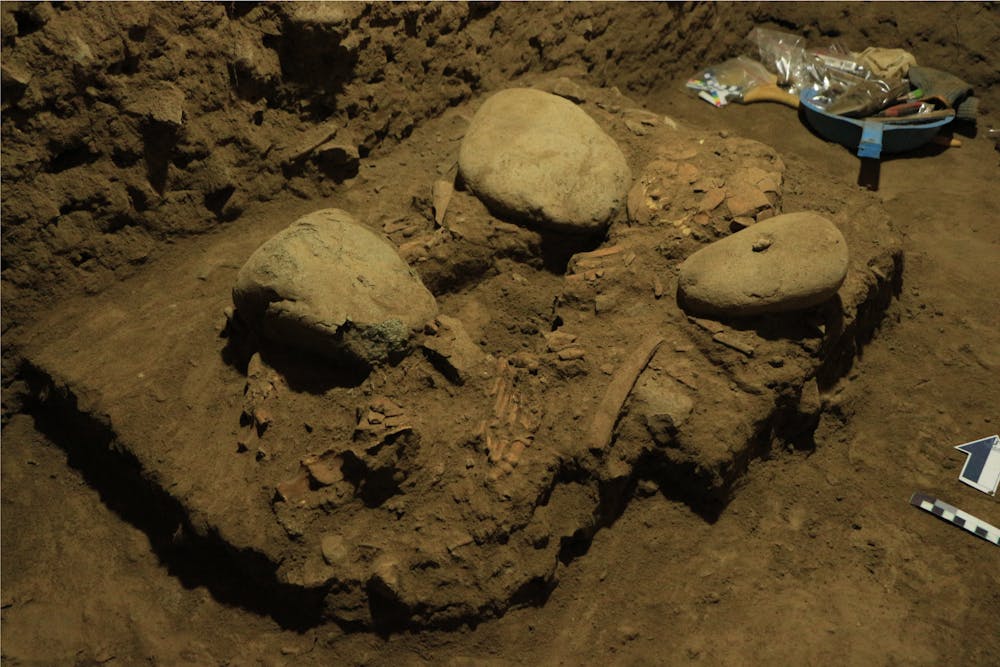 Burial of a Toalean hunter-gatherer woman dated to 7,200 years ago. Bessé’ was 17-18 years old at time of death. She was buried in a flexed position and several large cobbles were placed on and around her body. Although the skeleton is fragmented, ancient DNA was found preserved in the dense inner ear bone (petrous).
University of Hasanuddin
Burial of a Toalean hunter-gatherer woman dated to 7,200 years ago. Bessé’ was 17-18 years old at time of death. She was buried in a flexed position and several large cobbles were placed on and around her body. Although the skeleton is fragmented, ancient DNA was found preserved in the dense inner ear bone (petrous).
University of Hasanuddin
Our team found ancient DNA that survived inside the inner ear bone of Bessé’, furnishing us with the first direct genetic evidence of the Toaleans. This is also the first time ancient human DNA has been reported from Wallacea, the vast group of islands between Borneo and New Guinea, of which Sulawesi is the largest.
Genomic analysis shows Bessé’ belonged to a population with a previously unknown ancestral composition. She shares about half of her genetic makeup with present-day Indigenous Australians and people in New Guinea and the Western Pacific. This includes DNA inherited from the now-extinct Denisovans, who were distant cousins of Neanderthals.
In fact, relative to other ancient and present-day groups in the region, the proportion of Denisovan DNA in Bessé’ could indicate the main meeting point between our species and Denisovans was in Sulawesi itself (or perhaps a nearby Wallacean island).
Read more: Evolutionary study suggests prehistoric human fossils 'hiding in plain sight' in Southeast Asia
The ancestry of this pre-Neolithic woman provides fascinating insight into the little-known population history and genetic diversity of early modern humans in the Wallacean islands — the gateway to the continent of Australia.
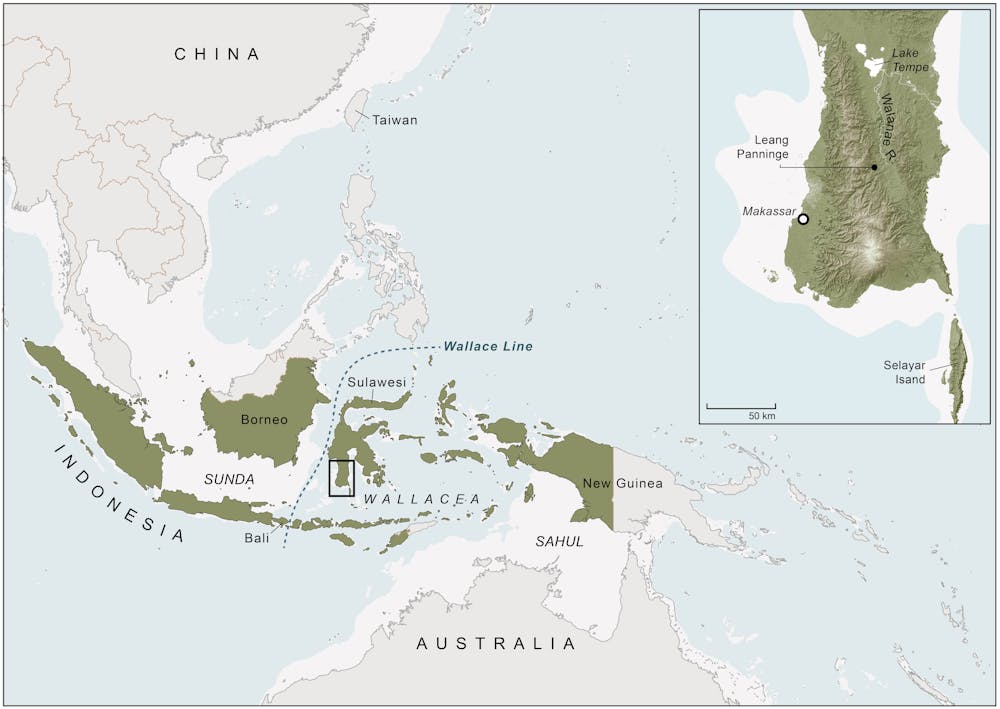 Sulawesi is the largest island in Wallacea, the zone of oceanic islands between the continental regions of Asia and Australia. White shaded areas represent landmasses exposed during periods of lower sea level in the Late Pleistocene. The Wallace Line is a major biogeographical boundary that marks the eastern extent of the distinctive plant and animal worlds of Asia. The Toalean cave site Leang Panninge (where Bessé’ was found) is located in Sulawesi’s southwestern peninsula (see inset panel). Toalean archaeological sites have only been found in a roughly 10,000 km² area of this peninsula, south of Lake Tempe.
Kim Newman
Sulawesi is the largest island in Wallacea, the zone of oceanic islands between the continental regions of Asia and Australia. White shaded areas represent landmasses exposed during periods of lower sea level in the Late Pleistocene. The Wallace Line is a major biogeographical boundary that marks the eastern extent of the distinctive plant and animal worlds of Asia. The Toalean cave site Leang Panninge (where Bessé’ was found) is located in Sulawesi’s southwestern peninsula (see inset panel). Toalean archaeological sites have only been found in a roughly 10,000 km² area of this peninsula, south of Lake Tempe.
Kim Newman
Toalean culture
The archaeological story of the Toaleans began more than a century ago. In 1902, the Swiss naturalists Paul and Fritz Sarasin excavated several caves in the highlands of southern Sulawesi.
Their digs unearthed small, finely crafted stone arrowheads known as Maros points. They also found other distinctive stone implements and tools fashioned from bone, which they attributed to the original inhabitants of Sulawesi — the prehistoric “Toalien” people (now spelled Toalean).
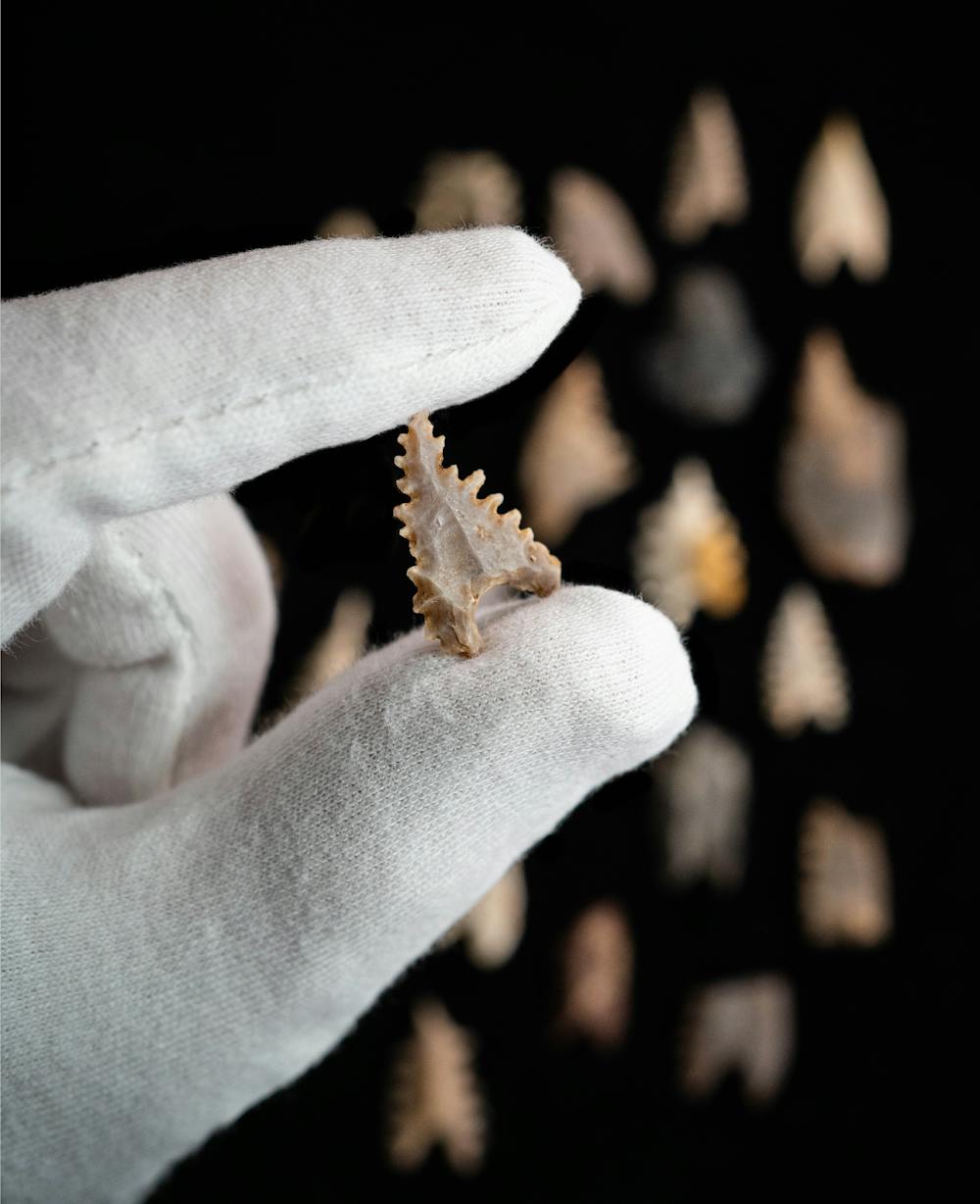 A Toalean stone arrowhead, known as a Maros point. Classic Maros points are small (roughly 2.5cm in maxiumum dimension) and were fashioned with rows of fine tooth-like serrations along the sides and tip, and wing-like projections at the base. Although this particular stone technology seems to have been unique to the Toalean culture, similar projectile points were produced in northern Australia, Java and Japan.
Shahna Britton/Andrew Thomson.
A Toalean stone arrowhead, known as a Maros point. Classic Maros points are small (roughly 2.5cm in maxiumum dimension) and were fashioned with rows of fine tooth-like serrations along the sides and tip, and wing-like projections at the base. Although this particular stone technology seems to have been unique to the Toalean culture, similar projectile points were produced in northern Australia, Java and Japan.
Shahna Britton/Andrew Thomson.
Some Toalean cave sites have since been excavated to a higher scientific standard, yet our understanding of this culture is at an early stage. The oldest known Maros points and other Toalean artefacts date to about 8,000 years ago.
Excavated findings from caves suggest the Toaleans were hunter-gatherers who preyed heavily on wild endemic warty pigs and harvested edible shellfish from creeks and estuaries. So far, evidence for the group has only been found in one part of southern Sulawesi.
Toalean artefacts disappear from the archaeological record by the fifth century AD — a few thousand years after the first Neolithic settlements emerged on the island.
Prehistorians have long sought to determine who the Toaleans were, but efforts have been impeded by a lack of securely-dated human remains. This all changed with the discovery of Bessé’ and the ancient DNA in her bones.
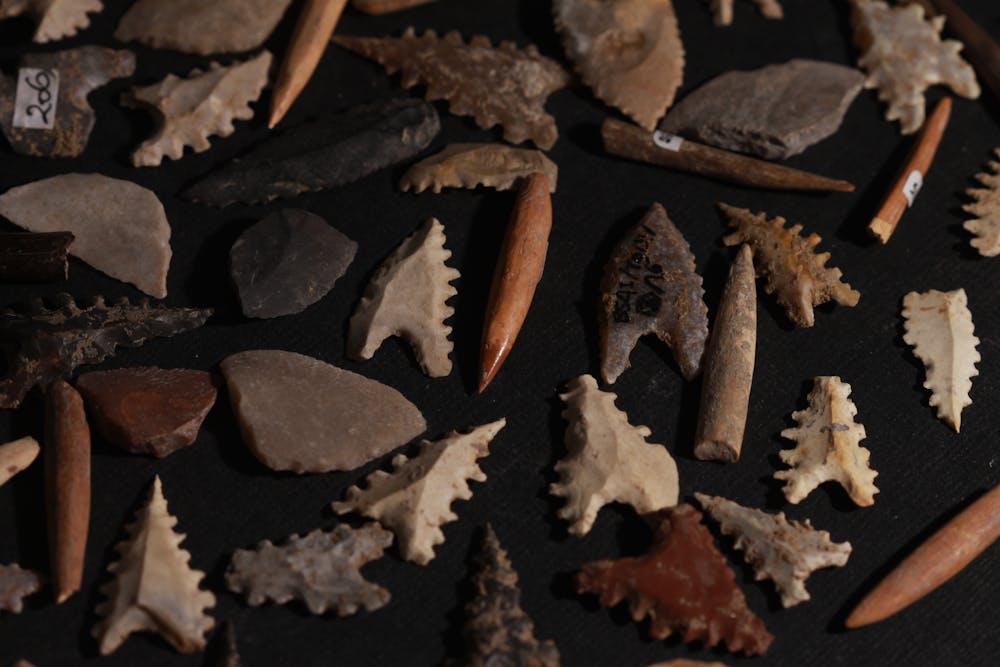 Toalean stone arrowheads (Maros points), backed microliths (small stone implements that may have been hafted as barbs) and bone projectile points. These artefacts are from Indonesian collections curated in Makassar and mostly comprise undated specimens collected from the ground surface at archaeological sites.
Basran Burhan
Toalean stone arrowheads (Maros points), backed microliths (small stone implements that may have been hafted as barbs) and bone projectile points. These artefacts are from Indonesian collections curated in Makassar and mostly comprise undated specimens collected from the ground surface at archaeological sites.
Basran Burhan
The ancestral story of Bessé’
Our results mean we can now confirm existing presumptions the Toaleans were related to the first modern humans to enter Wallacea some 65,000 years ago or more. These seafaring hunter-gatherers were the ancestors of Aboriginal Australians and Papuans.
They were also the earliest inhabitants of Sahul, the supercontinent that emerged during the Pleistocene (ice age) when global sea levels fell, exposing a land bridge between Australia and New Guinea. To reach Sahul, these pioneering humans made ocean crossings through Wallacea, but little about their journeys is known.
Read more: Island-hopping study shows the most likely route the first people took to Australia
It is conceivable the ancestors of Bessé’ were among the first people to reach Wallacea. Instead of island-hopping to Sahul, however, they remained in Sulawesi.
But our analyses also revealed a deep ancestral signature from an early modern human population that originated somewhere in continental Asia. These ancestors of Bessé’ did not intermix with the forebears of Aboriginal Australians and Papuans, suggesting they may have entered the region after the initial peopling of Sahul — but long before the Austronesian expansion.
Who were these people? When did they arrive in the region and how widespread were they? It’s unlikely we will have answers to these questions until we have more ancient human DNA samples and pre-Neolithic fossils from Wallacea. This unexpected finding shows us how little we know about the early human story in our region.
A new look at the Toaleans
With funds awarded by the Australian Research Council’s Discovery program we are initiating a new project that will explore the Toalean world in greater detail. Through archaeological excavations at Leang Panninge we hope to learn more about the development of this unique hunter-gatherer culture.
 Excavations at Leang Panninge cave, Mallawa, South Sulawesi.
Leang Panninge Research Team.
Excavations at Leang Panninge cave, Mallawa, South Sulawesi.
Leang Panninge Research Team.
We also wish to address longstanding questions about Toalean social organisation and ways of life. For example, some scholars have inferred the Toaleans became so populous that these hitherto small and scattered groups of foragers began to settle down in large sedentary communities, and possibly even domesticated wild pigs.
It has also recently been speculated Toaleans were the mysterious Asian seafarers who visited Australia in ancient times, introducing the dingo (or more accurately, the domesticated ancestor of this now-wild canid). There is clearly much left to uncover about the long island story of Bessé’ and her kin.
¹The “bur” syllable is pronounced as in the English word “bursary”. The “k” is essentially a strangulated stop in the throat, akin to the “t” in the Cockney “bo'ol”, for bottle. (With thanks to Professor Campbell Macknight).
Authors: Adam Brumm, Professor, Griffith University


 Daily Bulletin


