

Auckland is likely to remain in strict lockdown for several more weeks to stamp out NZ's Delta outbreak
- Written by: Rachelle Binny, Research scientist in mathematical modelling, Manaaki Whenua - Landcare Research
Editor’s update: All of New Zealand remains in level 4 lockdown conditions until midnight on Tuesday, August 31, after which everyone south of the Auckland boundary will move to level 3, while Auckland and Northland remain in level 4, likely for two more weeks.
As New Zealanders wait to hear if a nationwide level 4 lockdown continues beyond midnight on Friday, our latest modelling shows that the current Delta variant has spread much faster than last August’s outbreak, when around 90 people had been infected before it was detected.
Daily case numbers have continued to climb this week, with 68 new cases reported today, bringing the total to 277 cases. This rise is to be expected as contact tracers cast a wider net than before to work their way towards the edges of the fast-moving Delta clusters.
We now know that several superspreading events occurred before the outbreak was picked up, with a large number of people becoming infected at a church service on August 15. Incorporating data from contact tracing and testing makes it likely there were upwards of 200 people infected before New Zealand went into strict lockdown on August 18.
Given the scale of this outbreak, it’s likely that at least Auckland will need several more weeks at alert level 4 to stamp out community transmission.
The lockdown will have started to reduce transmission immediately but the lag time between being infected and getting a test means it takes time for the effect to filter through to reported case numbers.
Cases reported today are telling us about transmission seven to ten days ago. But we expect to see daily case numbers starting to level off over the next week.
Read more: New Zealanders haven't been scanning in enough, and that contributed to the need for a full lockdown
During earlier outbreaks, the goal for contact tracing has been to reach 80% of contacts within 48 hours to get people into isolation and break any chains of transmission. This hasn’t changed for Delta, but it is much more challenging for contact tracers, who now face thousands rather than tens or hundreds of new contacts each day.
This is why the rapid move to alert level 4 was so important to minimise the number of interactions between people so that contact tracing can catch up.
Delta is a formidable enemy
Data from around the world show that once someone in a household has Delta, almost everyone else in their household will get infected. This wasn’t the case with earlier variants of the virus, and means we may see case numbers remain high for a longer period than with previous outbreaks.
Exactly how long we’ll have to stay in lockdown depends on the R number — the average number of people an infected person passes the virus on to. We need alert level 4 to push the R number below 1 to see case numbers starting to drop.
In the March-April 2020 outbreak, we estimated the R number under alert level 4 to be around 0.4.
But as Director-General of Health Ashley Bloomfield explained, dealing with the Delta variant is like dealing with a whole new virus. In the absence of control measures or immunity, Delta’s R number is estimated to be at least 6, more than twice that of the original strain.
After accounting for vaccination coverage, alert level 4 restrictions and other measures like contact tracing will need to reduce transmission by at least 80% to see case numbers decline. If the R number stays close to one, case numbers will be slow to fall.
Once there is enough data from this outbreak, we’ll be able to estimate how effective alert level 4 is against Delta. This will allow us to gauge what it will take for Auckland to stamp out community transmission.
Regions with no cases aren’t out of the woods
Although regions with no known cases may see a drop in alert level announced tomorrow, we still need to remain cautious. We know the outbreak spread to Wellington and close contacts of known cases have been identified from many parts of the country, including in the South Island.
There may well be other contacts who haven’t been identified. The lack of detection of the virus outside of Auckland and Wellington in either waste water or community testing has been encouraging.
But today’s positive waste water sample from Christchurch adds to the uncertainty. Hopefully further testing from around Christchurch will identify if this was due to cases in MIQ rather than in the community.
This outbreak started when the virus was transported from New South Wales and leaked out of our MIQ system. Cook Strait is a much narrower neck of water than the Tasman Sea and we don’t have any quarantine for travellers between islands.
So while there is a large active outbreak in Auckland, there’s still a risk the virus could slip into other parts of the country.
Elimination remains the best strategy
The elimination strategy is still the best option for New Zealand, simply because the alternatives are grim.
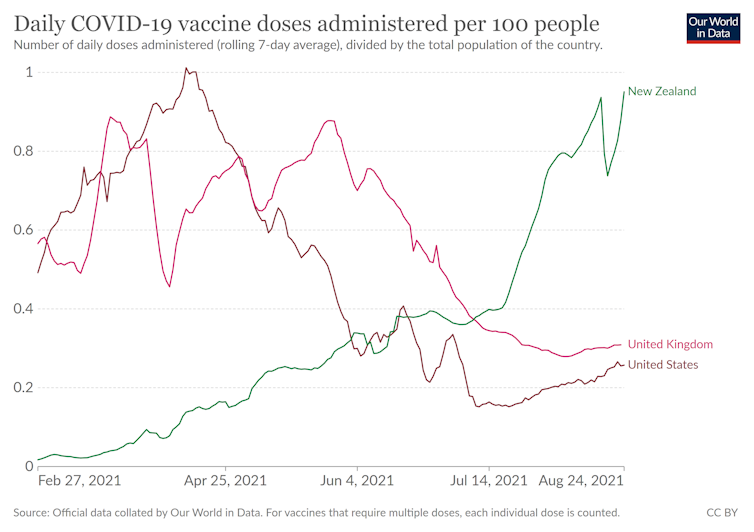
Nearly 24% of New Zealanders are now fully vaccinated and a further 18% have had one dose. This level of vaccination may reduce the R number by 15-20% nationally.
New Zealand’s vaccine rollout has accelerated over past weeks. We are now vaccinating around 1% of the population every day. But full protection from the vaccine only kicks in several weeks after the second dose.
Our vaccination programme is helping, but it won’t be fast enough to control this outbreak unless it is combined with an effective lockdown.
 CC BY-ND
Once our vaccine coverage is higher, we will have more options for dealing with an outbreak like this. But at the moment, our only option to bring major outbreaks under control is with a strict lockdown.
If we don’t use alert level 4 to eliminate the virus, we will either need a prolonged lockdown like New South Wales currently has or our hospitals will be rapidly overrun. Our best option is to throw everything we have at this outbreak in the coming weeks.
There is every reason to be optimistic we can eliminate this outbreak. The swift move to level 4 after the first positive test has undoubtedly prevented the outbreak from growing far bigger. Prospects for elimination are much better than if the government had sat on its hands for a few days.
New Zealand’s alert level 4 has been effective in the past and, more importantly, public support and adherence to the restrictions remain high. This means the opportunities for the virus to spread are greatly reduced and most transmission chains are stopped in their tracks.
The lockdown is working but we need to stay the course for a while longer.
CC BY-ND
Once our vaccine coverage is higher, we will have more options for dealing with an outbreak like this. But at the moment, our only option to bring major outbreaks under control is with a strict lockdown.
If we don’t use alert level 4 to eliminate the virus, we will either need a prolonged lockdown like New South Wales currently has or our hospitals will be rapidly overrun. Our best option is to throw everything we have at this outbreak in the coming weeks.
There is every reason to be optimistic we can eliminate this outbreak. The swift move to level 4 after the first positive test has undoubtedly prevented the outbreak from growing far bigger. Prospects for elimination are much better than if the government had sat on its hands for a few days.
New Zealand’s alert level 4 has been effective in the past and, more importantly, public support and adherence to the restrictions remain high. This means the opportunities for the virus to spread are greatly reduced and most transmission chains are stopped in their tracks.
The lockdown is working but we need to stay the course for a while longer.
Authors: Rachelle Binny, Research scientist in mathematical modelling, Manaaki Whenua - Landcare Research


 Daily Bulletin


