

The shifting sands of COVID and our uncertain future has a name -- liminality
- Written by: Sarah Wayland, Senior Lecturer Social Work, University of New England
During the pandemic, lots of us, myself included, are struggling to live in the “now”. That “now”, with all its uncertainty, doesn’t look like the life we used to live or the life we imagine we will return to.
That experience has a name — liminality.
Understanding liminality and its origins can provide ways to better understand the foggy, ambiguous space we currently inhabit.
Read more: Not all doom and gloom: even in a pandemic, mixed emotions are more common than negative ones
What is liminality?
European anthropologist Arnold van Gennep pioneered the study of liminality in the early 20th century. His work on liminal spaces focused on the rites of passage we transition through in life.
Since then, the term liminality has been used to describe the paths we navigate when faced with life events. These are the times when we are in a metaphorical waiting room between one life stage and another.
I’ve been studying liminality throughout my career working with families of missing people.
These families, waiting for missing people to come home, can also experience a sense of liminality. They can be stuck between certainty and uncertainty about knowing what happened to their loved ones and learning to live without answers.
What families of missing people taught me is what helps us survive uncertainty is reflecting on our own capacity to tolerate “not knowing”.
An everyday example might be sitting an exam and waiting for the outcome. You might be unable to plan ahead, and are balancing thoughts of passing or failing, all at the same time.
What’s this to do with COVID?
During COVID, how we believe our lives “should” work ceases to exist. And we’re left with uncertainty.
We ask ourselves, others or Google “how long will the pandemic last?”, “when will lockdown end” or “when can we safely travel?”.
Liminality shows up in other ways, with the:
lost life-stage rituals such as the sudden end of the school year, but without the formals or graduation ceremonies
newfound uncertainty about daily tasks we once took for granted. “I just need to pop to the shops” is now an exercise in decisions and questions about masks, social distancing and what’s essential
grandparents who haven’t cuddled their first grandchild and made that transition to a new stage of their life. They may live between saying “well at least we are healthy” while quietly lamenting those missed opportunities.
Read more: Learning to cope with uncertainty during COVID-19
There are real health impacts
The space between the life we had and the life we potentially will be able to live can cause us distress. And no amount of Zoom trivia, Uber Eats delivery or walking around the block can satisfy us.
Liminality during COVID has also impacting our health and well-being in other ways.
People with eating disorders have noted an increase in behaviours, as a coping tool, when faced with uncertainty. Diabetes educators have noted increased isolation and disconnection from usual routines can impact how diabetes is managed.
But the liminal space can also provide breathing room to learn to live with uncertainty and overcome what scares us.
Read more: It's OK if you have a little cry in lockdown. You're grieving
How to cope with uncertainty
To manage uncertainty, individually and collectively, we need to reflect on how we receive information.
A US study found one place we go to for information, for certainty in a pandemic, is science. However, given science changes as research progresses, public health messaging can also change. So this repetitive looking for certainty, in an uncertain world, makes it difficult to learn to live with COVID.
We know long periods of uncertainty can have impacts on our capacity to cope. Without the strong foundation of certainty or “knowns” in our life, the reshaping of the world, from the pandemic, can and will be unsettling.
Read more: Life is full of uncertainty, we've just got to learn to live with it
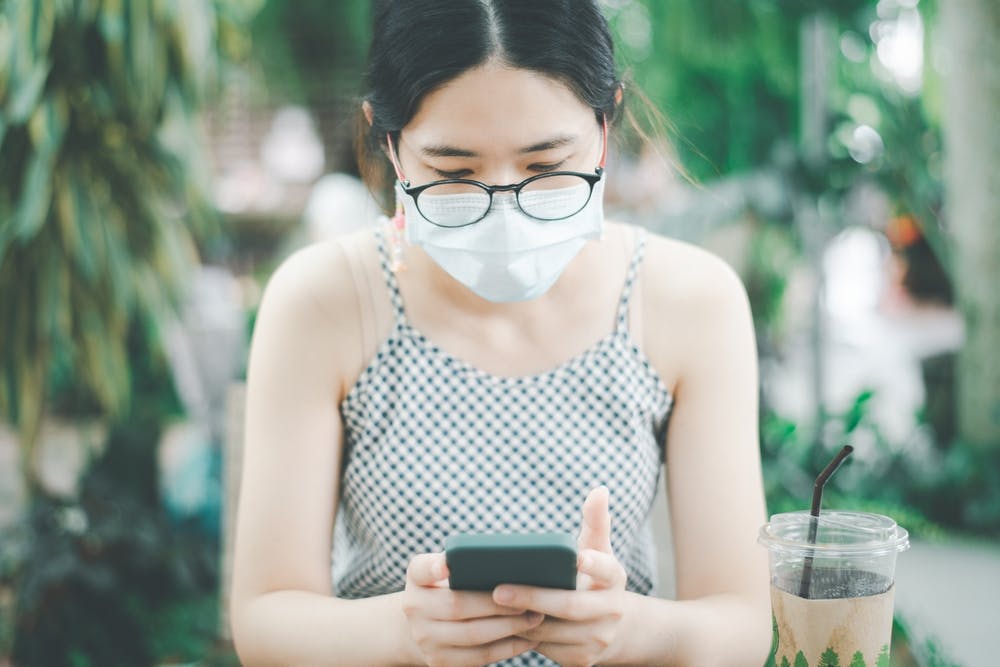 Do we really need to stay up-to-date with the latest twists and turns of the news cycle?
Shutterstock
Do we really need to stay up-to-date with the latest twists and turns of the news cycle?
Shutterstock
I’m not suggesting abandoning science, far from it. But those not at the forefront of designing vaccines, studying epidemiological trends or treating COVID patients might like to rethink our relationship with certainty.
Learning to “go with” all the twists and turns that come with rapidly changing science and the resultant uncertainty is what we need. We might enhance our lives by accepting liminality in how we navigate each day, to learn to tolerate ambiguity.
It is not simple to accept the unknown. However in this pandemic, learning to accept public health advice (and the science that underpins it) might change is part of living through a worldwide event.
Not knowing what next week will look like and finding ways to “tolerate ambiguity” is where we’re at right now. We can help ourselves by finding daily routines within our control, small moments of the day where we connect with a person, nature, or an activity that reminds us where we are and who we are.
Read more: Coronavirus: tiny moments of pleasure really can help us through this stressful time
We also need space to safely grieve the small and big losses COVID has created. We need to accept that, globally, we are in the liminal space between here and there.
Hopefully, “there” is when life returns to somewhat normal and when popping down to the shops means just that.
Authors: Sarah Wayland, Senior Lecturer Social Work, University of New England


 Daily Bulletin


