

Jaws of death: how the canine teeth of carnivorous mammals evolved to make them super-killers
- Written by: Tahlia Pollock, PhD candidate, Monash University
Carnivorous animals come in all shapes and sizes, from the 500-gram quoll to the 500-kilogram polar bear. This disparate group of mammals shares a common feature: canine teeth at the front of their jaws.
Canine teeth are long and pointed, with a sharp tip and, in some cases, bladed edges. These fearsome weapons are what make carnivores such effective killers. In fact, our new research out today reveals how evolution has shaped canines into unique forms to suit each predator’s way of life.
We applied state-of-the-art 3D methods to measure the canine teeth of more than 60 predators including lions, cheetahs, grizzly bears, dingoes and Tasmanian devils. The research represents the first comprehensive analysis of canine tooth shape in predatory mammals.
We discovered canine teeth have evolved in special ways to help each species kill and eat their favourite prey – helping to make mammals some of nature’s most successful predators.
 A lion, meerkat, grizzly bear, and African wild dog bearing their canine teeth.
Lion Petr Ganaj, meerkat Joshua J. Cotten, grizzly bear mana520, African Wild Dog Matt Burke all via Unsplash
A lion, meerkat, grizzly bear, and African wild dog bearing their canine teeth.
Lion Petr Ganaj, meerkat Joshua J. Cotten, grizzly bear mana520, African Wild Dog Matt Burke all via Unsplash
Born to kill
When carnivorous mammals snarl, they reveal four long canine teeth at the front of their jaws - two at the top and two at the bottom. These teeth are the first point of contact between predator and prey, and are used to stab, kill and dismember a catch.
Not all carnivores have the same diet. Grizzly bears eat meat, fruit and plants, while meerkats feed mostly on invertebrates like scorpions and beetles. Big cats, like cheetahs, stick to meat.
Carnivores can also kill in myriad ways. Tigers suffocate their prey with a targeted throat bite, while wolves use multiple slashing bites to tear apart their prey. Small canids such as the red fox snap up and violently shake their prey, while wolverines can kill with a single, crushing skull bite.
There’s been little research into the associations between canine tooth shape, function and evolution. Our research sought to determine what canine shapes are best for each predator diet.
Read more: New research reveals animals are changing their body shapes to cope with climate change
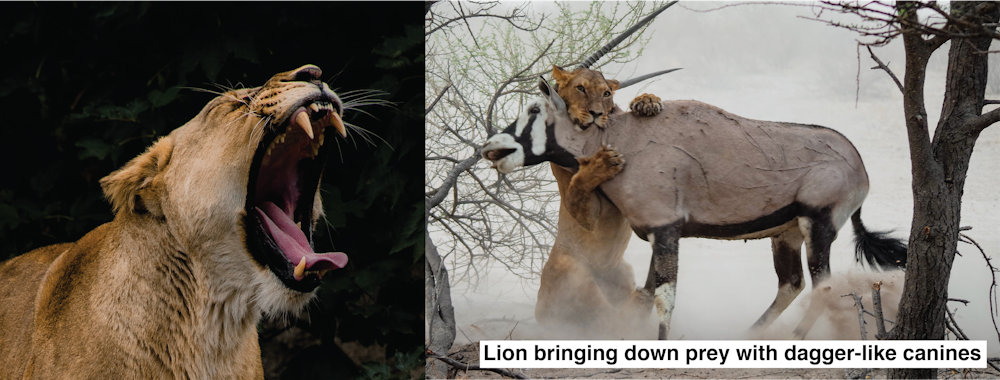 Lion using its long sharp dagger-like canines to deliver a targeted neck bite and taking down an Oryx in the Kalahari Desert.
Lion canines Mike van den Bos and hunting Thomas Evans both via Unsplash
Lion using its long sharp dagger-like canines to deliver a targeted neck bite and taking down an Oryx in the Kalahari Desert.
Lion canines Mike van den Bos and hunting Thomas Evans both via Unsplash
A bite worse than its bark
We scanned and compared the canine teeth of more than 60 carnivores, including tigers, coyotes, polar bears, wolverines, raccoons and even quolls. We then looked at the association between canine shape and function.
We found tooth shape varies depending on the types of food a carnivore regularly bites into – just like we choose different kitchen knives depending on what we want to cut up.
Big cats such as lions, tigers and cheetahs have some of the sharpest canine teeth in the animal kingdom. These long, dagger-like weapons are used to stab – biting down deeply into the throats of prey to bring them down.
Take a 3D look at the canine teeth of a cheetah in the interactive below.
Other species, such as the coyote and red fox, have slender, curved canines. These teeth act as hooks to help hold small prey and prevent it slipping from the mouth when shaking.
Animals that eat a lot of “soft” prey, or those that deliver throat bites, often have sharp, slender canines. The sharp tips make a crack in the prey and as the animal bites down, the long, sharp edges of the tooth help penetrate deeply into the catch.
Species with a tougher or more varied diet have stout, robust teeth that don’t break when crunching bone or other hard foods. These species include scavengers such as the Tasmanian devil, and generalists such as the honey badger.
The bluntest upper canine tips we examined belong to the crab-eating mongoose. As the name suggests, the species feeds on crabs and other hard prey such as reptiles, snails and insects.
We also found canine teeth with blunt tips and edges were found in animals that kill prey with crushing bites to the skull, such as the American martin or wolverine. Blunt tips are better able than sharp tips to withstand the stresses produced by such heavy force.
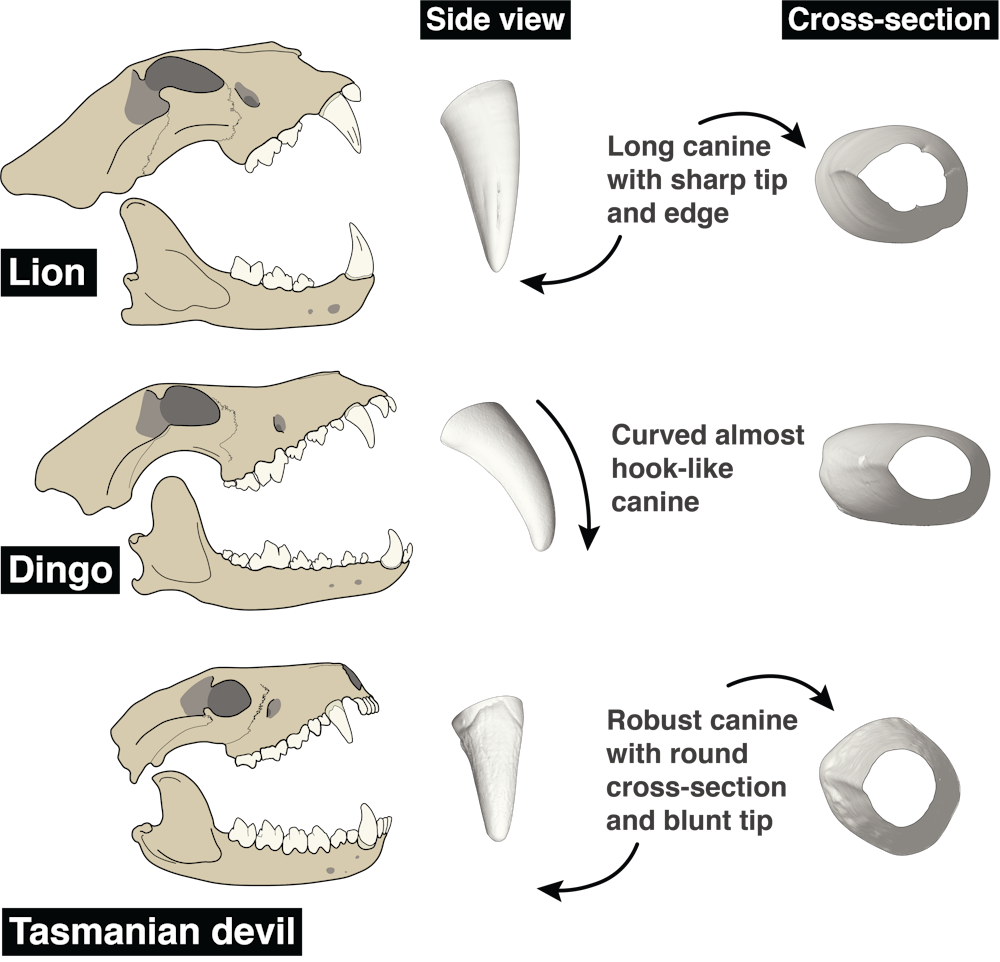 Canine teeth can be long and sharp, slender and curved, or blunt and robust. These differences relate to how these teeth are used during hunting and feeding.
Image by Tahlia Pollock
Canine teeth can be long and sharp, slender and curved, or blunt and robust. These differences relate to how these teeth are used during hunting and feeding.
Image by Tahlia Pollock
Something to chew on
The research helps establish new links between tooth shape and ecology that may shed light on the diet and behaviour of extinct species.
For example, the thylacine (or Tasmanian tiger) had curved canines, which suggests it may have snapped up and shaken smaller prey. This supports recent research on thylacine skull shape which found that, contrary to previous theories, the thylacine likely hunted small rather than large prey.
By studying canine teeth up close, we’ve discovered just how well evolution shaped even the smallest animal features to suit the niches they fill in nature.
Authors: Tahlia Pollock, PhD candidate, Monash University


 Daily Bulletin


