

Why nuclear submarines are a smart military move for Australia — and could deter China further
- Written by: John Blaxland, Professor, Strategic and Defence Studies Centre, Australian National University
The Morrison government has decided it’s best for Australia to accelerate the production of a more capable, integrated, nuclear-powered submarine platform with the US and the UK.
This will more tightly enmesh Australia into the US orbit. Technologically and militarily, it means if the US goes into a conflict in the Indo-Pacific region, it would be much more difficult for Australia not to be directly and almost automatically involved.
The other side of argument is this is a good thing because it will at least incrementally add to the deterrence against China.
Chinese strategists and leaders will have to weigh up the risk and presumably be less likely to decide that crossing the threshold of war is something they are prepared to do. The hope is that added deterrence will make the stakes higher for the Chinese and the prospects of success lower.
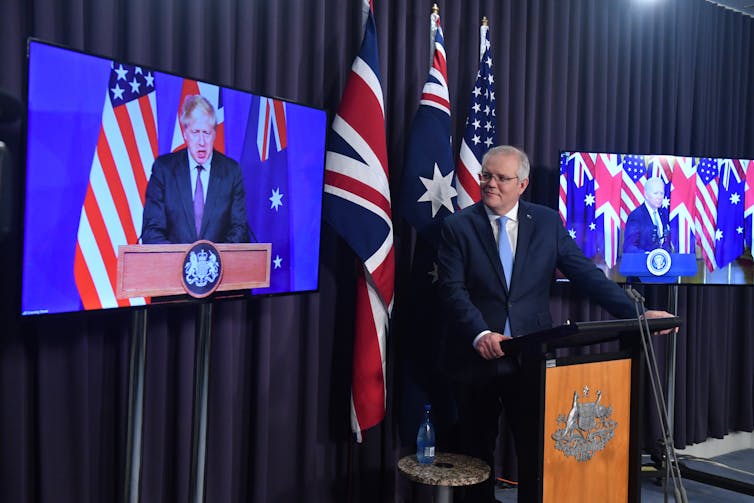 Scott Morrison (centre) announcing the new trilateral security partnership, AUKUS, with his counterparts in the US and UK.
Mick Tsikas/AAP
Scott Morrison (centre) announcing the new trilateral security partnership, AUKUS, with his counterparts in the US and UK.
Mick Tsikas/AAP
How do nuclear submarines differ from conventional ones?
In recent years, the Australian government and Department of Defence have been placing greater emphasis on longer-range military capabilities, particularly with the Defence Strategic Update in 2020.
This includes the acquisition of missiles, as well as space and cyber capabilities. Nuclear-powered submarines now leapfrog our existing naval capabilities.
The benefit of nuclear submarines is you don’t have to snorkel: they allow you to stay submerged and be stealthier for longer. The conventionally powered (diesel/electric) submarine does not have the same range without exposing itself to detection by surfacing.
This potentially will transform the ability of the Australian Defence Force to operate at range around Australia and beyond, and operate more closely in an integrated way with the US and UK.
Our previous A$90 billion deal with the French company DCNS to build up to 12 submarines was always less connected with the US and UK.
The French ironically had nuclear propulsion in their Barracuda submarine, and had we gone with that option when we signed the deal in 2016, they could have said, “OK, let’s replicate what we do and give that to you”. Had we done that, we would be well on the way to our first one.
But we said we wanted the propulsion to be conventional. That delayed the French program, so they now have cause to be irritated over this new deal.
The question is how quickly these new submarines will become available, because the French-designed ones were decades away from being operational.
This new deal potentially would see Australia able to lease British and/or American submarines on an interim basis to develop Australian expertise with nuclear propulsion, or at least operate with them and have Australian crew on board to learn the ropes.
But we do not have the capability in Australia at the moment to operate and maintain nuclear submarines. There’s a whole infrastructure that’s missing.
This means we either have to spend an enormous amount of money to develop it, or subcontract it to the UK or US, which makes us beholden to them and subject to their domestic, political dynamics.
Where did things go wrong?
We’ve fumbled the ball in our handling of our future submarine capability over the last decade and a half. We should have made a decision on a new submarine design a long time ago — one that was feasible — and locked it in.
We bypassed a couple of other options, including an upgrade of our current Collins-class submarine — a newer, snazzier, more capable version of what we already know.
Instead, we went for a radical new design that even the French had never built before. Anything with cutting-edge technology is going to incur delays and cost overruns. And that’s exactly what we faced.
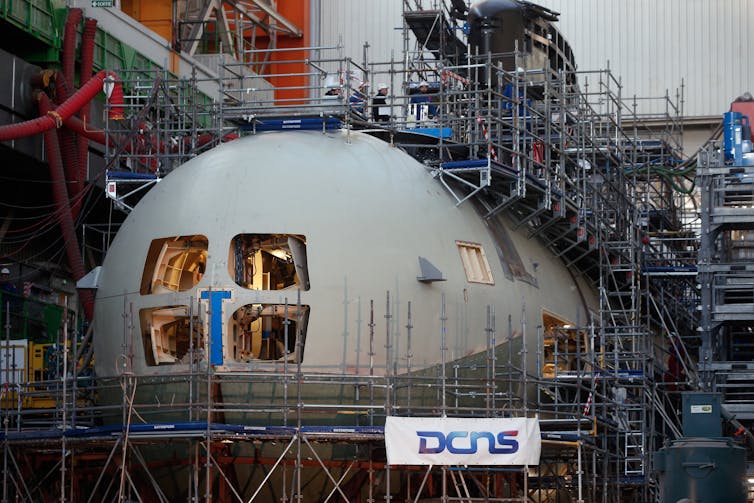 A Barracuda submarine under construction in France. DCNS, a French company, had been chosen to design 12 diesel-electric, Shortfin Barracuda submarines for Australia in 2016.
Thibault Camus/AP
A Barracuda submarine under construction in France. DCNS, a French company, had been chosen to design 12 diesel-electric, Shortfin Barracuda submarines for Australia in 2016.
Thibault Camus/AP
In the meantime, the clouds have gotten darker in our region and the need to acquire new, capable submarines has become all the more pressing and important.
The combination of those factors has driven a hard-nosed re-evaluation of our previous half-baked decisions on our future submarine requirements.
Interestingly, in defence industry circles there is emerging a strong sense of approval that Australia is now going with a known quantity — a reliable, technological platform that is more integrated with the US and hopefully can become operational much sooner.
How will this build up Australia’s defence industry?
The details remain sketchy but it appears the initial plan will be to subcontract the development of the submarines to the US or UK.
But if Australia is to be self-reliant, which I believe the government recognises the need for, then much of this technology will have to be transferred to Australia — at least to allow for maintenance.
No doubt, aspects of the fit-out are not directly linked to insider knowledge on nuclear propulsion secrets, so there will be a considerable portion of the work that could be done in Australia. But that will incur delays and additional costs.
Australia’s circumstances are more turbulent and the prospect of the American alliance coming to the rescue is more precarious than ever. The irony is that to be more self-reliant, there’s a need to double down on US technology and US capabilities. They are the world leaders and they have the industrial capacity to quickly provide the technology.
One of the things Defence Minister Peter Dutton went to Washington to do was to persuade the US to share technology. This AUKUS arrangement talks about developing a technology industrial basis and supply lines — this means the US and UK are appear prepared to invest in Australia’s ability to sustain it.
Read more: China does not want war, at least not yet. It's playing the long game
How will China likely react?
That’s the million dollar question: does this make us safer? There’s no question we will get strong and sharp-edged criticism from Beijing, where the Chinese government will see it in conspiratorial terms.
But Chinese rhetoric doesn’t need be taken at face value. This is largely for domestic purposes and about influencing and shaping opinion in a way that’s consistent with China’s perceived interests.
In the past few years, China has become more assertive in its rhetoric, matching its military buildup, which most security pundits now say is about seeking to intimidate potential adversaries so they’ll just back down.
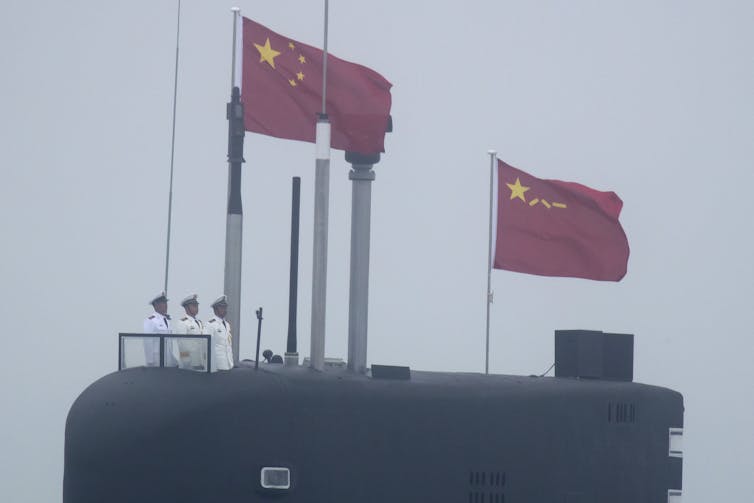 One of China’s new nuclear-powered submarines, the Long March 10.
Mark Schiefelbein/AP
One of China’s new nuclear-powered submarines, the Long March 10.
Mark Schiefelbein/AP
So, does a more capable AUKUS coalition, with Australia in the middle, deter or aggravate China?
It’s fair to say there is growing consensus we need to do more to deter Chinese actions in the region. Deterrence requires credible capabilities. This new alliance is consistent with that line of reasoning.
We have put our eggs in the US security basket for the past 70 years — and this new coalition puts more eggs in that basket. The hope is collaborating with the UK and US will improve our ability to defend ourselves. But submarines are only really useful if you find yourself contemplating having to use them.
Short of such circumstances, some deft diplomacy and regional engagement is key. Australia’s Foreign Policy White Paper of 2017 spoke of investing in regional security ties. For this policy change to enhance security, it needs to be coupled with much greater efforts aimed at bolstering security and stability alongside our neighbours in Southeast Asia and the Pacific.
Authors: John Blaxland, Professor, Strategic and Defence Studies Centre, Australian National University


 Daily Bulletin


