

How Cuban medical training has helped Pacific nations face the pandemic challenge
- Written by: Sharon McLennan, Senior Lecturer in Development Studies, Massey University
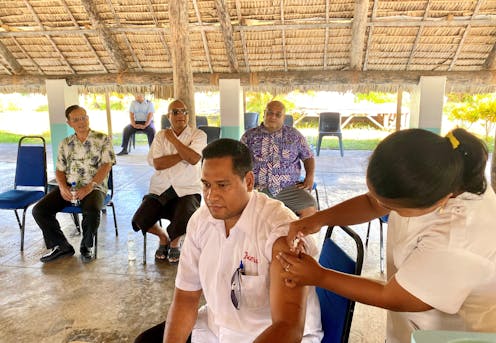
With the COVID-19 pandemic stretching health systems worldwide, Pacific countries have capitalised on their relative isolation to avoid the worst. Border closures and other measures have slowed and stopped the spread of the virus to the point some nations have recorded no cases at all.
Even where the virus has not spread, however, establishing screening, quarantine and mass vaccination programmes has stretched already limited health systems. Where community transmission has occurred, as in Fiji and Papua New Guinea, it has severely tested national health systems.
The good news is that these small nations have been more resilient than they might otherwise have been due to a dramatic increase in the number of doctors employed in the Pacific in the past decade.
In some countries this has seen a doubling or more of doctor numbers. For example, from 2012 to 2019, the number of doctors in Kiribati increased from 18 to 51. Remarkable increases have also been recorded in the Solomon Islands (79 to 170), Tonga (44 to 80), Vanuatu (27 to 67) and Tuvalu (7 to 27).
Where these doctors come from may surprise you. Most are new graduates of the Latin American School of Medicine (ELAM) in Cuba. Over the past decade, more than 250 Pacific students have travelled to Cuba, learned Spanish, and completed six years of medical training on full scholarships from the Cuban government.
Solidarity and compassion
Cuba has a long history of international medical cooperation and Cuban doctors have served in over 150 countries. In the Pacific, approximately 50 Cuban doctors have served in Nauru, Kiribati and Vanuatu since 2006.
But Cuba has also recognised that having foreign doctors staff health systems indefinitely is unsustainable, and that “the ideal provider is a well trained, homegrown health professional”.
The purpose of ELAM is therefore to train students from lower income and medically under-resourced communities who will go on to serve their countries. Training doctors is an act of solidarity and compassion built on Cuba’s commitment to health as a human right.
Read more: Pacific nations grapple with COVID's terrible toll and the desperate need for vaccines
While the programme began long before the COVID-19 pandemic, its impact on health system resilience and crisis response has been crucial. Without skilled professionals as a first line of defence, there can be no effective health security or pandemic response.
Cuban medicine and medical training also emphasises prevention, public health and community care. It’s a model designed for low-resource environments, well matched to the needs of the Pacific. As one Cuban-trained graduate in Tuvalu said:
Cuban-trained doctors have a sense for preventive medicine […] I think our best contribution in the health services would be to apply what we learned in Cuba and to adapt it to our health system in Tuvalu.
As a result of this pandemic our resources have become even more limited than before. So, prevention and good health promotion would be the main goals to achieve to limit the use of already scarce resources.
Problems persist
At the same time, the return of these graduates and their integration into local practice hasn’t always been smooth. Their initial integration has been threatened by a lack of places in medical internship programmes in the region. These had to be rapidly created or upscaled in the Solomon Islands, Vanuatu and Kiribati.
While they demonstrated good basic medical knowledge and strong foundations in preventative health, many Cuban graduates did poorly on their entry exams for internship training.
In particular, they struggled with basic procedures and also with medical English, having studied in Spanish.
Read more: Cuban compassion: Training doctors for a Pacific island nation running out of time
Partly, though, problems have been the result of differences between Cuban and Pacific health systems and needs. Many diseases prevalent in the Pacific have been eradicated in Cuba, which also has a much higher doctor to population ratio and therefore more defined professional roles within the health sector. As a medical trainer noted:
The Cuban-trained interns said that in Cuba you would never take your own blood samples […] You wouldn’t interpret the X-rays. You’d have lots of other people to do that for you. So they’d never learn any of those skills. But they were keen to. They were so keen to learn.
Sustaining front line workers
Bridging courses and successful intern training have addressed these differences. Concerns have eased as graduates have moved into jobs, with some also undertaking post-graduate training in Fiji, New Zealand and elsewhere.
Cuba’s direct Pacific contribution has slowed due to the pandemic and changes in regional governments, with only one Cuban doctor still in the region (in Kiribati).
Read more: By sending doctors to Italy, Cuba continues its long campaign of medical diplomacy
But a virtual meeting last year between Cuban experts and representatives from seven Pacific countries did address regional responses to the pandemic. Cuba has also offered post-pandemic support to Nauru and Palau, and remains open to cooperation with other Pacific countries.
It’s safe to say, however, that many Pacific nations have been able to respond well to the challenges of COVID-19 because of Cuba’s past assistance. In particular, the strong sense of service, community and solidarity built into Cuban medical training has sustained and motivated Pacific health workers on the front lines.
Thanks to Dr Helen Leslie and Assoc. Prof Robert Huish for their advice and support early in this research, and to Cristine Werle for her master’s thesis work in Kiribati.
Authors: Sharon McLennan, Senior Lecturer in Development Studies, Massey University


 Daily Bulletin


