

On the eve of an AFLM grand final like no other, can the shadow of the pandemic make us strive for something better?
- Written by: Matthew Klugman, Research Fellow, Institute for Health & Sport, member of the Community, Identity and Displacement Research Network, and Co-convenor of the Olympic Research Network, Victoria University
On the last Saturday of September every year many of the inhabitants of Melbourne, and indeed of the whole of Australia and even in foreign lands, are stricken with a strange infirmity.
So wrote the Australian historian Manning Clark in 1981. He was speaking of the Grand Final of the Victorian Football League (men’s) competition. Of the way around 100,000 people would journey to a place
mistakenly known as the Melbourne Cricket Ground [MCG]. There for two and a half hours they lose the appearance of human beings and become like beasts of the field. They growl, they roar, they bellow, they yell and they howl.
Forty years later, the grand final of the (now) Australian Football League Men’s competition (AFLM) continues to provoke fervent anticipation in the millions who hold a passionate interest in the sport.
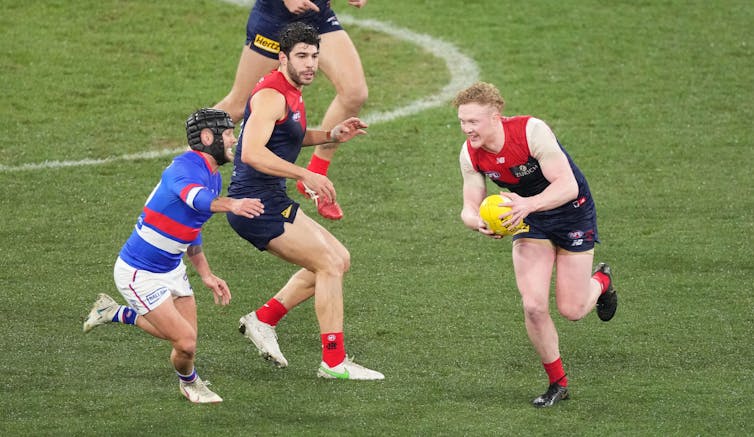
Once again, it is being held on the last Saturday of September. Once again “a strange infirmity” grips supporters of the two teams left to battle for the premiership - the Melbourne Demons and the Western Bulldogs. If Melbourne wins, some of their barrackers will inevitably note that they can now die happy - which testifies to the absurdly profound meaning the game still holds for many.
Yet for the second year running, the location of the AFLM Grand Final will not be in Melbourne at the cricket ground that remains a spiritual home of footy.
Part of the grief over the displacement of the AFLM Grand Final from the MCG is that COVID has made it impossible for so many lifelong barrackers of the Demons and Dogs to cheer, bellow, and roar from the stands as the game unfolds amid a babel of sound. However another part seems to be the dismay over the loss of what was once “normal”.
But should we be craving a return to normality, or striving for something better?
Football and place
Place is central to the stories that AFL tells. It is the only major spectator sport to be so intertwined with the emergence - and growth - of a city. The game was first codified in 1859 at a time when Melbourne was in its early years as a rapidly developing city fuelled by Victoria’s gold rush. The riches of gold lead to bountiful parks and gardens where football could be played.
The activism of Melbourne’s Stonemasons in 1856 - and the ensuing eight-hour work day - meant that many men, and soon women, had the leisure time to watch games of football.
The game quickly became not only popular, but a site of communal passion. It was supposed to produce good, strong white men. Yet by the 1880s, Melbourne was already more famous for its raucous, seemingly mad football spectators, or “barrackers” as they became known. In 1890 “JEB” wrote in a suburban Melbourne newspaper:
For an Englishman to visit Australia, and go home without having seen an Australian football match, with its attendant multitude of ardent barrackers, would be as unintelligible as for a Colonial to see London and omit the tower […]
For what an experience it is to be at one of the big matches! What a babel of sound! What a magnificent uproar! What a glorious cloud-shattering eruption of profanity!
By 1900, Melbourne was already home to two major men’s Australian Rules football competitions: The Victorian Football League and the Victorian Football Association. The expectation was that everyone who lived in the city barracked for a team.
Migrants like the novelist Peter Temple quickly realised that “footy talk” was the city’s “lingua franca – it transcended class, transcended gender, you could talk about football to anyone”. By 1967 some Melbourne residents so abhorred the incessant “footy talk” that a rival Anti-Football League was created.
However, place in Australia is complex, layered, and inescapably leads back to questions of sovereignty and justice. Melbourne was built on a place called Naarm that has never been ceded by its original inhabitants. The form of football that grew with the city has been shaped by acts of invasion, migration, and the displacement, survival, and resistance of First Nations Peoples.
Tom Wills, one of the four white men who wrote the first laws of Australian Rules football, spent much of his childhood among the Djab-wurrung people in the western districts of Victoria, speaking their language and playing their games. How much Wills was influenced by one of these games - the football game of Marn Grook - is a contentious question. While some have dismissed any possible links, they rely on sources drawn solely from the archive that reflect an exclusively colonial memory.
It is a colonial past that history is able to reconstruct, a past that says little or nothing about Indigenous experience or Indigenous remembrance of that same past carried into the present from the other side of the colonial frontier.
Wills has been a celebrated figure in the folklore of Australian Rules football. He is memorialised in a statue outside the MCG. This past week, the football world has been rocked by the revelation of an account detailing Wills’ involvement in the horrific reprisals that followed the killing of his father and other pastoralists in Queensland in 1861 (which itself was a response to the murder of Gayiri men by a neighbour of Wills).
Yet even before this news, it was known Wills supported the massacres of Gayiri and other First Nations Peoples. Indeed Wills asked his cousin and co-author of the first laws of Australian Rules - H.C.A. Harrison - to send “good resolute men that will shoot every black they see.”
Wills was made an inaugural member of the Australian Football Hall of Fame in 1996. The brilliant Yorta Yorta player, administrator and activist (amongst many other things), Sir Doug Nicholls, is still yet to be inducted into that Hall of Fame, despite having an AFLM round named after him. There is a statue of Sir Doug (and Lady Gladys Nicholls) outside the Victorian Parliament, but none outside the MCG or other football grounds.
Read more: The land we play on: equality doesn’t mean justice
Those attending this Saturday’s AFLM Grand Final, however, will walk past a statue of St Kilda legend Nicky Winmar. When the statue was announced, many people in the football world argued it should be in Melbourne, where in 1993 Winmar responded to racial abuse from opposing fans and players by raising his jumper, pointing to his skin and stating over and over that he was “Black and proud”.
But Winmar is a Noongar man, and he wanted the statue commemorating his call for justice to be on Noongar land.
And then came COVID …
If anything, the pandemic has intensified Australia’s fascination with the football game that was first known as Melbourne Rules. Like the Olympics, it has provided a spar of meaning, joy, angst, relief, and at least momentary escape. The game has provided great comfort in a time of communal distress.
But the non-COVID happenings of the past football year - the continued racial abuse of Eddie Betts, the systemic racism found at Collingwood in its treatment of Héritier Lumumba, Taylor Walker’s racist vilification of Robbie Young, and the retirement of AFLW players because they are not being paid a living wage by Australia’s richest sporting body - reveals the need for the AFL to grapple more critically with its colonial past and present.
Reflecting more deeply on the game’s relationship to land and justice would be a good place to start.
Authors: Matthew Klugman, Research Fellow, Institute for Health & Sport, member of the Community, Identity and Displacement Research Network, and Co-convenor of the Olympic Research Network, Victoria University


 Daily Bulletin


