

How do police forensic scientists investigate a case? A clandestine gravesite recovery expert explains
- Written by: Brendan Chapman, Senior Lecturer in Forensic Science, Murdoch University
Recent high-profile missing persons cases, including that of William Tyrrell – who went missing in Kendall, New South Wales, at the age of three in 2014 – have focused public attention on the forensic practices involved in crime scene investigations.
As a forensic scientist who has worked at thousands of homicide, sexual assault and serious crime scenes, I can tell you this process is not as straightforward as depicted on popular true crime shows.
I research and teach forensic science at Murdoch University and specialise in cold-case techniques and clandestine gravesite recovery. Here’s what typically happens behind the lines of police tape when forensic teams are at work.
The crucial first moments
In the first moments after a major crime, what has happened is often a mystery.
Like a scene from a painting, it’s as if time stood still; many regular household items sit as they did before the violent event took place. Investigators take great care not to disturb the initial scene, lest valuable evidence be lost.
The first task is to record everything as it appears in incredible detail – by video, photo and in written notes. Even items that may first appear innocuous can later take on new significance.
This stage is vital; years later, this may be the only way cold-case teams can virtually revisit the scene to identify new clues.
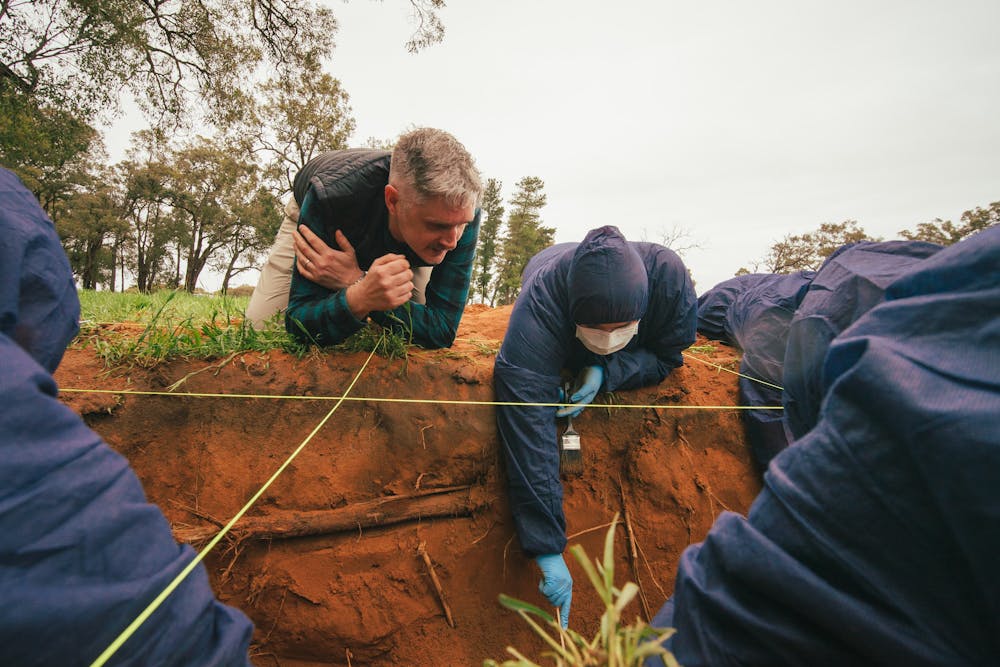
 The first task, before anything in the scene is disturbed, is to record everything as it appears.
Brendan Chapman, Author provided
The first task, before anything in the scene is disturbed, is to record everything as it appears.
Brendan Chapman, Author provided
Evidence testing and collection
As the forensic investigation unfolds, information and evidence are gathered and given to investigators at the crime scene. This helps provide context to guide the search for evidence.
The crime scene team works meticulously to identify and “field-test” items (meaning tests are done in situ) before securing them in bags.
In some cases, that’s by using chemicals and testing kits to identify body fluids or other traces associated with the crime.
We also use some very high-tech torches that can emit a specific type to light to help us see otherwise invisible clues. This works a bit like the lighting in nightclubs that might expose lint on your black outfit.
At this stage, the best crime scene examiners invoke the scientific method, proposing hypotheses as to what has happened, and then searching for evidence that may refute their suggestion.
Theories are presented and then ruled out in place of new theories as new evidence emerges.
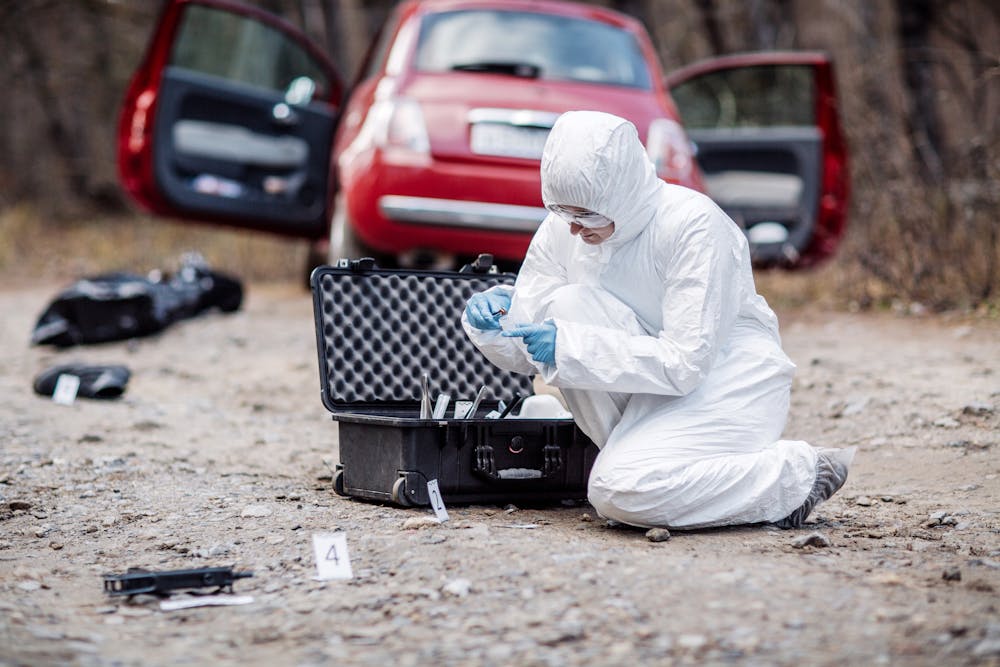 The crime scene team works meticulously to identify and field test items of evidence before securing them in bags.
Shutterstock
The crime scene team works meticulously to identify and field test items of evidence before securing them in bags.
Shutterstock
Testing for traces of blood, semen and other body fluids
On the scene, forensic investigators have a suite of tools to help identify body fluids such as semen and blood.
The Kastle–Meyer test, deployed to test for the possible presence of blood, has been used since the early 20th century.
A chemical called phenolophthalin is dropped onto the suspected sample, followed quickly by a drop of hydrogen peroxide. These chemicals can detect the blood ingredient haemoglobin. If it rapidly turns pink, there’s a good chance there’s blood in the sample.
A different method called the acid phosphatase test, which can detect an enzyme secreted from the prostate gland, is used to identify the presence of semen. A prepared chemical is dropped onto a sample of the suspected stain; a colour change from clear to dark purple suggests the likely presence of semen.
You may also have heard of investigators using luminol, which can detect old blood stains or traces a person has tried to scrub away. The investigator sprays luminol and other chemicals on a darkened area; a blue glow suggests traces of blood may be present.
For all these tests, and everything we do as forensic investigators, meticulous records are kept about both observations and ideas. These notes will eventually become part of the huge case file that goes to court.
Different types of forensic experts work together
There are many different types of specialist crime scene investigators, such as:
fingerprint specialists, who use chemicals and powders to visualise fingerprints invisible to the naked eye and determine if they’re good enough to compare with prints on a database
bloodstain pattern analysis experts who, like Dexter from the eponymous crime show, observe the shape of blood droplets or marks in an effort to reconstruct a bloodshed scenario
physical evidence comparison experts, who record evidence such as shoe impressions or tool marks to compare with objects at the scene (for example, was this screwdriver used to create that mark on a window frame?)
ballistics and firearms experts, who identify and analyse evidence such as gunshot residues and fired bullets. They can also reconstruct shooting events to determine trajectories and distances
clandestine grave recovery experts (like me!), whose knowledge of the natural processes after death can help locate and exhume grave sites using painstakingly careful archaeological approaches.
Other specialised forensic practitioners include pathologists, insect experts, anthropologists, biologists and chemists.
Forensic investigations are most successful with a multidisciplinary team, which allows for many different opinions and ideas.
Specialists must work together to ensure one person’s evidence-collection method doesn’t ruin another specialist’s chance to use their own techniques.
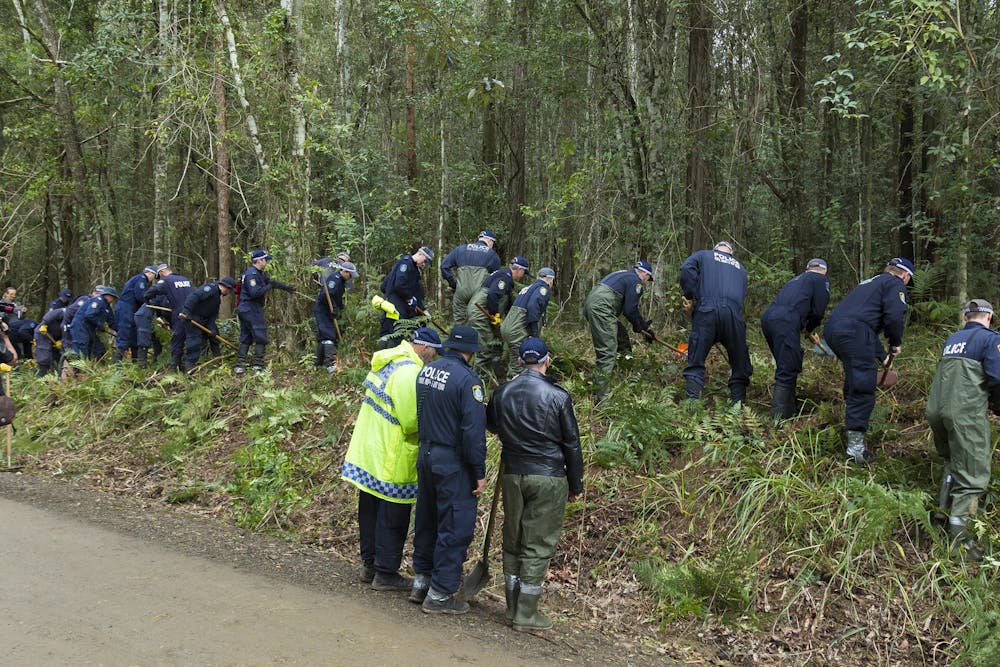 NSW police search bushland at Batar Creek in 2018. Outdoor scenes present extra challenges.
SHANE CHALKER/AAP
NSW police search bushland at Batar Creek in 2018. Outdoor scenes present extra challenges.
SHANE CHALKER/AAP
Read more: Trust Me, I'm An Expert: forensic entomology, or what bugs can tell police about when someone died
Clandestine gravesites
Outdoor scenes present extra challenges, as evidence can be damaged or destroyed by weather, wildlife and the landscape itself. Clandestine gravesites, however, can help preserve clues underground.
It’s not easy to find a hidden burial site; even a freshly dug gravesite, if done well, can be difficult to identify in an expansive bush scene.
Investigators will be looking for areas where the ground looks disturbed or spots where vegetation has grown unusually lushly (caused by the decomposition of a body underneath).
Investigators may also deploy cadaver dogs to search for human remains, or ground-penetrating radar, which uses radio waves to identify changes in the soil underground.
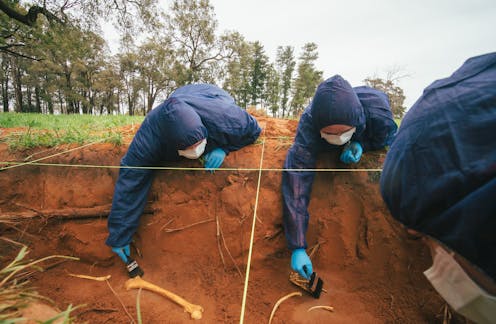
Once a grave is identified, you can’t just roughly dig it up; the grave fill must be gradually removed using small brushes and shovels, like those used on archaeological dig sites.
All removed soil is sifted and searched for tiny pieces of evidence; even a tiny fibre or hair could connect the grave to a suspect.
Even the sidewalls of the grave can offer clues about the type or shape of the shovel used to dig it.
Layer by layer, we work down until we reveal the deceased person at the bottom of the grave. Utmost care is taken here, as repatriation of the remains to loved ones is a pivotal part of the process of gaining closure.
 It’s not easy to find a hidden burial site; even a freshly dug gravesite, if done well, can be very difficult to identify in an expansive bush scene.
Brendan Chapman, Author provided
It’s not easy to find a hidden burial site; even a freshly dug gravesite, if done well, can be very difficult to identify in an expansive bush scene.
Brendan Chapman, Author provided
Time is of the essence
All evidence has a life span. The sooner forensic scientists can identify and analyse a piece of evidence, the better the chances are of it producing a result.
This can be one of the greatest challenges in a cold case, where a crime scene has been changed by the elements over many years.
Authors: Brendan Chapman, Senior Lecturer in Forensic Science, Murdoch University


 Daily Bulletin


