

Low bar for 'genuine consultation' set by UWA case feeds into crisis of legitimacy for Australian institutions
- Written by: Tauel Harper, Senior Lecturer, Media and Communication, UWA, The University of Western Australia
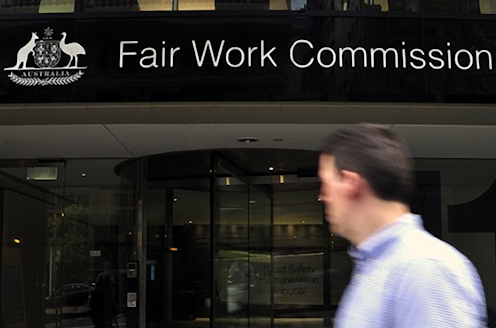
When Martin Forsey was presented with a proposal for change at his workplace that lacked a logical argument and used flawed data, he brought a case to the Fair Work Commission. The associate professor at the University of Western Australia argued that such a flawed proposal could not be used as the basis of “genuine consultation” about structural reform, as required under his enterprise agreement.
However, the commission has ruled the university was under no obligation to provide data, let alone accurate data, to justify its proposal. Staff had been given the opportunity to respond to the proposal, the commission said in its judgment. This meant UWA had clearly fulfilled its remit to provide “genuine consultation”, despite having created a proposal using incorrect enrolment data and then ignoring the vast majority of responses.
The term “genuine consultation” was included in the enterprise agreement. Presumably, this was done to imply that consultation will not be based on a cursory or misleading representation of the justification for change. However, while the commission assumed the university had included data that was “proven to be incorrect” because “it believed this data was persuasive”, it did not see this as an indication that the consultation could not be genuine.
The problem with this ruling does not sit necessarily in its adherence to the Fair Work Act. The problem is it simply doesn’t pass the pub test of common sense. In spelling out its finding, the commission outlined the dictionary definition of data “figures, statistics, etc”, but overlooked the dictionary definition of “genuine”:
truly what something is said to be, authentic; sincere.
In the real world, if your manager produced false data to justify the end of your career and called that “consultation”, would you understand that consultation to be authentic or sincere?
No, the manager wants you out, and out you’ll go – regardless of the consultation. That surely means the consultation can’t be authentic or sincere – or genuine. At least as far as the common person would understand it.
Why does being genuine and authentic matter?
In his vast body of work on communicative ethics, democracy and law, philosopher Jurgen Habermas repeatedly states that real authenticity has its own, inherent power. If something is correct, genuine or true, it can analysed almost endlessly because that truth is inherent and can easily be explained. As Habermas writes:
“The democratic procedure is institutionalised in discourses and bargaining processes by employing forms of communication that promise that all outcomes reached in conformity with the procedure are reasonable.”
The process of questioning as a way of finding truth is how democratic systems ensure their legitimacy. According to Habermas, in a legitimate system all claims should withstand scrutiny and interrogation – because they are true!
Our reality is defined by what we can all agree upon by “redeeming claims to truth”, as Habermas put it. So we have courts of law organised around the principle that people will be questioned and questioned again until the truth comes out. Our government is organised around the principle that if enough people can present their arguments, with enough scrutiny of those arguments, then the outcome of those debates should be legitimate.
Only by opening decisions up to cross-examination is it possible to present an outcome that stands up to public scrutiny.
The concern for our society is that Habermas always understood that these mechanisms of democratic legitimacy were embedded in a broader democratic public that would oppose illegitimacy and understand and act upon the inherent value of broad social truths. If this weren’t the case, he states in Between Facts and Norms, “then the experts’ perception of problems will prevail at the citizens’ expense”.
Habermas was an optimist in this respect. He believed democratic opinion and will formation were in some sense guaranteed in liberal democracy. Free speech, a free press and adversarial political parties should ensure some accountability in public statements.

‘Post-truth’ world challenges that optimism
To be accountable is to have to answer for one’s action and be responsible for the consequences. But as people with intimate experience of Australia’s federal politics and employment law are often finding out, this belief in a general demand for accountability seems mislaid.
Instead, politicians and employers bank on the notion that they won’t be asked to redeem their claims to truth and will not be held accountable if they lie or fail to deliver what they promised. This is what it means to be in a “post-truth” world.
The problem then is that people lose faith in democratic institutions that ought to be able to “redeem their claims to truth” but are not able to do so. In this way, our “democratic institutions” too often betray the trust citizens place in them. If enough citizens give up on believing in the legitimacy of our political and legal institutions, we end up in a vicious cycle of spin, deceit and manufactured ignorance.
Following this Fair Work Commission ruling on Forsey’s case, UWA has put sweeping changes in place. These changes have decimated UWA’s critical and social research capacity and ended the careers of many academics who would have legitimately criticised such decisions and their implications. A team of people who have made their careers out of questioning faulty logic have essentially had their life-long contribution to public knowledge curtailed by faulty logic. As a result, more faulty logic will go unquestioned.
At a time when Prime Minister Scott Morrison has called on universities to focus more on priorities such as the defence industry and less on critical research, Australians should not take our democracy for granted.
Authors: Tauel Harper, Senior Lecturer, Media and Communication, UWA, The University of Western Australia


 Daily Bulletin


